Feb 22 2009
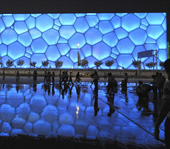
BASF’s specialty foam Basotect® is being used in the Beijing swimming stadium in order to clad the interior of the building with flame-retardant and environmentally friendly acoustic insulation. The National Aquatics Center has been fitted with a specially developed ceiling structure made of large Basotect panels that not only provide sound protection but fulfill additional prerequisites: The lightweight panels blend in with the architectural design and meet the environmental requirements. They are load-bearing, flame-retardant and able to withstand high levels of humidity.
Novel and invisible cladding construction
The BASF melamine resin foam stands out for its extraordinary acoustic properties. Thanks to its open-cell and fine foam structure, the sound-absorption values in the medium and high frequency ranges are particularly good. Moreover, the lightweight material is easy to process. For instance, the ventilation conduits under the ceiling were wrapped in such a way that the suspension structure for the cladding is not visible.
The installation is made of Basotect panels of different sizes, some of which span more than two meters. Securing these panels over such a distance called for their reinforcement with tubes. This resulted in a novel construction that is sufficiently stiff and can expand in response to temperature fluctuations. The entire installation was tested for its load-bearing capacity, sound protection and fire safety in a series of examinations. The company Entech, Shanghai has processed the Basotect panels for this purpose.
The National Aquatics Center, which has been dubbed the "Water Cube" because of its shape, can seat 17,000 spectators. The first competitions to take place in the stadium were the swimming competitions of the Olympic Games in 2008.
Basotect, the jack-of-all-trades
Thanks to its favorable properties – Basotect is temperature-resistant, flame-retardant, extraordinarily lightweight, flexible, sound-absorbing and thermally insulating – the foam has long been used to acoustically insulate buildings and vehicles. It is now available in several grades for various applications. For example, it protects the sensitive satellites that the Ariane 5 launcher delivers into space. Since 2004, the versatile foam has been employed in fireproof airplane seats and will soon be used as cabin insulation in the new Dreamliner 787 by the American aircraft manufacturer Boeing.