May 18 2009
Empa and the Paul Scherrer Institute (PSI) have, together with Bucher Schoerling, Proton Motor, BRUSA Elektronik AG und Messer Schweiz, developed a hydrogen powered municipal street cleaning vehicle which was presented to the public on Thursday 14th May 2009 in Basel. The vehicle is named the "Bucher CityCat H2" and is the first municipal utility vehicle in the world powered by fuel cell technology. For the next 18 months it will be tested in everyday usage.
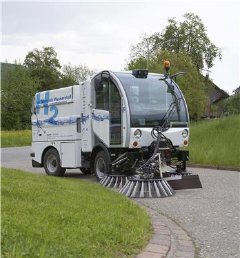 Empa and the Paul Scherrer Institute (PSI) have, in cooperation with industrial partners, developed a hydrogen powered municipal street cleaning vehicle
Fuel cells are considered to be clean energy sources well-suited for our future mobility needs. They convert hydrogen directly into electrical current, which is then used to drive a vehicle's electric motor. The great advantage is that no pollutants are emitted in the vehicle's exhaust, just water vapor produced by the chemical reaction between hydrogen and oxygen in the fuel cell. When such vehicles are used in sensitive areas such as pedestrian precincts, railway station halls or even in enclosed structures such as exhibition halls, air pollution is reduced significantly compared to conventional vehicles, which are generally powered by diesel engines.
Project creates a window of opportunity for hydrogen technology
"Our aim is to take fuel cell technology from the laboratory onto the street", explains Project Leader Christian Bach, Head of Empa's Internal Combustion Engines Laboratory. In addition, the project scientists want to test the operational characteristics and ageing behavior of the new technology under typical, everyday conditions of use. But it doesn't stop there. Beyond these obvious aims, the project, called "hy.muve" ("hydrogen-driven municipal vehicle") also serves as a research platform for socio-economic studies in which questions regarding the acceptance of hydrogen technology, its market introduction and its cost effectiveness will be investigated.
Because of their low power operational cycles, municipal vehicles are particularly well-suited for these kinds of drives and can be used to good effect in areas where the refueling infrastructure is limited. "They therefore offer an important window of opportunity for introducing other hydrogen powered vehicles onto the market," according to Bach.
Significantly less pollution emitted
Computer simulations made at Empa show that the amount of energy consumed can be halved by using fuel cell drives instead of conventional diesel engines. This means that CO2 emissions can be reduced by some 40%, even when using conventional hydrogen production techniques based on natural gas. The project is financed by the ETH Domain's Competence Centre for Energy and Mobility (CCEM), the Swiss Federal Office for Energy (SFOE), the various project partners and pilot regions where the vehicle will be tested.