As global attention to energy efficiency and carbon reduction intensifies, condensing boilers have become the mainstream solution for heating due to their high efficiency, energy-saving, and environmental characteristics compared with traditional boilers.

Image Credit: Cubic Sensor and Instrument Co. Ltd
By recovering heat from flue gases, condensing boilers significantly improve thermal efficiency, meeting the demands of building energy conservation and environmental protection. However, achieving efficient, stable, and environmentally friendly operation requires precise control of the combustion process, and this is exactly where sensor technology could make a difference.
Reliable sensor technologies could enable real-time monitoring of gas composition, combustion status, and airflow parameters, thereby enabling intelligent combustion control and system optimization.
To improve control over the combustion process, Cubic, a leading manufacturer of gas sensors and gas analyzers, has drawn on its extensive experience in sensor technology R&D and strong in-house manufacturing capabilities to develop an intelligent combustion control system.
This system brings together sensors, key components, and supply chain integration into a cohesive, end-to-end solution. By closely integrating sensors with core boiler components such as heat exchangers and burners, Cubic enhances how these systems work together, helping deliver better overall performance and more efficient operation.
Cubic's intelligent combustion control system is specifically developed for condensing boilers, with intelligent gas sensors at its core. It enables real-time monitoring and dynamic adjustment of the combustion process, helping improve the energy efficiency, stability, and environmental adaptability of the whole system. The solution supports current and future market demands for higher efficiency, lower carbon emissions, and smarter operation.
Existing boilers usually use flame ion current to implement adaptive combustion control technology for condensing boilers, which has the disadvantage that the flame ion current is saturated under heavy load and cannot linearly control the combustion state.
Cubic combines flame ion detection technology, gas composition and calorific value detection technology, and ultrasonic air flow/gas flow meter to develop a maximum efficiency real-time tracking control algorithm that can be applied to condensing boilers under different thermal load operating conditions.
This solution addresses the limitations of existing adaptive combustion technologies. It can adapt to fluctuations in gas composition and calorific value, accurately control both air and gas flow, and adjust the air–fuel ratio in real time. By combining feedback from the gas flame ion concentration signal, the system can also determine whether the condensing boiler is operating at its optimal combustion efficiency.
From a technical perspective, Cubic’s intelligent combustion control system integrates a gas flow sensor, an air flow sensor, flame ion monitoring, and temperature feedback, working together with an MCU microprocessor to achieve closed-loop control of burner fan speed, gas valve opening, and the ignition curve.
The system can automatically identify and switch between different gas sources, including natural gas, liquefied gas, and hydrogen-blended gas, and dynamically optimize the air–gas supply ratio based on actual operating conditions. This helps ensure combustion remains efficient while maintaining low emissions.
With this capability, the system can increase overall thermal efficiency to as high as 108 % while also reducing NOx and CO emissions, enabling the boiler to meet European Class 6 emission standards.
Currently, Cubic’s intelligent combustion control system includes the C210, C220, C320, and C230 series, designed to meet the different needs of condensing boiler customers.
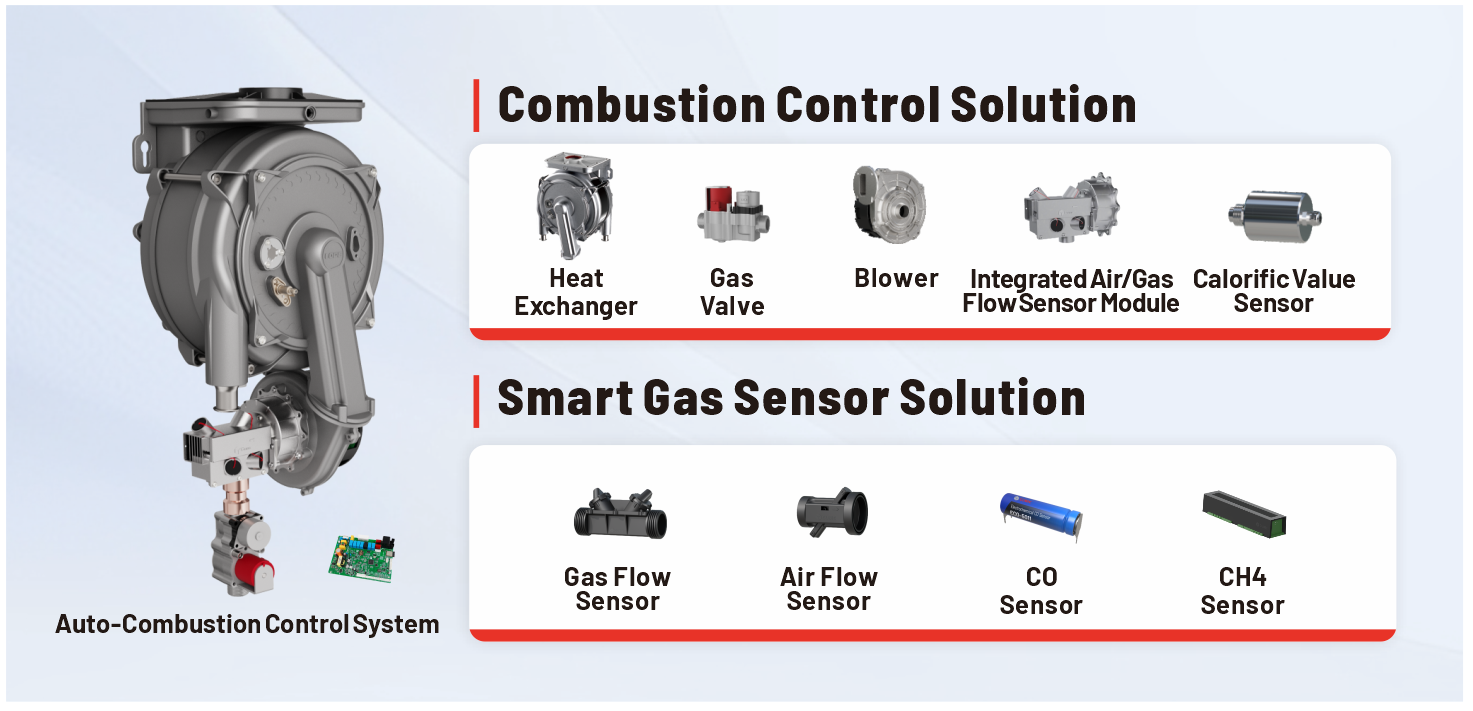
Image Credit: Cubic Sensor and Instrument Co. Ltd
The Cubic C210 Auto-combustion System integrates a condensing heat exchanger, gas proportion valve, blower, and intelligent controller to deliver stable operation and precise water temperature control (±1 °C). With thermal efficiency of up to 108 %, ultra-low NOx and CO emissions (<30 mg/kWh), and an 8:1 modulation ratio, the C210 supports energy savings and environmental compliance while maintaining smooth performance at low loads and ensuring long service life.
Building on the C210, the Cubic C220 Auto-combustion System introduces an integrated air and gas flow sensor module, enabling real-time monitoring and adaptive control of the air-fuel ratio during combustion.
The C220 significantly reduces fuel waste while enhancing performance stability. It achieves 108 % energy efficiency, a 9:1 modulation ratio. The C220 also features auto-adaptation to gas quality, pressure, flue configuration, and altitude – requiring no manual tuning – powered by a commercial-grade 32-bit mainboard for long-term reliability.
Building on the C220, the Cubic C320 series incorporates a stepper motor–controlled gas valve to enable more precise and dynamic regulation of gas flow. This allows the system to respond more effectively to changing operating conditions, supporting improved adaptive combustion control while optimizing both efficiency and environmental performance.
At the top of the series, the Cubic C230 auto-combustion system includes all the features of the C220 and adds a high-precision calorific value sensor. This sensor enables the system to dynamically adjust combustion based on the real-time energy content of the fuel, including hydrogen-blended natural gas (0–30 %).
The system maintains precise fuel–air control, enhances operational safety, and supports stable performance even when gas composition fluctuates. The C230 also supports multi-boiler parallel control for scalable clean heating applications and features a 304 stainless steel body for improved resistance to corrosion and poor water quality.
With condensate recovery technology and compatibility with hydrogen and LPG, the C230 provides a platform designed to support low-carbon, high-efficiency heating systems.
Intelligent combustion control systems represent not only a functional upgrade but also an important technical foundation for entering higher-end markets and responding to evolving policy requirements. As the industry moves toward hydrogen blending (H2 Ready), carbon emission labeling, and future building carbon footprint assessments, intelligent combustion systems offer greater adaptability and scalability to support these developments.
Building on years of technical expertise, Cubic has developed strong in-house capabilities across the entire development chain, with all key sensor technologies independently designed and manufactured. Its ability to closely integrate sensors with core boiler components, including heat exchangers and burners, allows Cubic to deliver complete system-level solutions.
This integration helps improve thermal efficiency, enhance combustion stability, and increase adaptability to different gas types and operating conditions.
Moreover, Cubic has been recognized as a Chinese national-level technical center and has established a series of advanced laboratories for boiler performance testing, along with a postdoctoral research workstation. These facilities provide important platforms for continuous innovation and cross-disciplinary collaboration, further strengthening Cubic’s ability to validate new technologies, accelerate product iteration, and ensure reliability from prototype through to mass production.
Leveraging its mature gas sensor technology platforms and the extensive expertise of its core R&D team in combustion control technology, Cubic has built an industrial ecosystem for residential, commercial, and industrial boilers centered on a supply chain of sensors, actuators, and controllers.
The company integrates key component resources used in fully premixed condensing boilers, including heat exchangers, burners, gas proportional valves, blowers, smart gas sensors, and intelligent gas combustion controllers, to create an in-house, one-stop supply chain solution. Through this approach, Cubic has become the first enterprise in China to establish a complete supply chain for boiler combustion systems and their related core components.
Looking ahead, Cubic will continue advancing its products toward higher efficiency, greater intelligence, and stronger performance, supporting the industry’s environmental goals and contributing to the transition toward cleaner, smarter, and more sustainable energy solutions.

This information has been sourced, reviewed, and adapted from materials provided by Cubic Sensor and Instrument Co., Ltd.
For more information on this source, please visit Cubic Sensor and Instrument Co., Ltd.