Sponsored by UltrarayReviewed by Olivia FrostMar 17 2026
Stainless steel lead-lined cabinets are fixed radiation protection enclosures designed to store, contain, or manage radioactive materials within controlled environments. They combine structural stainless steel construction with internal radiation shielding to limit exposure to staff and adjacent areas.
These cabinets are not standalone safety devices. They function as components within a broader radiation protection system that includes room shielding, workflow planning, ventilation, and regulatory oversight.
Why Are Stainless Steel Lead-Lined Cabinets Necessary?
These cabinets are necessary because radioactive materials must be stored, processed, or held for decay in a way that limits occupational exposure and meets regulatory limits.
Radiation exposure risk increases when:
- Sources are concentrated in small areas
- Storage occurs near occupied spaces
- Materials remain onsite for extended periods
- Shielding thickness is underestimated during planning
In many projects, shielding requirements are calculated for room construction but not for internal storage volumes. This gap often results in radiation surveys identifying unexpected hot spots after installation.
Cabinets reduce this risk when properly specified within a shielding calculation and operational plan.
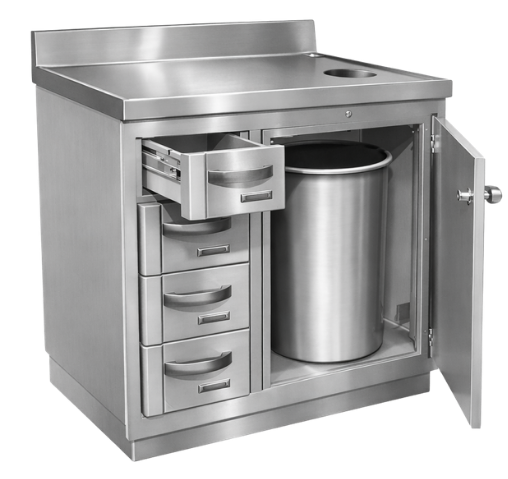
Lead-Lined Waste and Storage Cabinet. Image Credit: Ultraray
Where Are Lead-Lined Cabinets Typically Installed?
These cabinets are commonly installed in:
- Nuclear medicine departments
- PET imaging facilities
- Hospital pharmacies
- Research laboratories
- Radiopharmacies
- Oncology centers
- Academic isotope labs
Installation location directly affects shielding performance, and cabinets placed against unshielded partition walls, adjacent to corridors, near occupied offices, or beneath unshielded ceilings can create compliance risks if the room’s shielding design was not coordinated with cabinet placement.
When Should Stainless Steel Lead-Lined Cabinets Be Specified?
Stainless steel lead-lined cabinets should be specified during the early design phase, not after construction begins.
Late-stage procurement often creates coordination problems such as floor load conflicts, door clearance limitations, insufficient service routing, inadequate ventilation planning, and unexpected structural reinforcement requirements.
Because these cabinets are heavy and frequently integrate with plumbing, electrical, or exhaust systems, attempting to retrofit them after millwork installation or MEP rough-in can become costly and disruptive.
A more effective approach follows a clear planning sequence:
- Radiation shielding design
- Workflow mapping
- Cabinet function selection
- Structural and MEP coordination
- Procurement and fabrication
Skipping or rearranging these steps increases the risk of inspection issues, design revisions, and project delays.

Lead-Lined Radioisotope Storage Cabinet. Image Credit: Ultraray
What Materials and Construction Features Matter Most?
Not all cabinets perform equally. The critical factors include:
- Shielding thickness and uniformity
- Joint continuity at seams
- Door overlap design
- Stainless steel grade and weld integrity
- Corrosion resistance
- Interior cleanability
Radiation shielding can be compromised at:
- Hinges
- Latch areas
- Access penetrations
- Drain connections
- Service openings
These interfaces are where failures typically occur, not in the flat panel surfaces. Understanding this distinction is essential for architects and engineers reviewing submittals.
Where to Review Available Cabinet Configurations
Understanding the purpose of stainless steel lead-lined cabinets is only the first step. Practical implementation requires reviewing available configurations to confirm that internal layout, shielding continuity, and service interfaces align with project-specific requirements.
A full overview of the following stainless steel lead-lined cabinet configurations can be reviewed within Ultraray’s cabinet section, including:

This information has been sourced, reviewed and adapted from materials provided by Ultraray.
For more information on this source, please visit Ultraray.