The Antarctic Environment as a Design Driver
Modular Design and Prefabrication
Foundations on Moving Ice
Thermal Insulation and Building Envelope
Energy Systems and Sustainability
Human Factors in Station Design
References and Further Reading
Antarctica holds some of the most scientifically valuable data on Earth, from critical ozone measurements to essential ice-core climate records. Building the infrastructure that makes this research possible requires engineers to solve problems that exist nowhere else. The environment is extreme, the logistics are punishing, and every material choice carries consequences that ripple across decades.
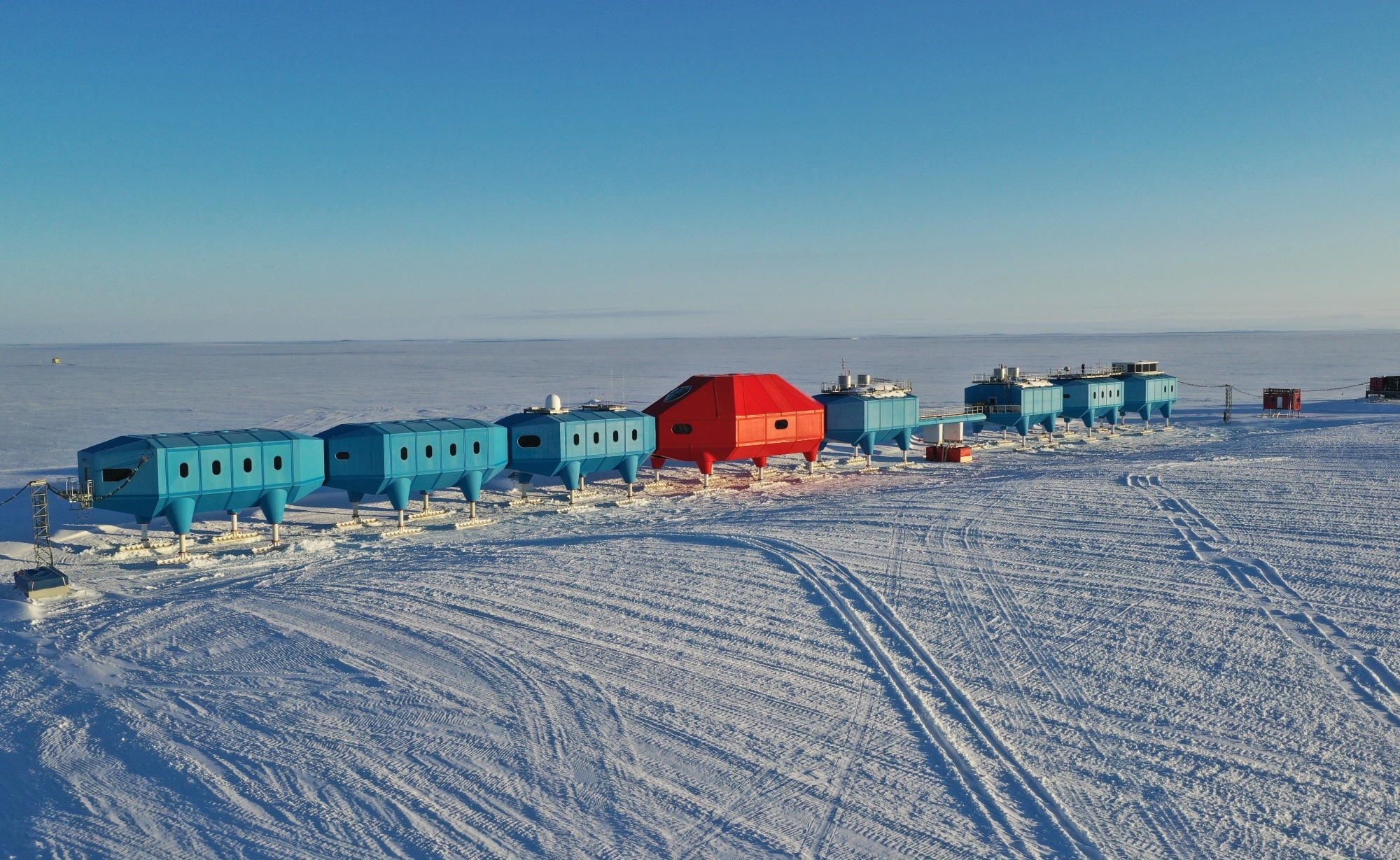
Image Credit: SQ1SGB/Shutterstock.com
The Antarctic Environment as a Design Driver
Temperatures at certain Antarctic sites drop to -56 °C, and wind speeds exceed 160 km/h. Snow accumulates at roughly 1.5 meters per year at ice-shelf stations, meaning that buildings placed directly on the surface will be buried within a few seasons.1,2
The Brunt Ice Shelf, where the British Antarctic Survey operates Halley VI, moves approximately 400 meters toward the sea each year, adding another layer of structural unpredictability.1,2
Saving this for later? Download a free PDF of this article here.
These conditions directly shape architectural decisions from the ground up. Stations built on rock outcrops face different problems than those on floating ice shelves. On rock, engineers anchor foundations deep into permafrost and account for freeze-thaw cycles. On ice shelves, the ground beneath the station flows, tilts, and eventually calves into the ocean, making fixed foundations a serious liability.2
The construction season itself is the sharpest constraint of all. Access by ship and aircraft is typically limited to a two- to three-month window between December and February. At Rothera Research Station, temperatures fluctuate between -22 °C and +15 °C, and workers must clear accumulated winter snow before any productive work begins.3
Modular Design and Prefabrication
Almost all components of Antarctic architecture arrive by ship, so the construction of these parts begins in factories thousands of kilometers away. Prefabricated and modular construction is the standard approach across many modern Antarctic programs.
China's Qinling Station used a prefabricated steel structure and modular system in which all functional units were manufactured in China, shipped south, and assembled on-site like building blocks. This strategy reduces on-site labor time and minimizes the risk of errors in harsh weather.4,5
For the British Antarctic Survey's Discovery Building at Rothera, contractor BAM worked with consultants Sweco and Ramboll to develop a "kit-of-parts" approach. Assemblies were fabricated in Cambridge, tagged, and sequenced so workers in Antarctica could reconstruct the building in the correct order without ambiguity.6
Building information modeling plays a central role in coordinating this process. Over 100 suppliers contributed to the Discovery Building's 3D Revit model, shared through Autodesk Construction Cloud. This digital workflow allowed project managers to pre-plan excavator placement, map delivery routes from ship to site, and ensure that no component arrived before the structure was ready to receive it.6
Foundations on Moving Ice
The foundation strategy for ice-shelf stations has evolved through several generations of failure and innovation. Early stations at Halley were simply left to be buried under snow, and the ice eventually crushed them. Later iterations used elevated steel platforms on jackable legs, which allowed engineers to raise the building annually above the rising snow level.2
Halley VI, operational since 2013, introduced hydraulically elevated ski-based modules. Each leg contains a hydraulic jacking mechanism in the lower section. Every year, bulldozers push accumulated snow beneath the platform, and the hydraulic system lifts each module to maintain ice clearance. The entire station can be raised in six days with two vehicle operators and one supervisor.2
The ski base serves a dual function. It acts as a spreader beam foundation, distributing the module's load to stay within the sea ice bearing capacity of approximately 9.5 tons. The skis also make the station physically relocatable. Standard modules weighing approximately 80 tons can be pulled by a single Caterpillar D5 bulldozer to a new site, a capability demonstrated during the station's initial deployment.2
Thermal Insulation and Building Envelopes
Maintaining habitable interior temperatures at -40 °C requires wall systems with extremely low thermal conductance. The Princess Elisabeth Antarctica station in Belgium uses a sophisticated design featuring nine distinct wall layers.7
It has stainless steel cladding that progresses inward through closed-cell polystyrene foam, EPDM silicone sealant, laminated wood, and a 400 millimeter layer of graphite-charged low-density polystyrene. This innovative multi-layer sandwich maintains positive interior temperatures using only the heat generated by occupants and electrical equipment, requiring no active heating system.7
China's Qinling Station adopted a different but equally rigorous approach, using polyurethane insulation panels with a thermal conductivity of 0.024 W/(m·K). The station's window system uses a five-glass, three-cavity design filled with inert gas and polyurethane composite profiles, achieving a heat transfer coefficient of 0.6 W/(m²·K), far below conventional polar building standards.8
At Halley VI, cladding panels are made from glass-reinforced plastic encapsulating closed-cell polyisocyanurate foam. The panels interlock with neoprene rubber gaskets, forming a continuous barrier against cold-air infiltration, moisture, snow spindrift, thermal shock, and ultraviolet radiation. The envelope must withstand 100 mph winds without delaminating or developing air leaks that would degrade thermal performance.2
Energy Systems and Sustainability
Power in Antarctica cannot rely on a grid supply, so stations run on diesel generators as their primary power source, increasingly supplemented by renewables.
Water generation at Halley VI comes from snowmelt tanks located beneath the bridge linking its two module platforms. A vacuum drainage system reduces potable water consumption by 50% compared to the previous station, a significant saving given the fuel cost of melting every liter of snow.2
At Rothera, the Antarctic Infrastructure Modernisation Programme includes a renewable energy component running in parallel with the Discovery Building construction.9
Ventilation in sealed polar buildings must balance heat retention with fresh-air supply and humidity control. Princess Elisabeth Antarctica uses a heat-exchange ventilation system that extracts vitiated interior air and introduces fresh exterior air while distributing recovered heat throughout the building.
Halley VI localizes heating, ventilation, and humidification plants within each module, giving station managers independent thermal control over every space.7
Human Factors in Station Design
Construction decisions in Antarctica are inseparable from the physiological and psychological needs of the people who will spend months inside these structures. Halley VI's interior was designed with the help of a color psychologist, who specified warm palettes for sleeping corridors and energizing tones for work areas.2
Each bedroom includes a window for natural light, daylight simulation lamps, and long beds sized for taller residents, all supporting circadian rhythm maintenance during the 105-day polar night.2
Social spaces receive equally deliberate attention. The station's central module widens the main corridor to 1.8 meters and raises the ceiling height, creating natural gathering points where residents pause and interact rather than moving straight to their rooms. Unexpected views of the Antarctic landscape appear at module ends, punctuating daily circulation routes with moments of spatial interest.2
Lighting systems across modern stations are specified to meet high color-rendering standards, with cool-white, high-illumination fixtures in laboratories and warm-white, lower-level lighting in recreational areas. Runway lighting at Rothera was upgraded as part of the AIMP to energy-efficient systems that maintain safe flight operations through the austral winter.
These choices reflect the recognition that well-designed infrastructure sustains not only the physical survival of a crew but also the quality of the science they are there to produce.1,3
References and Further Reading
- Rooney, A. Lighting the Halley VI British Antarctic Research Station. PennWell. https://na.eventscloud.com/file_uploads/93b4d7d7f625021065629168edb7b878_MTS5AnnaRooney.pdf.
- Rendina, G. and Broughton, H. Polar Research Stations: Meeting the Challenge of Isolated Living. Social Studies of Science. 46(6). https://journals.sagepub.com/pb-assets/cmscontent/SSS/Rendina_and_Broughton1.pdf.
- (2024). New construction season drives Antarctic modernisation forward. [Online] British Antarctic Survey. Available at: https://www.bas.ac.uk/news/new-construction-season-drives-antarctic-modernisation-forward/.
- Gu, Jin-Ben. et al. (2025). Architectural and Structural Design Technologies in Polar Regions: A State-of-the-Art Review. Civil Engineering Sciences, 1(25). https://www.sciencedirect.com/org/science/article/pii/S3067780725000023
- Xinping, L. (2025). Building a modern Antarctica research hub: Chinese team behind Qinling Station. [Online] CPC Central Committee Bimonthly. Available at: https://en.qstheory.cn/2025-09/08/c_1122997.htm.
- Jeff Yoders. (2022). Antarctic Research Station Kept on Track by BIM Teaming. [Online] Engineering News-Record. Available at: https://www.enr.com/articles/55280-antarctic-research-station-kept-on-track-by-bim-teaming.
- Passive Buildings Techniques. [Online] Antarctic Station. Available at: http://www.antarcticstation.org/station/passive_building.
- (2025). Thermal Insulation Strategy of China’s Antarctic Qinling Station. [Online] Nonmetallic Excellence and Innovation Center for Building Materials. Available at: http://www.non-metallic.net/index.php?m=content&c=index&a=show&catid=241&id=224.
- (2025). The Antarctic Infrastructure Modernisation Programme (AIMP). [Online] Ciria. Available at: https://www.ciria.org/ci/iCore/Events/Event_display.aspx?EventKey=E24204.
Disclaimer: The views expressed here are those of the author expressed in their private capacity and do not necessarily represent the views of AZoM.com Limited T/A AZoNetwork the owner and operator of this website. This disclaimer forms part of the Terms and conditions of use of this website.