*Important notice: This news reports on an unedited version of an accepted paper and is awaiting final editing. Therefore, the paper should not be regarded as conclusive or treated as established information.
A recent study highlights the need to balance water-to-binder ratio, superplasticizer dosage, and limestone powder content to achieve printability and structural performance in 3D-printed concrete. These parameters can affect water retention, shrinkage, strength, microstructure, and interlayer adhesion.
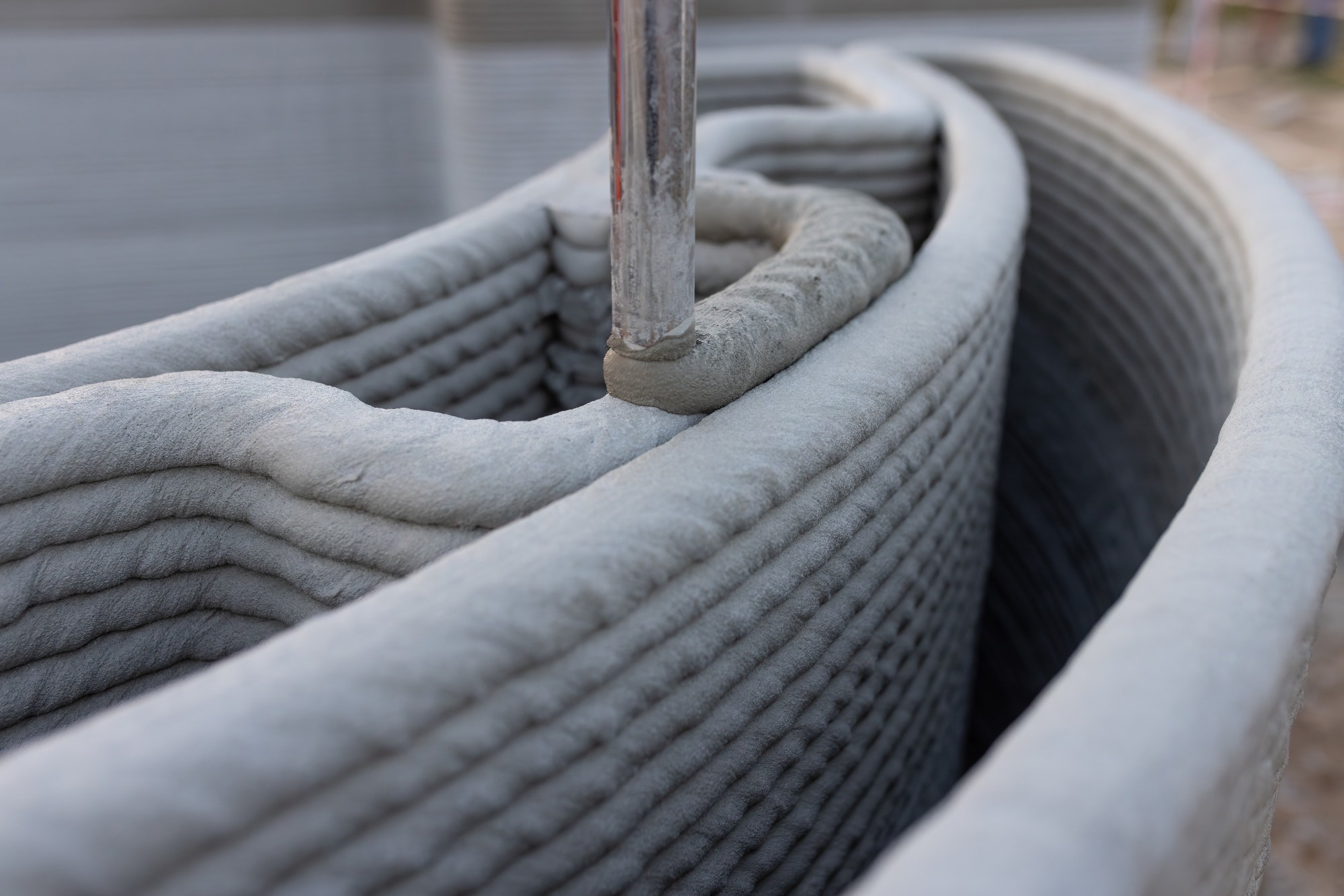 Study: Synergistic approach to enhancing interlayer bonding in 3D printed concrete via water to binder ratio and water retention addition. Image Credit: sergey kolesnikov/Shutterstock.com
Interlayer Bonding in 3D Printing
Three-dimensional (3D) concrete printing is gaining attention for its ability to create complex structures without conventional formwork. The process deposits fresh concrete layer by layer, which can reduce material waste and labor requirements.
However, this layered approach also creates interfaces within the finished structure. Poor bonding between adjacent layers can make these interfaces weak points.
Download a copy of this news piece for later by clicking here!
Surface moisture plays an important role in interlayer bonding, supporting continued hydration and promoting chemical bonding between a newly deposited layer and the layer below.
Excessive moisture loss can create dry interfaces, increase shrinkage, and contribute to defects. The time between layers, nozzle characteristics, and environmental conditions can further affect moisture loss and bonding quality.
Previous studies have examined printing parameters, rheological properties, surface treatments, and supplementary materials. However, few studies have examined how the water-to-binder ratio, superplasticizer dosage, and limestone powder content work together to influence interlayer bonding.
This study, published in Scientific Reports, addresses this gap by evaluating the effects of these additives on flowability, water retention, drying shrinkage, compressive strength, microstructure, and interlayer bond strength.
Optimizing Interlayer Bonding in 3D-Printed Concrete
The researchers tested three water-to-binder ratios of 0.30, 0.34, and 0.40, with corresponding superplasticizer dosages of 0.22%, 0.16%, and 0.10% by cement mass. They also replaced part of the binder with 5% or 10% limestone powder and examined how interlayer bonding changed with printed height.
The mixtures contained ordinary Portland cement (OPC), limestone powder, natural river sand, water, and superplasticizer. The sand had a maximum particle size of 2.5 mm, while the limestone powder had a fineness of approximately 5100 cm2/g.
Nine mixtures covered three water-to-binder ratios and three limestone powder contents: 0%, 5%, and 10%. The researchers adjusted superplasticizer dosage to maintain slump flow between 18.0 and 21.0 cm and assessed fresh-state behavior through slump flow and water-retention tests. Drying shrinkage and compressive strength were measured using ASTM C596 and ASTM C109, respectively.
A gantry-based 3D printer produced 400 × 400 × 180 mm blocks at a nozzle speed of 40 mm/s. Each layer was approximately 40 mm wide and 10 mm high, with an interlayer interval of about 40 seconds.
After 28 days of curing, the team tested interlayer adhesion using splitting tensile tests. Scanning electron microscopy (SEM) also examined pore structure and hydration products in selected mixtures.
Optimizing Mix Design for Stronger Interlayer Bonding
The results showed that both the water-to-binder ratio and limestone powder content affected fresh-state behavior. All mixtures achieved slump
flow values between 18.0 and 21.0 cm. Increasing the water-to-binder ratio improved flowability, while limestone powder produced a smaller increase. This balance provided sufficient fluidity for extrusion while maintaining the stability required for successive layers.
Water retention showed a stronger relationship with interlayer performance. CP07, which contained 10% limestone powder and a water-to-binder ratio of 0.30, achieved the highest water retention at 92.1%.
The fine limestone particles increased surface area and created a finer particle structure, limiting moisture movement. Better moisture retention can support continued hydration and improve contact between adjacent layers.
The water-to-binder ratio also affected drying shrinkage: the mixture with a ratio of 0.40 showed greater shrinkage than mixtures with lower ratios. CP01, with a ratio of 0.30, exhibited approximately 9% lower shrinkage than CP03.
Adding 10% limestone powder reduced shrinkage further, with CP07 showing a 12.2% reduction compared with CP01. The researchers linked this improvement to limestone’s filler effect and its influence on pore refinement and hydration-product development.
Mechanical testing showed similar benefits. Mixtures containing 10% limestone powder achieved higher compressive strength than corresponding mixtures without limestone. CP07 recorded the highest strength, approximately 15% higher than CP01.
SEM analysis revealed that CP03 contained more capillary pores and fewer calcium silicate hydrate (C-S-H) crystals, while CP07 showed a denser structure with interconnected C-S-H phases and more developed hydration products.
Interlayer bond strength improved in mixtures with a water-to-binder ratio of 0.30 and 0.22% superplasticizer. Higher water content can promote bleeding and create a thin water film that weakens contact between layers.
Adding 10% limestone powder increased bond strength by 33.6%, 27.4%, and 29.7% at water-to-binder ratios of 0.30, 0.34, and 0.40, respectively. CP07 achieved the strongest bonding, reaching 2.75 MPa at the uppermost interface.
Bond strength also decreased as printed height increased. Statistical analysis confirmed a significant effect (F = 44.3, p < 0.001), primarily due to reduced self-weight consolidation in higher layers.
Toward Stronger and More Reliable 3D-Printed Concrete
The study shows that reliable interlayer bonding in 3D-printed concrete depends on the combined control of mixture composition and printing conditions.
The optimized mixture used a water-to-binder ratio of 0.30, 0.22% superplasticizer, and 10% limestone powder. It maintained suitable flow while improving water retention, reducing drying shrinkage, increasing compressive strength, and creating a denser microstructure. These properties supported stronger bonding between printed layers.
Build height also affected interlayer performance. Bond strength decreased as the printed height increased, indicating greater vulnerability to weaker interfaces in upper regions. Continuous printing can help preserve surface moisture and support bonding during layer deposition.
The findings highlight the importance of managing moisture movement and microstructural development in additive cementitious manufacturing. Limestone powder contributes beyond its role as a filler by improving water retention and influencing the development of hydration products.
Overall, the optimized mix design provides a foundation for a more practical approach to stronger, more reliable 3D-printed concrete structures.
Journal Reference
Dang, T. T. H., et al. (2026). Synergistic approach to enhancing interlayer bonding in 3D printed concrete via water to binder ratio and water retention addition. Scientific Reports. DOI: 10.1038/s41598-026-64324-y. https://www.nature.com/articles/s41598-026-64324-y.
Disclaimer: The views expressed here are those of the author expressed in their private capacity and do not necessarily represent the views of AZoM.com Limited T/A AZoNetwork the owner and operator of this website. This disclaimer forms part of the Terms and conditions of use of this website.