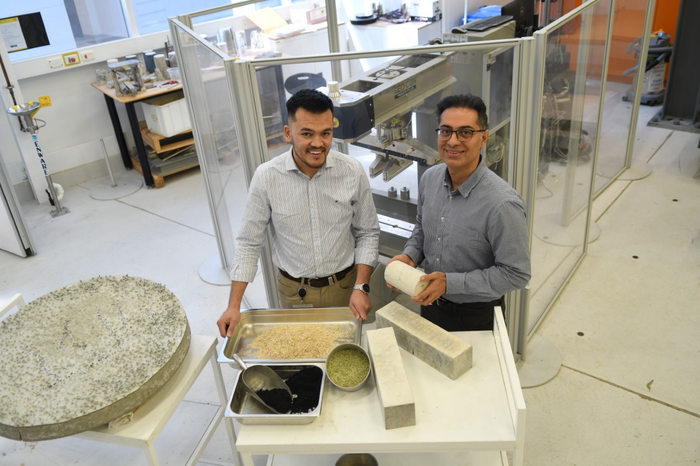
Flinders University sustainable construction materials lead researcher Dr. Aliakbar Gholampour, right, and Ph.D. civil engineering candidate Zakir Ikhasi who use natural fibers, lead slag (black sand) and waste glass sand materials in new-age concrete mixes. Image Credit: Flinders University.
With 25 billion tons used each year, conventional concrete is the most frequently used construction material. It consumes approximately 30% of nonrenewable natural resources, emits approximately 8% of atmospheric greenhouse gases, and accounts for up to 50% of landfill.
According to lead researcher Dr. Aliakbar Gholampour of Flinders University’s civil and structural engineering department, this research shows great promise for the use of natural fibers in the advancement of structural-grade construction materials in which binder and aggregate are replaced by industrial by-products and waste-based materials.
Geopolymers made from waste glass sand have higher strength and lower water absorption than those made from natural river sand, whereas lead smelter slag (LSS)-based geopolymers have lower drying shrinkage than geopolymers made from natural river sand.
Natural fibers such as sisal, ramie, coir, hemp, jute, and bamboo were also used in the experiments.
The new Australian-led research contributes to global efforts to reduce the environmental effect of the production of conventional building materials and the volume of waste that goes to landfill. The study was published in the journal Construction and Building Materials.
With concrete, we can not only recycle huge volumes of industrial by-products and waste materials, including concrete aggregates, to improve the mechanical and durability properties of concrete, but also use alternative eco-friendly natural fibers which otherwise would not be used constructively.
Dr. Aliakbar Gholampour, Civil and Structural Engineering, Researcher, Flinders University
Dr. Gholampour adds, “This research will also look to design mixes of recycled coarse aggregates and other types of cellulosic fibers including water paper, for different construction and building applications. We also plan to investigate their application in construction 3D printing for the future.”
Journal Reference:
Gholampour, A., et al. (2022) Mechanical and durability properties of natural fiber-reinforced geopolymers containing lead smelter slag and waste glass sand. Construction and Building Materials. doi.org/10.1016/j.conbuildmat.2022.129043.