*Important notice: This news reports on an unedited version of the paper which has been accepted. and is awaiting final editing. Scientific Reports sometimes publishes preliminary scientific reports that are not fully edited and, therefore, should not be regarded as conclusive or treated as established information.
A multiscale approach reveals early-stage creep dominates tunnel concrete deformation. Microstructural insights enable accurate long-term predictions, improving material design, reducing testing time, and enhancing underground infrastructure safety.
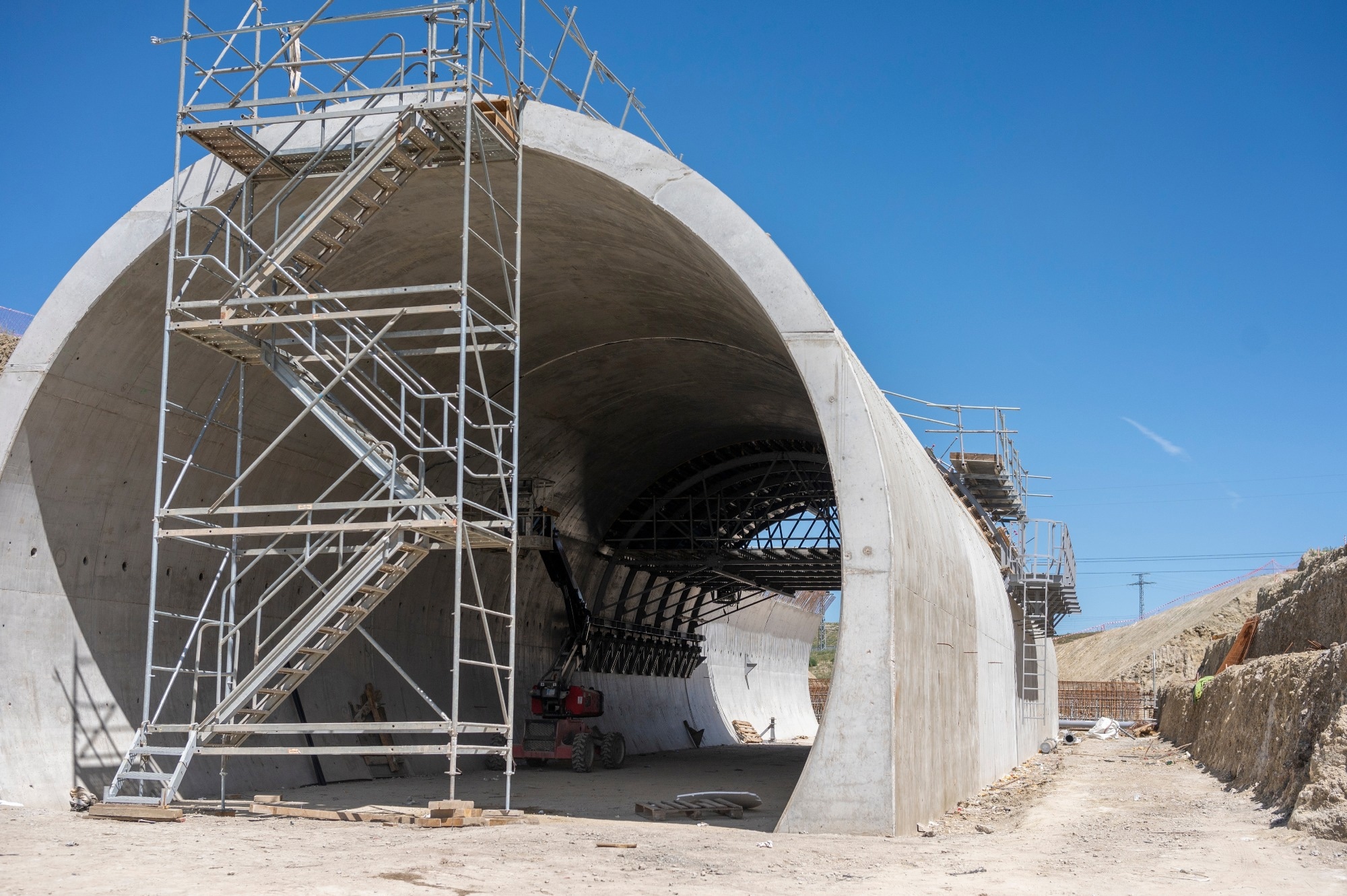 Study: Research on the creep behavior of tunnel lining concrete based on a multi-scale approach. Image Credit: Lancho/Shutterstock
The stability of underground transport networks relies heavily on how concrete maintains its shape under the pressure from surrounding rock and soil. A recent study published in the journal Scientific Reports examined the creep behavior of tunnel lining concrete using a multi-scale approach. By combining large-scale field experiments with microscopic analysis, researchers developed a model to predict long-term structural behavior.
The findings demonstrate that most deformation occurs early, with over 75% of the total creep measured over six months occurring within the first 30 days. This highlights the critical importance of the initial weeks for long-term tunnel stability, while microscopic interactions between cement and aggregates govern long-term behavior.
The Impact of Geostress on Concrete Performance
Concrete creep is a phenomenon where a material slowly changes shape over time while sustaining heavy loads. This is a critical concern for engineers because in deep tunnels, earth pressure can exceed 40 MPa. Unlike bridges or columns, tunnel linings experience long-term, multi-directional geostress, especially in high-altitude environments. Understanding this behavior requires analysis beyond visible structural changes.
Advances in materials science enable researchers to study concrete from the "bottom up." Nano-scale analysis shows how the chemical components of cement paste respond to stress. This helps design more durable concrete mixes suited for underground construction.
Investigating the Microstructure of Tunnel Concrete
A series of field tests was conducted to understand long-term behavior. Researchers tested a concrete mix designed for high-altitude use that included fly ash to fill tiny pores and reduce heat generated during drying. In the lab, they subjected large specimens to a constant load for 180 days to measure their displacement. The environment was kept at a steady temperature and humidity to prevent changes due to weather conditions. This ensured consistent measurement of creep deformation.
Micro-scale analysis using nanoindentation assessed the properties (strength and flexibility) of cement paste. X-ray techniques and microscopy were used to identify mineral composition and examine the interfacial transition zone (ITZ), the weak layer between cement and aggregates. The collected data were then integrated into mathematical models to create a digital representation of the material’s behavior under real conditions.
Deformation Mechanisms and Material Properties
The outcomes showed that most deformation occurs early, highlighting the significance of the first few weeks for long-term tunnel stability. Microstructural analysis identified distinct phases within the cement matrix. Rigid components, such as unhydrated particles, resisted deformation due to their solid nature, while tiny pores in the mix were more prone to collapse.
The ITZ around coarse aggregates was approximately 30 μm thick, approximately 50% thicker than the layers surrounding fine sand particles. These thicker zones were about 8.3% softer, making them primary sites for creep initiation. Additionally, a gel phase constitutes more than one-third of the material and plays an important role in long-term deformation.
Applications for Infrastructure Design and Construction
This research benefits large-scale infrastructure projects such as mountain highways and railway tunnels. It shows that micro-scale tests can predict long-term behavior with less than 10% error, allowing engineers to rely on 28-day lab results instead of waiting six months. This reduces testing time and enables faster decisions on concrete mix design.
The findings also enhance digital modeling by providing accurate material parameters necessary for better computer simulations of tunnel life. This can help predict when cracks might form or when a tunnel might settle excessively, thereby allowing construction teams to better plan the thickness of tunnel walls and the timing of support structures needed.
Download the PDF of this page here
Future Directions in Concrete Research
In summary, this study demonstrates that multi-scale analysis, from nano to macro, is a reliable approach for assessing concrete performance. The model closely matched test results, with only minor differences compared to real-world tests. Researchers believe this occurs because concrete is a living material that changes and hardens over time.
The findings also support the development of concrete mixes with improved creep resistance. Strengthening the bond between cement paste and aggregates enhances durability and long-term stability. This provides a pathway for designing safer and more resilient underground infrastructure capable of withstanding high geological pressures.
Future work should examine creep behavior under more complex environmental conditions. The homogenization model can be refined through machine learning to improve prediction. Greater focus is needed on quantifying the effects of impurities and moisture variation, and the use of mineral admixtures should be explored to enhance long-term performance.
Journal References
Lan, L., Mu, J., & et al. (2026). Research on the creep behavior of tunnel lining concrete based on a multi-scale approach. Sci Rep. DOI: 10.1038/s41598-026-48698-7, https://www.nature.com/articles/s41598-026-48698-7
Disclaimer: The views expressed here are those of the author expressed in their private capacity and do not necessarily represent the views of AZoM.com Limited T/A AZoNetwork the owner and operator of this website. This disclaimer forms part of the Terms and conditions of use of this website.