3D-printed concrete reinforced with alternating layers of mortar and polyurethane mimics deep-sea sponge architecture, enhancing fracture toughness, ductility, and crack control while preserving strength for resilient construction components in infrastructure applications.
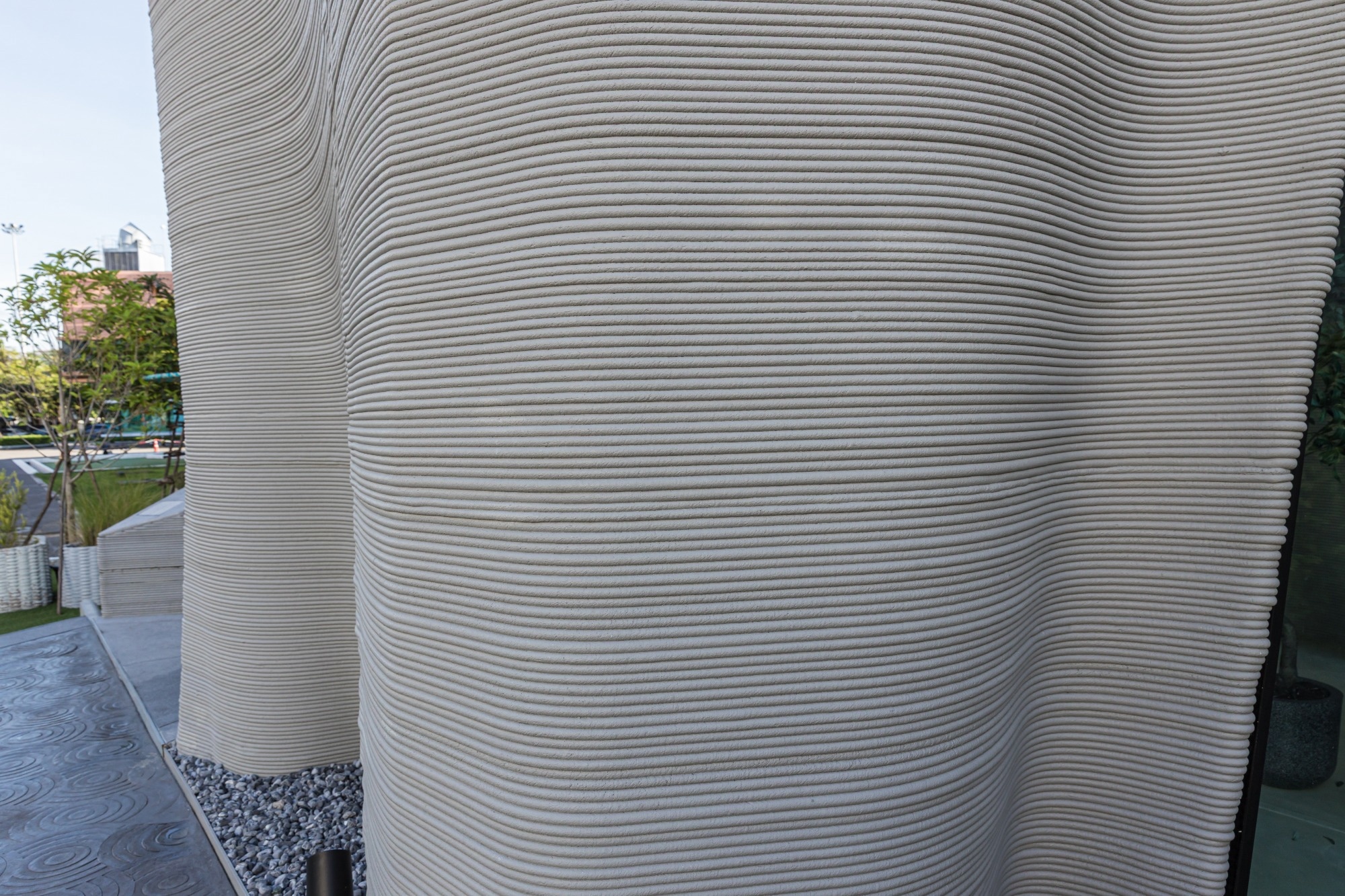 Study: Tough, ductile, and strong hard-soft cementitious composite enabled by multi-material additive manufacturing. Image Credit: kckate16/Shutterstock
In a recent research article published in the journal Advanced Materials, researchers developed a multi-material 3D-printing technique that integrates alternating layers of polymer and mortar to create concrete composites with significantly enhanced toughness and ductility, offering new possibilities for faster, stronger, and more resilient construction.
Challenges in Concrete 3D-Printing
Conventional concrete offers high compressive strength but exposes its Achilles’ heel in tension, manifesting brittleness as cracks propagate. Builders typically address this by embedding steel reinforcement bars into concrete to manage tensile stresses, control crack growth, and impart ductility, creating reinforced concrete.
Recent advances in 3D-printing technology have positioned cement-based materials to revolutionize construction by cutting costs, accelerating build times, and enabling more complex architectural designs. However, traditional concrete is intrinsically brittle, prone to sudden cracking and catastrophic failure once cracks initiate.
Yet, the methods for 3D-printing concrete generally focus on single-material extrusion without reinforcement, limiting the material’s ability to resist crack development and mechanical failure. Nature offers a compelling model for enhanced toughness through layered hard-soft architectures.
The deep-sea glass sponge (Euplectella aspergillum), also called Venus’s flower basket, features a skeleton made of alternating hard silica and soft layers. Its layered skeleton arrests crack growth, distributes fracture stress, and prevents sudden structural failure, thereby inspiring the new concrete-polymer composite design.
Innovations in Multi-Material Printing
The core of the research lies in developing a multi-material additive manufacturing system capable of precisely alternating between depositing layers of cementitious mortar and thin polymer films. The printed architecture mimics the natural hard-soft layering strategy observed in the glass sponge skeleton.
Researchers built a custom 3D printer equipped with dual-extrusion capabilities, one for mortar and the other for polymer interlayers. Early experiments used silicone polymer layers to establish proof of concept, examining how layer thickness and stiffness affected mechanical properties.
Following computational modeling to optimize interlayer characteristics, polyurethane was selected for its favorable stiffness and adhesion properties. The team calibrated the thickness of polymer layers to be thin enough to maintain load capacity while sufficiently stiff to deflect and bridge cracks.
A rigorous workflow-controlled material deposition geometry, including layer thicknesses and spatial arrangement, to ensure consistent composite architecture throughout fabrication.
Mechanisms Enhancing Toughness
The resulting architected cementitious composite (ACC) featured repeating thin layers of polyurethane polymer embedded within mortar layers, creating a mechanically synergistic structure. Mechanical testing demonstrated fracture toughness improvements of up to 187-fold over conventional 3D-printed or cast cementitious materials.
Ductility, or the material’s ability to deform before failure, increased by over 20 times, while flexural strength was statistically comparable to traditional composites without polymers. The polymer layers functioned not as reinforcements like steel rebars but as crack-arresting soft interlayers, forcing cracks initiated in hard mortar layers to deflect, arrest, or bridge over polymer regions, delaying catastrophic failure.
This multi-material build strategy restores toughness and load capacity simultaneously, which traditional concrete extrusion methods cannot achieve. Careful tuning of polymer layer thickness and stiffness was critical: too thick or too soft layers reduced load capacity, while appropriately thin, stiff layers optimized fracture resistance without sacrificing strength.
The design space for constructing composite components expanded significantly with the incorporation of a secondary polymer extrusion head, facilitating integration with existing gantry or robotic 3D-printing platforms. This flexibility also opens up broader functional possibilities beyond load-bearing, such as thermal regulation or insulation integrated directly into structural elements.
The approach advances additive manufacturing in construction from single-material shaping toward architecting material behavior on the microstructural level through precise layering and material combination.
Inspired by biological evolution’s optimization of materials, this manufacturing method transforms modest raw materials into composites exhibiting exceptional mechanical performance. As demonstrated, the layering design is a form of "programming" the fracture and deformation pathways during the build, a breakthrough for printed infrastructure components exposed to demanding mechanical and environmental loads.
Future Directions and Applications
This research represents a paradigm shift in 3D-printing concrete for construction, moving from brittle monolithic materials toward architected composites that incorporate thin, mechanically tuned polymer interlayers to dramatically enhance toughness and ductility.
Download the PDF of this page here
By adopting nature’s layered hard-soft architecture observed in deep-ocean sponges and implementing it via multi-material additive manufacturing, the Princeton team achieved a composite material that is 187 times tougher than conventional concrete.
The 3D build process benefits from precise control over material deposition, geometry, and mechanical properties, which is essential for replicating the toughening mechanisms imparted by polymer layers. This approach holds significant promise for the scalable manufacturing of structural walls, facades, and protective elements that can withstand impact, vibration, and seismic forces.
Furthermore, the method is compatible with existing robotic printing platforms, facilitating rapid adoption in construction settings. Future work will focus on scaling the technology, exploring environmental durability, and expanding functional capabilities such as integrated thermal management. The study paves the way for multi-material additive manufacturing to redefine concrete construction by directly engineering fracture, deformation, and multifunctionality into built components.
Journal Reference
Najmeddine A., Gupta S., et al. (2026). Tough, ductile, and strong hard-soft cementitious composite enabled by multi-material additive manufacturing. Advanced Materials. DOI: 10.1002/adma.202515461, https://advanced.onlinelibrary.wiley.com/doi/10.1002/adma.202515461