Here's some good news regarding crude oil and natural gas: When processed into rigid foam panels for facades and walls, they can help save energy. For the sixth time, Ceresana has analyzed the global market for insulation materials used in the construction industry. These building materials are usually sold under abbreviations such as PUR, PIR, EPS, and XPS. The market research institute predicts that global demand for thermal insulation building materials will grow to over 660 million cubic meters by 2035.
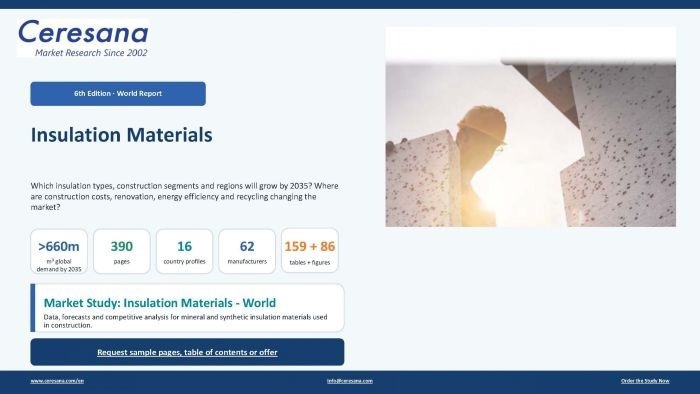 Image Credit: Ceresana
Good Prospects for Insulation Manufacturers
Insulation alone can reduce energy consumption in a typical single-family home built in the 1980s by more than a third: Exterior walls, roofs, floors, and basement ceilings can be insulated, among other parts of the house. Many countries therefore have state subsidy programs for the thermal insulation of buildings. In the European Union, the Energy Performance of Buildings Directive sets specific renovation targets: For residential buildings, average primary energy consumption is to be reduced by 16% by 2030 and by about 20% by 2035, compared to 2020. For nonresidential buildings, about one-quarter of the least energy-efficient buildings are to be renovated by 2033. Around the world, the entire construction industry and its suppliers continue to benefit from investments in data centers, logistics facilities, and warehouses. The business environment therefore remains generally favorable for insulation manufacturers, despite high construction and financing costs, reluctance to invest, and regulatory uncertainty.
PUR and PIR Insulation Systems Show the Strongest Growth
More than half of the global demand for insulation materials currently comes from mineral wool – that is, glass wool or rock wool which is made from sand, stone, lime, and various minerals. As the market study shows, these are followed by foamed plastics: expanded polystyrene (EPS), extruded polystyrene (XPS), polyurethane (PUR), and polyisocyanurate (PIR). Ceresana market researchers expect PUR and PIR to see the highest growth: about 5.3% per year. Although these synthetic foams are expensive, they offer high insulation performance even at low thicknesses. They are therefore used primarily in roofing applications, for certain types of facades and building envelopes, and wherever thin, high-performance insulation is required. However, there is still room for improvement when it comes to waste disposal and recycling.
Competitive Analysis as the Key to Market Expansion
The comprehensive market report offers valuable insights into current trends in the global insulation materials market. The market potential of the most commercially significant insulation materials is analyzed in detail: for mineral wool as well as for expanded or extruded polystyrene (EPS, XPS) and polyurethane (PUR, PIR). In addition to market data and forecasts, the study also contains background information on the general economic situation and the situation in the construction industry (including important companies, construction activities, investments, planned construction projects) in the individual countries. Particularly in the residential construction and renovation segments, Ceresana expects above-average global growth in the coming years. In contrast, commercial construction and new construction are being held back in many places, for example by high construction costs and a weaker economy. Forecasts on future demand and growth opportunities for synthetic insulation materials provide a sound basis for strategic decisions. The market report thus supports planning efforts to increase market share.
Sixth Edition of the Ceresana Market Study “Insulation Materials – World”:
Chapter 1 provides a complete description and analysis of the global insulation material market – including forecasts up to 2035. For each region of the world, this chapter shows production in cubic meters, demand in cubic meters and tons, as well as the revenues generated with insulation materials in US dollars and euros.
Chapter 2 presents the production, demand, import, export, and sales of insulation materials for 16 countries that are particularly relevant for the insulation materials market.
Demand is broken down for the five most important insulation types both in millions of cubic meters and in 1,000 tons:
- EPS (expanded polystyrene)
- XPS (extruded polystyrene)
- PUR/PIR (polyurethane/polyisocyanurate)
- Glass wool
- Stone wool.
These construction segments are differentiated:
- Residential construction
- Commercial construction
- New construction
- Renovation.
Chapter 3 presents company profiles of the most important insulation material manufacturers – clearly arranged according to contact details, revenues, net income, product range, production sites, profile summary, as well as product types and application areas. Detailed profiles of the 62 leading manufacturers are provided, including Compagnie de Saint-Gobain S.A., Fletcher Building Limited, Gebr. Knauf KG, Huamei Group, Holcim Ltd., Kaneka Corporation, Kingspan Group plc, Owens Corning, and Standard Industries.
Further information on the new market study “Insulation Materials – World”: https://ceresana.com/en/produkt/insulation-material-market-report-world