Material produced at MCi Carbon’s Myrtle demonstration plant in Newcastle has been successfully used in concrete field trials hosted by Boral at its Maldon Cement Works in New South Wales.
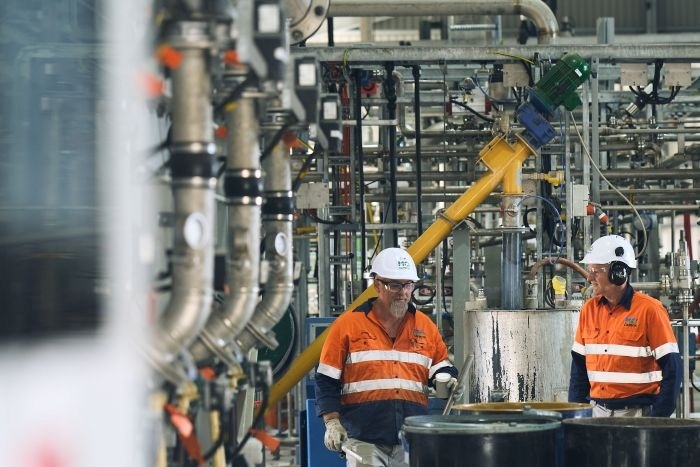 Image Credit: MCi Carbon
The trials were conducted as part of a project led by the SmartCrete Cooperative Research Centre with project partners Transport for NSW and University of Technology Sydney, which is investigating new supplementary cementitious materials for potential use in lower-carbon concrete for infrastructure applications.
Concrete produced for the trial incorporated a low-carbon cement material ‘Pozzlock’ – a synthetic pozzolan - manufactured at MCi Carbon’s Myrtle demonstration plant in Newcastle, which was officially opened by Australia’s Climate Change and Energy Minister Chris Bowen in June 2026.
In this process called mineral carbonation, CO2 reacts with mineral-rich feedstocks to form stable carbonates while generating a cementitious material that can partially replace high-emissions clinker in concrete. The Myrtle facility provides a platform for scaling MCi Carbon’s technology from pilot research to industrial deployment.
In addition to the CO2 mineralized during production, the MCi cementitious material generated through this process can contribute to further downstream emissions reductions when used in concrete. Each ton of MCi cementitious material has the potential to avoid approximately 0.5 tons of CO2, providing a pathway for additional lifecycle emissions reductions as the technology scales.
The concrete mix evaluated in the field trial used the MCi cementitious material at 5% cement replacement, with the project identifying a pathway to evaluate replacement levels of up to 10% in future work.
Marcus Dawe, Founder and CEO of MCi Carbon, said: “Producing Pozzlock at this scale is a critical step in our commercialization journey. What’s particularly significant about this project is how it brings together industry, research and government to demonstrate how innovation in concrete can be delivered in practice. It’s a strong example of how new low-carbon materials can be validated and integrated into existing construction processes, accelerating their pathway to adoption.”
Ali Nezhad, Head of Sustainability and Innovation at Boral, said: “Boral is proud to be supporting MCi Carbon in advancing their mineral carbonation carbon capture solution. Decarbonizing our cement manufacturing operations is a key focus for Boral, and we are pleased to contribute to developing utilization pathways for products generated as part of the mineral carbonation carbon capture process. Aligned with our work developing low-carbon supplementary cementitious materials, such as calcined clay, to decarbonize concrete manufacturing at scale, we are excited to be part of the development journey for other innovative solutions.”
Testing progressed through a staged validation program beginning with mortar testing and laboratory concrete trials before moving to larger-scale mixing trials. Early-stage concrete testing was conducted at UTS Tech Lab in Sydney, where workability, slump retention and compressive strength development were assessed against a fly ash control mix.
Concrete performance was then evaluated using high-shear mixing equipment to replicate commercial batching conditions prior to field testing.
The final stage involved back-to-back concrete truck loads produced at Boral’s Maldon Cement Works. One load used conventional fly ash as the supplementary cementitious material while the second incorporated MCi cementitious material. Each load produced approximately 3.5 m3 of concrete, which was pumped, placed and finished into a test slab.
Fresh concrete properties, including slump retention, air content and density, were comparable between the MCi cementitious material mix and the fly ash control. Early-age compressive strength development and drying shrinkage were also within the expected range.