Drier climates are exacerbating an expensive problem for millions of Australians whose homes sit on expansive soils prone to shrinkage cracks, which have already cost insurance companies and individuals billions of dollars in damage bills.
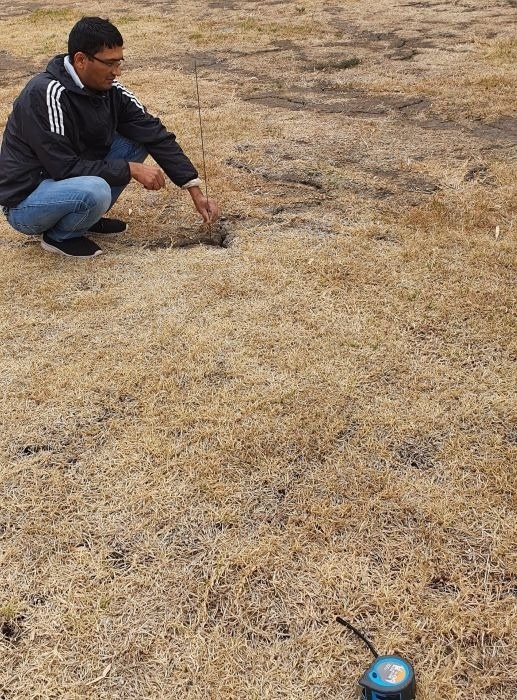 Dr Bikash Devkota measuring shrinkage cracks at the test site in Adelaide. Image Credit: Adelaide University
A new study by Adelaide University, using computer modeling and field observations, shows that homes are more vulnerable to damage than previously thought, and climate change is expected to worsen the problem in coming years.
With 20-30% of Australian surface soils classified as expansive or reactive, researchers say it is imperative that newer homes are built on stronger foundations to withstand increased soil movement, where repeated drying and wetting can cause the ground to shrink and swell beneath foundations.
Geotechnical engineers from Adelaide University’s School of Civil Engineering and Construction Management have demonstrated that shrinkage cracks in expansive soils can plunge more than one meter underground, creating hidden pathways for water and changing the way moisture moves through the soil.
Their findings have been published in the Journal of Rock Mechanics and Geotechnical Engineering.
Senior author Associate Professor Rajibul Karim said cracks that look relatively small in size at the surface can have a much bigger impact.
"These cracks are not simply surface features. They can extend deep into the soil and provide pathways for water to move much further into the ground," Associate Professor Karim said.
The issue is particularly significant in South Australia, which is renowned for its highly reactive soils.
In their multi-year field study conducted on an Adelaide site, researchers recorded cracks between 5mm and 40mm wide and up to one meter deep, with the deepest cracks appearing during the drier months of March and April.
While some cracks narrowed or closed after rain, others persisted throughout the year.
In one field experiment, researchers poured more than 30 liters of Plaster of Paris into cracks but were unable to fill them. When the ground was later excavated, traces of plaster were found as deep as one meter below the surface, demonstrating just how extensive and interconnected the cracks could be.
The computer modeling revealed that these cracks can significantly increase the depth of soil affected by changes in moisture.
In uncracked soil, the depth of significant moisture-related ground movement was estimated at 3.8 meters – close to the four meters recommended for Adelaide residential construction.
But when cracks were included in the modeling, the affected depth increased substantially, reaching up to seven meters in the largest crack scenarios examined.
Lead author Dr. Bikash Devkota said the findings show that what is happening beneath the surface needs to be considered when designing homes.
"A footing design that may be suitable for uncracked ground may not perform in the same way when significant shrinkage cracks are present," Dr. Devkota said.
The potential difference was demonstrated through a hypothetical residential footing design. A footing requiring a 300mm-deep beam in uncracked soil would need a 550mm-deep beam under one of the modeled cracking scenarios, with larger cracks requiring further increases.
Expansive soils cover 20-30% of Australia’s surface – distributed across major populated regions and regional centers – making the issue relevant well beyond individual properties. South Australia is particularly exposed because of the combination of expansive soils and a relatively dry climate.
An earlier study in Australian Geomechanics showed that almost 480,000 houses constructed in South Australia prior to 1981 had incurred $1.5 billion in structural damages caused by shrinkage cracks. There is no data for structural damage in houses built after 1981.
Dr. Devkota said climate change could make understanding the behavior of these soils even more important.
"As rainfall patterns and temperatures change, we need to better understand how our soils respond to cycles of drying and wetting. Further work is also needed to understand how crack behavior interacts with vegetation, extreme rainfall events, drainage, soil type and other local conditions," he said.