*Important notice: This news reports on an unedited version of an accepted paper and is awaiting final editing. Therefore, the paper should not be regarded as conclusive or treated as established information.
Watermelon vine has been investigated as a dual-functional additive in ecological porous concrete, simultaneously enhancing mechanical strength and regulating pore alkalinity for improved plant compatibility and sustainability. These findings were published in Scientific Reports.
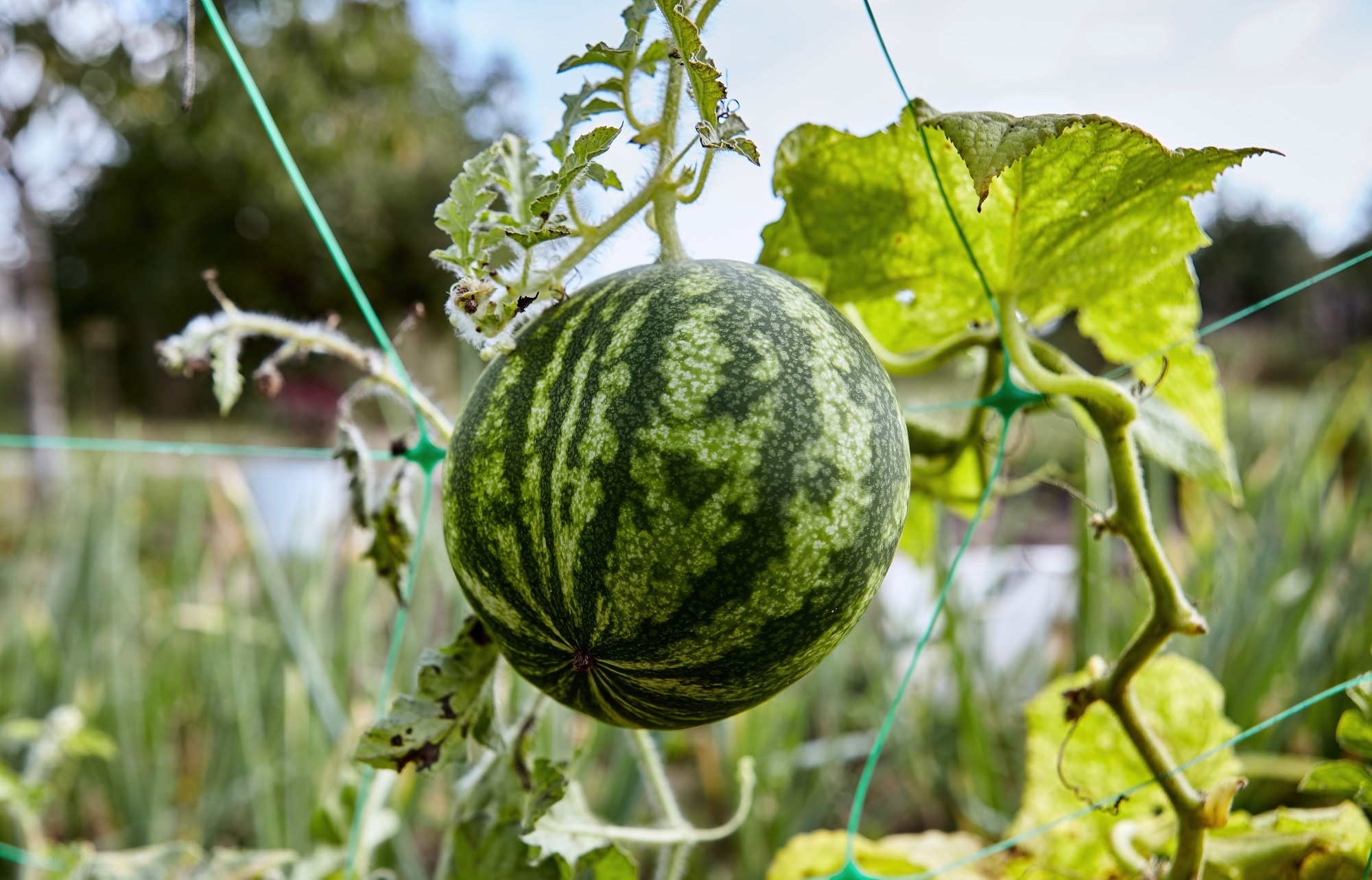 Study: Watermelon vine as dual-functional additive in ecological porous concrete. Image Credit: Vital Hil/Shutterstock.com
Can Watermelon Vine Make Concrete More Plant-Friendly?
Ecological porous concrete (EPC) is valued for its interconnected pores enabling water permeability and plant root growth, beneficial in applications such as slope protection and permeable pavements. However, EPC faces a fundamental trade-off: increasing cement for strength reduces porosity and generates highly alkaline pore solutions (pH >11), inhibiting seed germination and vegetation establishment.
Traditional mitigations targeting either strength or alkalinity often add complexity or cost. The present study investigates watermelon vine (WV), an abundant agricultural byproduct, as a dual-functional additive intended to reinforce EPC physically and regulate its pore alkalinity chemically through intrinsic organic acids.
This novel approach aims to advance a sustainable construction material blending durability with environmental compatibility.
Nonetheless, quantitative validations of these chemical effects and multi-objective optimizations remain sparse. Watermelon vine, rich in cellulose fibers and organic acids including citric, malic, and oxalic acids, was hypothesized to function both as micro-reinforcement and a chemical mediator reducing pore solution pH through acid–base reactions.
Turning Agricultural Waste Into Porous Concrete
Materials included Portland cement, Class I fly ash, several coarse aggregate size fractions, and watermelon vine residues prepared in 10–20 mm dried segments to preserve organic acids.
The organic acid contents were quantified by HPLC, confirming citric acid as most abundant, followed by malic and oxalic acids. Orthogonal array experiments studied four factors: aggregate size, fly ash content, water-to-binder ratio (w/b), and WV content at three levels each, followed by response surface methodology (RSM) based on a Box–Behnken design to develop predictive models.
Mixtures were prepared with sequential dry mixing, partial water addition, and aggregate incorporation. Key responses measured included compressive strength at 28 days, effective porosity, and pore solution pH after 14 days. Microstructural analysis utilized SEM to observe hydration products and fiber-matrix interactions.
Plant germination trials with drought-tolerant species evaluated functional compatibility. The multi-objective optimization applied entropy-weighted TOPSIS combining strength, porosity, and pH metrics.
Watermelon Vine Concrete Reaches pH 7.6
The results of this study demonstrate that incorporating watermelon vine (WV) as an additive in ecological porous concrete (EPC) effectively addresses the critical trade-off among strength, porosity, and alkalinity.
Orthogonal experiments indicated that the water-to-binder (w/b) ratio is the principal factor influencing compressive strength, with lower ratios (0.26) yielding the highest strength due to a denser cement matrix.
Fly ash content primarily governs effective porosity, as its pozzolanic action and filler effects reduce porosity by up to 31.4%. Importantly, WV content emerged as the dominant factor controlling pore solution alkalinity, with an optimal dosage of 3 wt% reducing pH from above 11 to near-neutral 7.6 within 14 days.
This alkalinity reduction is attributed to acid-base neutralization between WV-derived organic acids, including citric, malic, and particularly oxalic acid, and cementitious calcium hydroxide.
Oxalic acid’s strong calcium chelation forms insoluble calcium oxalate crystals, as revealed by scanning electron microscopy, which appear densely packed in the interfacial transition zones, corroborating the in situ neutralization mechanism.
Download a free copy of this page here!
Response surface methodology and entropy-weighted TOPSIS optimization identified the best mix design: 16–20 mm aggregate, 20 wt% fly ash, w/b ratio of 0.26, and 3 wt% WV.
This mixture achieved a compressive strength of 10.4 MPa and an effective porosity of 27.7%, with strength stability maintained at 60 days, surpassing benchmarks for vegetation-supporting concrete.
Plant germination tests confirmed biological compatibility, showing over 80% vegetation coverage within 60 days for two drought-tolerant species. Interaction effects highlighted that the reinforcing function of WV fibers depends on matrix quality, necessitating a low w/b ratio to prevent strength reduction due to fiber aggregation or weak bonding.
Overall, WV acts as a dual-functional, low-cost, sustainable additive that enhances mechanical performance, regulates alkalinity, and promotes vegetative growth in EPC, making it a promising approach for ecological and structural applications in arid environments.
Could Plant-Based Concrete Support Greener Infrastructure?
The integration of watermelon vine as a micro-fiber and chemical additive could resolve the conventional EPC trade-off between strength, porosity, and alkalinity. The dual-functionality design achieved a mechanically competent, interconnected porous concrete with a pore environment conducive to plant growth.
This approach combines waste valorization, carbon sequestration potential, and cost-effectiveness, particularly suited for arid regions with water limitations.
Future work is recommended to definitively characterize precipitate phases, extend plant species trials, conduct long-term durability testing, and perform life-cycle environmental assessments, reinforcing the practical viability of WV-modified ecological porous concrete as a sustainable infrastructure material.
Journal Reference
Wang Y., Zhuang J., et al. (2026). Watermelon vine as dual-functional additive in ecological porous concrete. Scientific Reports. DOI: 10.1038/s41598-026-74981-8, https://www.nature.com/articles/s41598-026-74981-8.