A sky bridge is a structure that is physically supported and connected at least six floors above ground level between two or several separate buildings. It is often an enclosed space, with the path of travel under shelter. Sky bridges are installed between adjacent tall buildings to provide amenities such as swimming pools, sky gardens, and observation decks. Horizontal connectivity for pedestrians, enhanced fire safety, and improved structural performance under lateral loads owing to coupling effects are other notable advantages.1-4
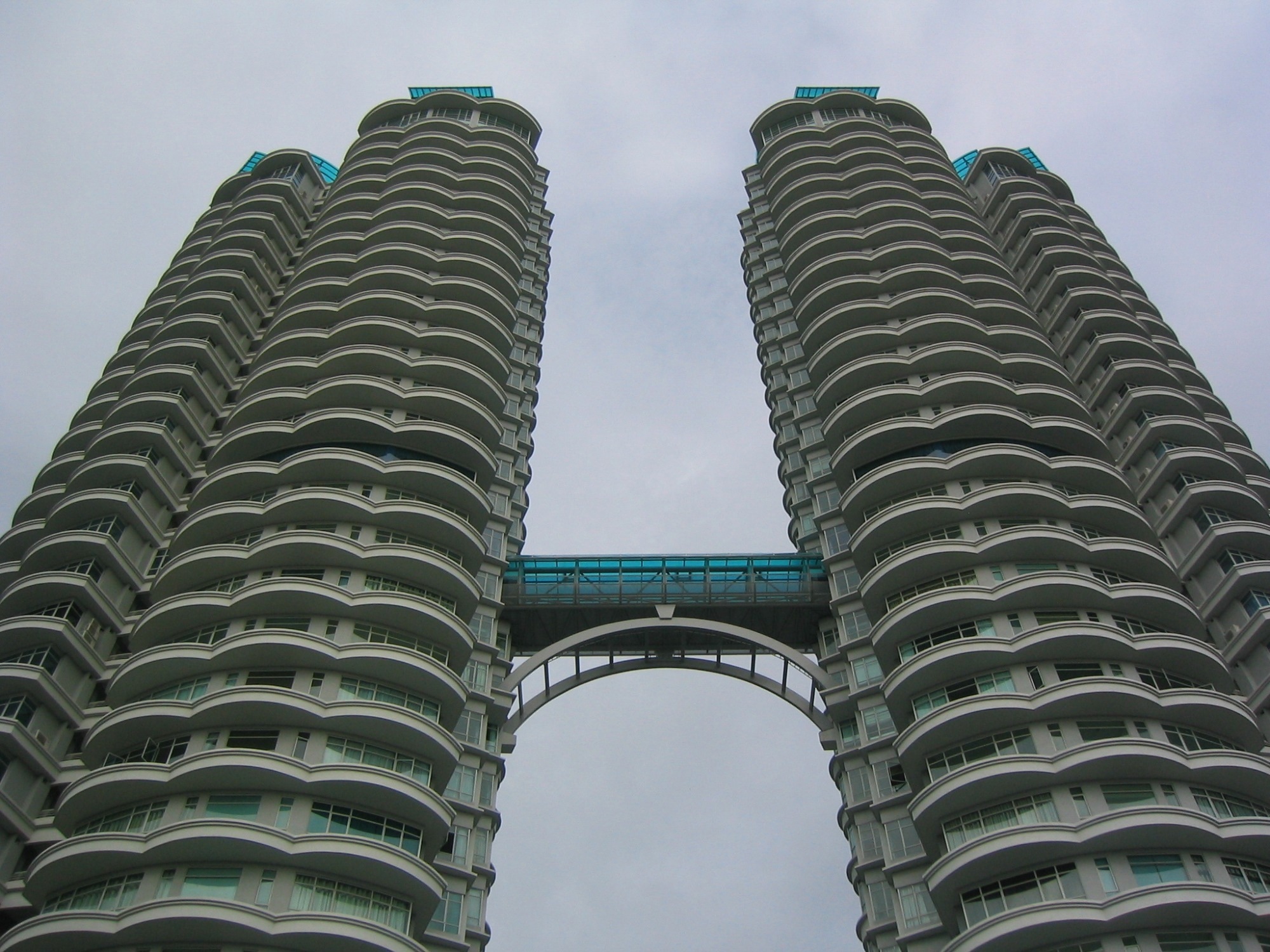 Image Credit: seanlean/Shutterstock
Typology of Sky Bridges
A paper published in Journal of Asian Architecture and Building Engineering examined the typological differences among sky bridges in Asian high-rise complexes using statistical analysis. The six identified types were open circulation (OC), open sky park (OS), open programmatic (OP), enclosed rooftop programmatic (ErP), enclosed circulation (EC), and enclosed programmatic (EP).2
Researchers verified the suitability of six proposed sky bridge types through the Kruskal–Wallis test and further confirmed differences in variable distribution using Dunn’s test and violin plots.2
The findings revealed that factors like completion year, sky bridge size, length-to-width ratio, and relative elevation varied significantly among the types. Additionally, open sky bridges were mainly found in tropical climates, whereas enclosed large-scale sky bridges were more common in office complexes in temperate regions.2
Some outlier cases were identified that differed from the typical characteristics of their categories. These cases were interpreted as pioneering examples that either demonstrated functional transformation or indicated possible future directions for sky bridge development.2
Structural Considerations of Sky Bridges
Structural behavior of buildings connected through sky bridges changes based on their mass, stiffness, locations, and connection configurations with the buildings, like roller, hinge, and rigid connections.3
Slider or roller connections enable skyscrapers to sway independently under lateral loading. Axially stiff sky bridges are hinge-connected to the skyscrapers, constraining them to sway in unison, while flexurally stiff sky bridges constrain the skyscrapers to deflect as a cantilever unit as they are rigid-connected to them.3
The structural system of a sky bridge is chosen based on the span to resist gravity loading and on the stiffness requirement when structural coupling between towers is required.3
Hinged joints are suitable when the sky bridge has sufficient axial stiffness and structural coupling is required to prevent pounding between closely located buildings and to improve damping or lateral performance. Sky bridges with less stiffness are roller-connected, enabling freedom for independent lateral twist and movement.3
Rigid connections are preferred where rigid joints are necessary for the stability of the sky bridge or when sky bridges consist of multiple stories with greater flexural stiffness. Determining the connection mechanism and investigating the dynamic performance are critical in the structural design of sky bridges.3
Representative Cases of Rigid Connections
An example of a rigidly connected tall building is the China Central Television Headquarters (CCTV) in Beijing, China. Its connecting bridge incorporated an integrated system of a cantilevering overhang linking the two towers using an external continuous diagrid tube system, where the diagonal braces express the pattern of forces visually in the structure.3
Another example is the Gate of the Orient in Suzhou, China, which incorporated a rigidly connected arch linking the top eight stories of the two towers. The 81-story Union Square residential skyscraper in Hong Kong comprises four towers designated Moon, Sun, Sky, and Star. Among them, the Moon and Sun towers are connected at the 69th story and above, forming the arch below.3
Hinge and Roller Connections
The Island Tower Sky Club in Fukuoka City, Japan, consists of three 42-story apartment building towers, with the towers having threefold rotational symmetry. These towers are linked at the 37th, 26th, and 15th stories by truss sky bridges with hinged joints.3
Additionally, the lower part of those buildings was designed as a single structural element with an uninterrupted foundation. Each of these towers has a core wall at the center of the plan with connecting beams and perimeter columns. Vibration-control dampers were used to connect the trusses to the towers, reducing the overturning response to lateral loads.3
The twin 88-story Petronas Towers in Kuala Lumpur, Malaysia, are a major example of a roller-connected sky bridge. A sky bridge connects the twin office towers at the 41st story, with the main bridge being a two-level steel frame with large columns and beams that connect to continuous girders.3
These girders are connected to the two towers via roller bearings, allowing the towers to twist or sway independently. The sky bridge has a two-hinged, inverted V-shaped arch supporting the bridge mid-span. Additionally, the key bridge girders have a rotational pin directly over the arch, allowing the bridge to rise and fall as the towers move closer or farther apart.3
Investigating Seismic Effect
A recently published paper examined the dynamic interaction between twin towers and sky bridges to elucidate how these components affect the buildings' seismic reactions by reviewing previous studies.4
Numerical analysis shows that link placement impacts structural response, with the top two floors displaying the best results. This indicates the importance of connected building system design.4
While the single tower experiences higher drift than the double tower, the twin tower shows much higher rigidity and shear. Numerical analysis and seismic tests validate the reliability of the connected super high-rise structure, providing critical insights for designing complex connected structures.4
Modal analysis of the twin towers showed complex vibration modes affected by podium coordination. On the upper floors, the twin towers experience greater shear forces due to the interaction created by the podium's increased rigidity.4
Sky bridge location and shear wall placement influence seismic performance. Displacement is reduced while base shear and stiffness increase when shear walls are added. Optimal performance is realized when a sky bridge is located at one-fourth of the building height and shear walls are placed on both sides.4
Structural Design Optimization
Rigidly connecting twin buildings with sky bridges results in altered mode shapes, higher stresses, greater drifts, and structural irregularities. Safer alternatives include flexible movement joints or connections. Horizontal and inclined sky bridges influence base shear, storey shear, and drift. The use of several sky bridges decreases displacement and exhibits directional influence.4
The optimal link location for 40- and 50-story structures, considering variations in displacement and shear, is between 0.6H and 0.8H, with an optimal width of 1.0B. Resonance effects are observed in 50-story buildings.4
Additionally, the diagrid structural system with dampers installed at mid-levels is more advantageous than alternative structural configurations, particularly in reducing drift and displacement.4
Base shear is highly impacted by twin towers with basements, with basement depth playing a crucial role. Structural geometry improves basement sustainability and affects dynamic analysis. Structural parameter identification in a real-world twin-tower heritage building can be effectively performed using a Bayesian model-updating method employing subset simulation optimization.4
Efficient lateral load resistance is essential in connected tall buildings. The combination of shear walls with linear viscous dampers reduces acceleration, displacement, and base shear. Design considerations are emphasized when twin towers are linked at specified spacing, as this affects base shear, displacement, and drift in medium- and high-rise structures.4
Importance of Sky Bridges
Sky bridges are structural links connecting two or more tall buildings above ground level, often providing enclosed pedestrian routes and additional functional spaces. They improve horizontal connectivity and enhance safety while also contributing to better structural performance under lateral loads through coupling effects.
Saving this for later? Download a PDF here.
Different connection types, including rigid, hinged, and roller systems, influence building movement, stiffness, and seismic response. Sky bridges also support functions such as sky gardens, swimming pools, and observation decks. Studies show that their placement and design significantly affect drift, shear, and overall stability of connected high-rise structures.
References and Further Reading
- Sky bridges of Significance [Online] Available at https://www.skyscrapercenter.com/skybridges (Accessed on 18 May 2026)
- Lee, D., & Park, C. (2022). Typology of skybridges in Asia. Journal of Asian Architecture and Building Engineering, 21(3), 663-676. DOI: 10.1080/13467581.2021.1941986, https://www.tandfonline.com/doi/full/10.1080/13467581.2021.1941986
- Kiriparan, B., Waduge, B., Fernando, W. J. B. S., & Mendis, P. (2019). Analysis and Design of Skybridges connecting Tall Buildings–A case study. Society of Structural Engineers, Sri Lanka. http://repo.lib.jfn.ac.lk/ujrr/handle/123456789/4232
- Arekar, V. A., Patel, V. B., M, D. D., Bhatt, P. M (2024). Seismic Effect of Multi-Tower Connected with Sky Bridge-A Review. https://www.researchgate.net/publication/379952670_Seismic_Effect_of_Multi-Tower_Connected_with_Sky_Bridge-A_Review
Disclaimer: The views expressed here are those of the author expressed in their private capacity and do not necessarily represent the views of AZoM.com Limited T/A AZoNetwork the owner and operator of this website. This disclaimer forms part of the Terms and conditions of use of this website.