Green roofs entered mainstream construction as thin mats of drought-tolerant sedum laid above waterproofing, and were primarily valued for insulation and modest runoff control. However, living roofs built today carry considerably heavier expectations, with designers treating the roof plane as a controlled water store, a wildlife habitat, and an electricity-generating surface at the same time. Careful measurements and research support this change in expectations.1
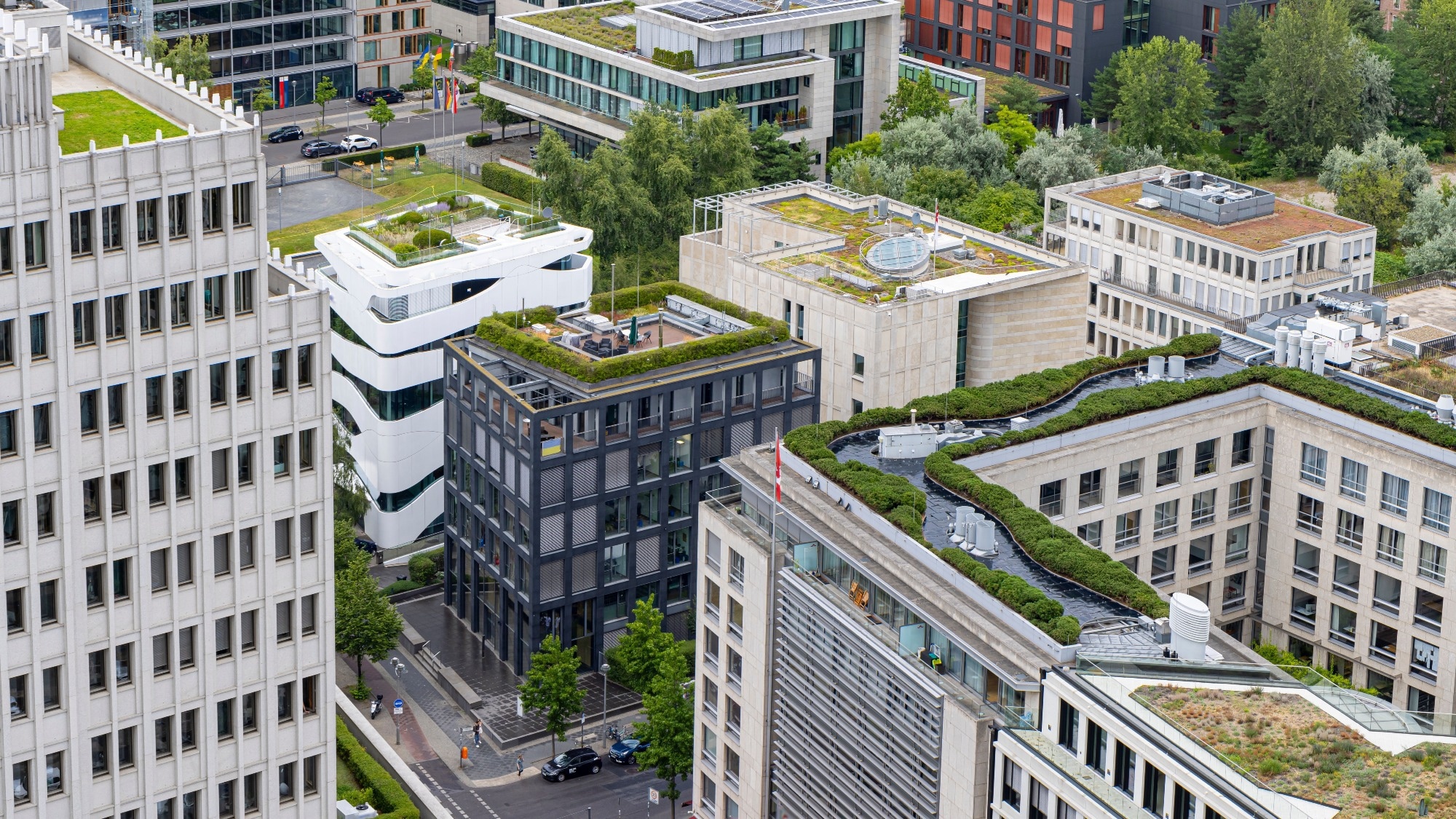
Image Credit: INTREEGUE Photography/Shutterstock
Green Roofs: The Fundamentals
Vegetated roofs have a rich history, with the Hanging Gardens of Babylon often cited as one of the earliest examples. In recent history, Germany has treated green roofing as part of its environmental strategy for decades, while uptake in Britain moved slowly until projects such as the Sheffield rooftop safaris.2
The construction of vegetated roofs follows a consistent process. A protective board covers the existing deck, and a waterproof membrane of rubbery ethylene-propylene-diene monomer blocks rainwater and roots. Next, an optional insulation layer sits above that, and filter, drainage, and retention layers spread water evenly while keeping the growing medium from washing out.3
Vegetated roofs fall into two main categories, differentiated by depth. Extensive roofs carry a thin growing medium of porous material blended with soil, suited to shallow-rooted sedum, mosses, and delosperma that tolerate dry conditions. In contrast, intensive roofs have a deeper soil layer, so grasses, shrubs, and small trees with stronger root systems become viable choices.3
Green roofs come with a variety of benefits; planting slows heavy downpours, cools the surrounding air, captures airborne pollutants, and adds insulation that trims heating bills.
As extensions of green roofs, brown and biodiverse roofs push habitat value further by using sand, stones, and species chosen to draw rare birds, butterflies, and insects displaced by urban development.3
Blue-Green Roofs and Controlled Storage
A blue-green roof adds a deliberate water storage layer beneath the growing medium. Water sits in the void and rises into the substrate through
capillary action, feeding plants during long dry weeks. An outlet valve controls release, so the roof holds its volume while the downstream drainage network still carries an earlier surge.4
In a pilot project, researchers from Hafen City University Hamburg tested four full-scale blue-green roof types built in 2015 and tracked their behavior from 2017 through 2023 with hydrologic monitoring equipment. The roofs retained 64–74% of precipitation across that period, and summer outflow was almost absent. Individual heavy rain events produced low outflow intensity and long detention times.1
Forecast-linked operation pushes the concept considerably further. In an Amsterdam modeling study, roofs that drained ahead of predicted downpours captured 70–97% of rainfall exceeding 20 mm/hour. A conventional green roof captured 12% of the same extreme rainfall, and a permanently closed valve reached 59%.4
Stormwater Management in Dense Cities
A monitored multilayer roof in Palermo, Italy shows how these layered assemblies behave under semi-arid Mediterranean conditions across a full year of rainfall. Average daily retention reached roughly 77%; peak flow dropped by about 80%; total runoff volume fell by 61%; and the resulting hydrograph arrived about four hours later.5
Delay carries real engineering value for a city. Municipal sewers can become overloaded when many hard urban surfaces discharge simultaneously during a single cloudburst. Roofs that stagger their release spread that load across several hours and lower the peak flow that pipes and pumps must handle. Nearly half of the monitored rainfall events produced no measurable runoff.5
Total coverage determines whether individual roofs change catchment behavior. Suitable flat roofs occupy about 13.3% of the area of Amsterdam catchments prone to pluvial flooding. Converting them at an 84% capture ratio would intercept close to 11% of the rainfall landing on those flood-prone catchments.4
Biodiversity-Focused Installations
Recent research from the University of Technology Sydney compared two identical Sydney office buildings: one with a green roof and the other with a bare membrane. The green roof supported four times as many bird species and over seven times as many arthropod species, including spiders and millipedes.6,7
The survey combined motion-sensing cameras with environmental DNA sampling of water running off both roofs; DNA traces registered algae, fungi, and visiting birds that went unrecorded by the cameras. Blue-banded bees and metallic shield bugs appeared among the residents, indicating genuine foraging value on the planted surface.
The choice of native and introduced grasses, along with diverse flowering species, ensures year-round availability of nectar and pollen, enhancing habitat quality and attracting a wider range of resident invertebrates.6,7
Standing water changes which species persist over years. On the Hamburg roofs holding rainwater permanently, plant composition shifted across the monitoring period and overall diversity increased. Steady moisture sustains species that shallow dry substrates cannot support, so the hydrological layer performs ecological work as well.1
Substrate Design as an Ecological Decision
Substrate composition decides long-term vegetation outcomes. A recent Ecological Engineering study ran 45 plots on an experimental blue-green roof at Wageningen and surveyed them eight times between 2013 and 2021, comparing lightweight mineral mixes, locally collected soil, plain gravel, and a standard sedum blend. Local soil plots averaged 11.8 plant species per square meter.8
Gravel plots, which serve as a substitute for conventional roofing, averaged 4.8 species and 8.9% plant cover. Unfertilized mixes containing 20% or less dense organic material never achieved a closed vegetation cover across the nine survey years. Richer mixes closed fully within two or three growing seasons after construction.8
For future living roofs, the authors recommend a 60 mm substrate containing 30% locally collected soil and 70% lightweight material, such as pumice, in their region. Higher organic fractions increase dead load and raise the risk of nutrient leaching into runoff, so the workable design range is fairly narrow.8
Integrated Solar-Green Roof Systems
Photovoltaic panels lose efficiency as they warm past 25 °C, which makes hot roof surfaces expensive over a summer. Vegetation beneath the array cools surrounding air through evapotranspiration. On the Sydney biosolar roof, panel surface temperatures fell by up to 9.63 °C and roof surface temperatures by up to 6.93 °C.6
The cooling effect directly contributed to energy generation. Maximum panel output rose by 21% to 107% depending on the month, with average peak temperatures around 8 °C lower than on the bare comparison roof. Performance modeling for central Sydney indicated 4.5% additional electricity at any given light level.6
Plants also influenced panel performance. Panels covered 40% of the planted area, and growth was fastest and healthiest immediately around their supports. Baby sun rose spread widely across the shaded ground despite low planting density, so panel shade created a distinct microhabitat with dense living cover.6
Structural and Maintenance Realities
These systems place clear demands on building structure. Stored water weighs about 1 kg/L, so an 11 cm retention void adds considerable dead load beyond a thin extensive assembly. Waterproofing detail, root barriers, and safe access for valve servicing belong in early coordination meetings between disciplines.8
In practice, ongoing maintenance is relatively light. For instance, the Wageningen roof required only the annual removal of tree saplings and nothing further across nine years of survey work. However, automated valves and moisture sensors introduce components that require periodic calibration, and forecast-driven control relies on a reliable data feed from a meteorological service.4
Where Living Roofs Are Heading Next
Performance figures are not easily transferable between different cities. Mediterranean retention values reflect long dry spells punctuated by intense bursts, while northern German values reflect steady rainfall spread through the year. Local monitoring supplies the site-specific evidence that planning authorities, drainage engineers, and insurers increasingly ask project designers to produce.1
Building with living roofs pays off through combination. A single assembly detains a storm for hours, cools a solar array through the afternoon, and shelters pollinators on ground that once served only as weather cover. Each of those functions is now quantified, which turns the roof into a deliberate engineering asset.6
References and Further Reading
- Richter, M., and Dickhaut, W. (2023). Long-Term Performance of Blue-Green Roof Systems - Results of a Building-Scale Monitoring Study in Hamburg, Germany. Water, 15(15). DOI:10.3390/w15152806. https://www.mdpi.com/2073-4441/15/15/2806.
- Richardson, J. (2026). Green Roofs in the UK: A Complete Guide for 2026. [Online] The Renewable Energy Hub UK. Available at: https://www.renewableenergyhub.co.uk/main/green-roof-information.
- Richardson, J. (2026). How do Green Roofs Work? [Online] The Renewable Energy Hub UK. Available at: https://www.renewableenergyhub.co.uk/main/green-roof-information/how-do-green-roofs-work.
- Busker, T. et al. (2022). Blue-green roofs with forecast-based operation to reduce the impact of weather extremes. Journal of Environmental Management. 301. 113750. DOI:10.1016/j.jenvman.2021.113750. https://www.sciencedirect.com/science/article/pii/S0301479721018120.
- Pumo, D. et al. (2023). The potential of multilayer green roofs for stormwater management in urban area under semi-arid Mediterranean climate conditions. Journal of Environmental Management. 326. 116643. DOI:10.1016/j.jenvman.2022.116643. https://www.sciencedirect.com/science/article/pii/S0301479722022162.
- Irga, P. J. et al. (2023). A green roof or rooftop solar? You can combine them in a biosolar roof, boosting both biodiversity and power output. [Online] The Conversation. Available at: https://theconversation.com/a-green-roof-or-rooftop-solar-you-can-combine-them-in-a-biosolar-roof-boosting-both-biodiversity-and-power-output-211347
- Irga, P., et al. Green Roof & Solar Array – Comparative Research Project. Final Report. (2021). University of Technology Sydney. https://opus.lib.uts.edu.au/bitstream/10453/150142/2/City%20of%20Sydney%20Final%20Report%20EPI%20R3%20201920005.pdf.
- Van der Kolk, H. et al. (2022). Substrate composition impacts long-term vegetation development on blue-green roofs: Insights from an experimental roof and greenhouse study. Ecological Engineering. 186. 106847. DOI:10.1016/j.ecoleng.2022.106847. https://www.sciencedirect.com/science/article/pii/S0925857422003081.
Disclaimer: The views expressed here are those of the author expressed in their private capacity and do not necessarily represent the views of AZoM.com Limited T/A AZoNetwork the owner and operator of this website. This disclaimer forms part of the Terms and conditions of use of this website.