*Important notice: This news reports on an unedited version of an accepted paper and is awaiting final editing. Therefore, the paper should not be regarded as conclusive or treated as established information.
A technique borrowed from the bakery could help make concrete tougher and better insulated. Researchers have created a “puff pastry-inspired” cement by repeatedly rolling and folding it into thin layers, producing a material that resists cracking far better than conventional cement while dramatically slowing heat transfer.
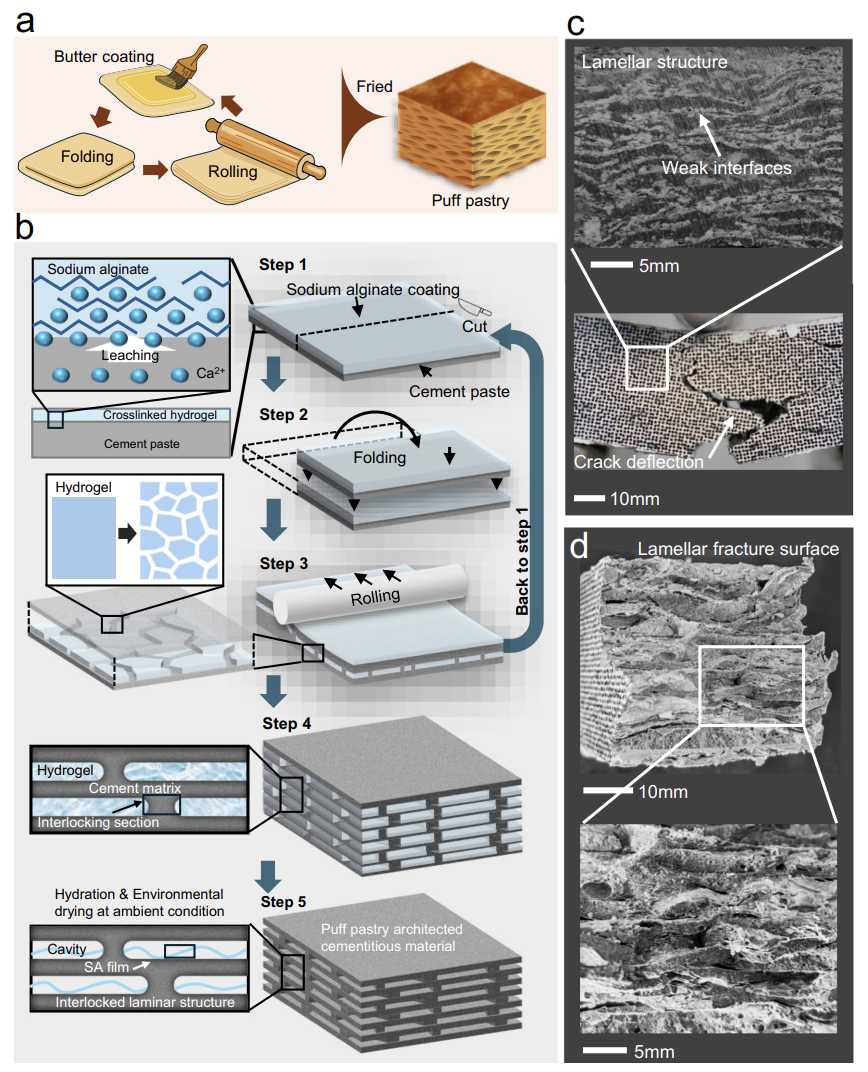
Fabrication and fracture feature of puff pastry architected cementitious material (PPAC). a. Schematic illustration of puff pastry fabrication process. Traditional preparation process involves repeated steps such as coating butter, folding, and rolling, followed by frying to produce the final puff pastry. b. Schematic illustration of rolling-folding method to manufacture PPAC. The process involves repeated cycles of coating with sodium alginate, folding, and rolling, followed by drying and hardening to form PPAC. c. Lamellar weak interfaces observed from the side of the PPAC specimen and crack deflection behavior observed in PPAC specimen during 3-point bending (3PB) test. d. Fracture surface with lamellar structure exhibited. Image Credit: Xia K., Chen Y., et al.
The researchers’ simple approach delivered up to a 20-fold improvement in specific fracture toughness and cut thermal conductivity by more than two-thirds, potentially opening a scalable route to safer, more energy-efficient buildings and infrastructure.
Pastry-Inspired Cement Architecture
Conventional cementitious materials, while fundamental to modern construction, inherently suffer from low toughness and poor energy dissipation, leading to unstable crack propagation and brittle failure under stress from events like earthquakes or impacts.
Current toughening methods using steel, fibers, or polymers provide only modest improvements, and concrete's poor thermal insulation requires energy-intensive HVAC systems, increasing carbon emissions. While lightweight foamed concrete can improve insulation, it often compromises mechanical performance.
Architected materials and bio-inspired designs have shown promise in enhancing properties, but their complex, energy-intensive fabrication, often involving methods such as 3D printing or ice-templating, severely limits scalability and large-scale implementation. This created a critical need for architected cementitious materials that could be produced efficiently under mild conditions.
Rolling-Folding Fabrication and Analysis
The groundbreaking "puff pastry-inspired" fabrication strategy for PPAC draws directly from food engineering, specifically the repetitive folding and rolling technique used to create the distinct layers of puff pastry. Researchers adapted this method to engineer a lamellar structure in cement.
The process begins with preparing a cement paste made with P·O 42.5 Portland cement, tap water, and hydroxypropyl methylcellulose (HPMC), which imparts crucial dough-like plasticity during the fresh stage. This plastic cement paste is then rolled to a uniform thickness of approximately 20 millimeters.
A key element in preventing adhesion between subsequent cement layers, akin to butter in actual puff pastry, is a sodium alginate (SA) solution. This SA solution is uniformly applied to the surface of the rolled cement paste. Sodium alginate, a low-cost, non-toxic bio-extracted polysaccharide, rapidly cross-links with calcium ions abundantly released from the fresh cement surface.
After SA application, the cement paste is cut in half, the two portions are carefully stacked, and the combined material is re-rolled to the same initial thickness. This cycle is repeated for a desired number of iterations. In this study, up to seven rolling-folding cycles were successfully performed within around 30 minutes without compromising the material’s integrity.
As the material undergoes repeated rolling and elongational deformation, the alginate-based hydrogel layer fractures due to its limited deformability. This controlled fracturing creates discrete regions that allow mechanical interlocking between adjacent cement layers. This is vital for maintaining the overall structural integrity of the final material while preserving the weak interfaces.
Under ambient drying conditions and water absorption by the cement paste, these hydrogel lamellae gradually dry out, transform into thin films, and ultimately form a structure punctuated by discrete, plate-like cavities.
Superior Toughness and Thermal Insulation
The rolling-folding fabrication process yields a lamellar cementitious architected material with a highly ordered internal structure of alternating parallel cement lamellae and discrete plate-like cavities. This architected design fundamentally alters the material's failure mechanisms.
Unlike the brittle fracture typical of conventional cement, PPAC exhibits ductile fracture behavior, with cracks deflecting along the weak interfaces introduced by the dried alginate hydrogel films. This crack deflection and the resulting mechanical interlocking between layers significantly enhance the material's resistance to crack propagation, leading to a remarkable increase in fracture toughness.
The specific fracture toughness of PPAC reaches up to 91 MPa·mm0.5/g·cm3, representing an approximate 20-fold improvement over its cast counterpart and even surpassing conventional reinforced cementitious composites, approaching the toughness levels of certain polymers and advanced technical ceramics. Importantly, these mechanical enhancements are achieved while maintaining a specific flexural strength comparable to conventional cast cementitious materials.
Beyond its exceptional mechanical performance, the lamellar architecture of PPAC also provides substantial thermal insulation. The discrete, plate-like cavities formed within the structure act as effective thermal barriers, significantly reducing heat transfer.
The thermal conductivity of PPAC decreases to 0.38 W/m·K, which is a substantial 68.3% reduction compared to cast cement paste. This performance outperforms lightweight cementitious materials with comparable densities, offering superior thermal management without compromising structural integrity.
A particularly crucial aspect highlighted in the results is the material’s manufacturing efficiency, scalability, and geometric adaptability, directly attributable to the simplicity of the rolling-folding process. The ability to complete the entire fabrication under ambient conditions, with multiple folding cycles in a short timeframe (e.g., seven cycles in 30 minutes), demonstrates high production efficiency.
Advancing Resilient Infrastructure Materials
The puff pastry-inspired architected cementitious material (PPAC) simultaneously achieves outstanding specific fracture toughness and excellent thermal insulation through a simple, scalable rolling-folding process.
Fabricated under ambient conditions and demonstrating remarkable efficiency and formability, this method addresses the complexity and scalability limitations that have hindered the implementation of previously architected cementitious materials.
This multifunctionality, combined with its facile production, positions PPAC as a highly promising material for developing next-generation resilient and energy-efficient infrastructure, ultimately enhancing both safety and environmental sustainability in construction.
Journal Reference
Xia K., Chen Y., et al. (2026). Tough, thermal insulating and scalable puff pastry-inspired architected cementitious material via simple rolling-folding. Nature Communications. DOI: 10.1038/s41467-026-77120-z, https://www.nature.com/articles/s41467-026-77120-z