Precast concrete infrastructure, including manholes, vaults, chambers, and box culverts, forms the backbone of modern utility, water, and wastewater networks. While the structural performance of these systems is well understood and heavily regulated, long term durability is often governed by a less visible factor: the integrity of joints, penetrations, and interfaces where water ingress begins.
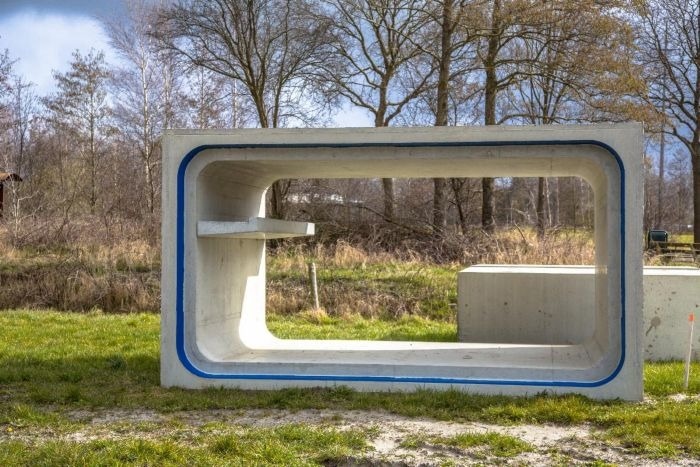 Visco-elastic sealing material installed along the joint of a precast concrete structure helps prevent water infiltration at critical interfaces. Because the material remains permanently flexible, it can accommodate joint movement and surface irregularities over time. Image Credit: Denso
When water infiltrates through joints, it does more than compromise watertightness. Over time, it accelerates corrosion of embedded steel components, degrades gaskets and coatings, introduces soil contaminants into controlled environments, and undermines the service life assumptions on which precast assets are specified. In applications that house critical valves, electrical infrastructure, fiber-optic connections, or sensitive mechanical equipment, even minor leakage can create outsized operational risk.
Traditional sealing methods such as rubber gaskets, bituminous mastics, or compression-based systems have long been used to address these vulnerabilities. However, as precast infrastructure expands into more aggressive soil conditions, variable climates, and retrofit scenarios, the limitations of these legacy approaches have become increasingly apparent.
Visco-Elastic Materials: A Different Sealing Mechanism
Denso’s visco-elastic sealants represent a fundamentally different approach to sealing precast concrete joints. Unlike purely elastic materials that rely on compression and rebound, or viscous materials that flow without shape retention, visco-elastic systems combine both behaviors in a single amorphous structure.
Precast structures rarely remain static over their operational life. Soil settlement, traffic loads, groundwater fluctuations, and temperature changes all impose movement at joints and interfaces. Traditional sealing systems often accommodate movement only within a narrow design envelope. Once exceeded, compression loss, tearing, or debonding can occur.
Visco-elastic sealants address this challenge differently. Because they remain flexible indefinitely and do not develop internal stresses during deformation, regular settlement and small joint movements are not failure mechanisms. The material conforms continuously without cracking, shrinking, or pulling away from the concrete surface.
This behavior is particularly advantageous in large precast assemblies and buried structures, where thermal expansion and soil interaction can be difficult to predict precisely during design. By eliminating reliance on rigid adhesion or compression preload, visco-elastic systems provide a more forgiving sealing solution under real world conditions.
Building on this behavior, new visco-elastic formulations are being developed specifically for moving and expansion joints in precast structures, where conventional seals often struggle to maintain watertight contact under repeated opening, closing, and differential movement.
Material Behavior and Interfacial Sealing Mechanisms in Visco-Elastic Systems
At the material level, visco-elastic sealants exhibit permanent flexibility while maintaining dimensional stability under sustained load. The viscous component enables continuous surface wetting, allowing the material to conform to surface roughness, voids, and any casting irregularities that are commonly present in concrete substrates. Simultaneously, the elastic component provides resistance to deformation, enabling the sealant to retain its geometry when subjected to compressive forces, hydrostatic pressure, or minor joint movement. Together, these behaviors allow the material to form a continuous, self-supporting seal without reliance on mechanical compression, chemical curing, or crosslinking reactions.
Visco-elastic sealants are entirely amorphous in structure. Rather than undergoing hardening, shrinkage, or embrittlement over time, they retain a homogeneous composition that remains in intimate contact with the substrate throughout their service life. This characteristic enables the seal to accommodate micro-movement, thermal expansion and contraction, and long term settlement without loss of continuity or adhesion.
A defining performance mechanism of visco-elastic sealants is adhesion through continuous molecular wetting rather than chemical bonding or mechanical interlock. The material remains in constant interfacial contact with the substrate, maintaining an extremely small separation distance that inhibits the migration of water molecules through microvoids, surface discontinuities, or interfacial defects.
This behavior is particularly relevant in precast applications, where surface condition can vary widely based on formwork, curing practices, age, and environmental exposure. Unlike sealing systems that require primers or stringent surface preparation to achieve adhesion, visco-elastic materials tolerate a broader range of surface conditions while maintaining full interfacial contact. Because the material does not cure or rigidize, it remains capable of localized redistribution in response to minor disturbances. Small indentations, displacement, or localized damage do not create permanent failure paths; instead, the material flows on a microscopic scale to reestablish continuity, preserving seal integrity over time - a phenomenon commonly characterized as self-sealing or self-repairing behavior.
Managing Chemical Exposure and Installation Constraints in Precast Structures
In many precast applications, sealing systems are exposed not only to water but to aggressive soil chemistries, variable pH levels, and contaminants carried by groundwater. Chemical resistance is therefore a critical performance criterion. Denso’s isco-elastic sealants exhibit excellent resistance to a wide range of chemical exposures, including acidic and alkaline environments. Because they contain no solvents, curing agents, or low molecular weight fractions, they do not leach harmful substances into surrounding soils or water systems. In many cases, a single layer of visco-elastic material is sufficient to achieve long-term sealing performance, simplifying installation compared to multi-component systems. This makes them particularly well suited for use in confined spaces and environmentally sensitive applications.
Preventing water infiltration also plays a direct role in environmental protection. By maintaining watertight integrity, visco-elastic sealing systems help prevent the migration of contaminants into soil and groundwater while protecting internal infrastructure from corrosion related failures.
From an installation standpoint, visco-elastic sealants offer notable advantages in both new construction and rehabilitation scenarios. In new precast assemblies, they can be applied directly at joints without primers and with minimal sensitivity to weather or humidity conditions. In existing structures, where concrete surfaces may be aged, porous, or irregular, visco-elastic systems remain effective with appropriate surface preparation. For internal sealing, caulkable visco-elastic formulations can be used in combination with mechanical barriers such as cementitious grouts. For external applications, wrap-based systems allow sealing and protection without dismantling the structure.
In practice, caulkable solutions such as Denso’s ViscoSealant visco-elastic sealant can be placed into small crevices or irregular transitions on the inside of a structure, while wrap-based systems such as Denso’s ViscoWrap visco-elastic coatings are applied externally to aged or porous concrete surfaces to control water infiltration without excavation or disassembly.
Visco-elastic materials are available in multiple formats such as mastics, tapes, and wraps, allowing engineers and contractors to select the appropriate configuration for complex geometries, tight access conditions, and irregular joint profiles.
For example, high-temperature, heavy-load conditions can be addressed with rigid XHT mastic formulations, while softer, more conformable sealants are chosen for tight or intricate precast joints.
Engineering Confidence Through Proven Performance
While visco-elastic sealing may be relatively new to some segments of the precast market, the underlying technology has been extensively tested and deployed in demanding applications, including high-pressure gas pipelines and other critical infrastructure exposed to aggressive environments over decades of service.
Denso has played a significant role in advancing visco-elastic technology through its Viscotaq™ product line. Drawing on decades of material testing, field trials, and third party validation, these systems have been engineered to meet the performance requirements of diverse precast structures, including manholes, box culverts, chambers, and underground vaults. Extensive testing, both in-house and externally, has been conducted to confirm compliance with evolving industry standards and long term durability expectations.
Within this broader category, new visco-elastic formulations have also been developed to address specific sealing challenges common in precast infrastructure, such as pipe penetrations, conduit entries, and active water intrusion. Caulkable compounds such as ViscoSeal WaterStop S are designed to stop active water leaks while remaining permanently visco-elastic. Because the material never cures or hardens, it maintains continuous conformability around pipes, cables, and irregular penetration geometries, allowing the seal to remain intact even as minor movement occurs. In addition, controlled swelling characteristics enable the material to expand slightly in the presence of water, helping close micro pathways and reinforce watertight performance over time.
Denso’s visco-elastic technology portfolio also includes both swellable and non-swellable mastic materials engineered to maintain interdimensional stability within complex joint environments. Unlike conventional sealing systems that rely solely on compression or rigid adhesion, these materials maintain dimensional integrity while continuously wetting and conforming to surrounding surfaces. Their performance characteristics also align with recognized industry specifications, including ASTM C990, the standard specification governing flexible joint sealants used in concrete pipe, manholes, and precast box sections, providing engineers and specifiers with a familiar framework for evaluating long-term watertight sealing performance.
Beyond precast applications, the same visco-elastic principles have been validated over decades in corrosion control for pipelines and infrastructure operating under far more severe mechanical and chemical stress, providing a strong performance pedigree for their use in concrete sealing applications.
Expanding the Role of Visco-Elastic Sealing
As precast infrastructure continues to age and new projects are developed in increasingly challenging environments, sealing systems will be expected to do more than simply close a joint at installation. Long term adaptability, environmental compatibility, and resilience under movement will define the next generation of performance expectations.
Denso’s ongoing development efforts are focused on expanding visco-elastic technology to address broader surface sealing challenges, including sealing entire exterior surfaces of aged, porous concrete to mitigate water infiltration through the concrete matrix itself. New product concepts, some currently under patent review, aim to simplify large-scale rehabilitation while maintaining the same core principles of molecular wetting, permanent flexibility, and long term reliability.
For engineers, asset owners, and specifiers evaluating sealing strategies for precast systems, visco-elastic materials offer a compelling combination of material science and practical performance that aligns closely with the durability demands of modern infrastructure.