Construction sites are some of the world’s most hazardous workplaces. According to the U.S. Occupational Safety and Health Administration, falls, electrocutions, struck-by incidents, and caught-in/between incidents, collectively called the "Fatal Four," account for a large share of construction fatalities each year.1
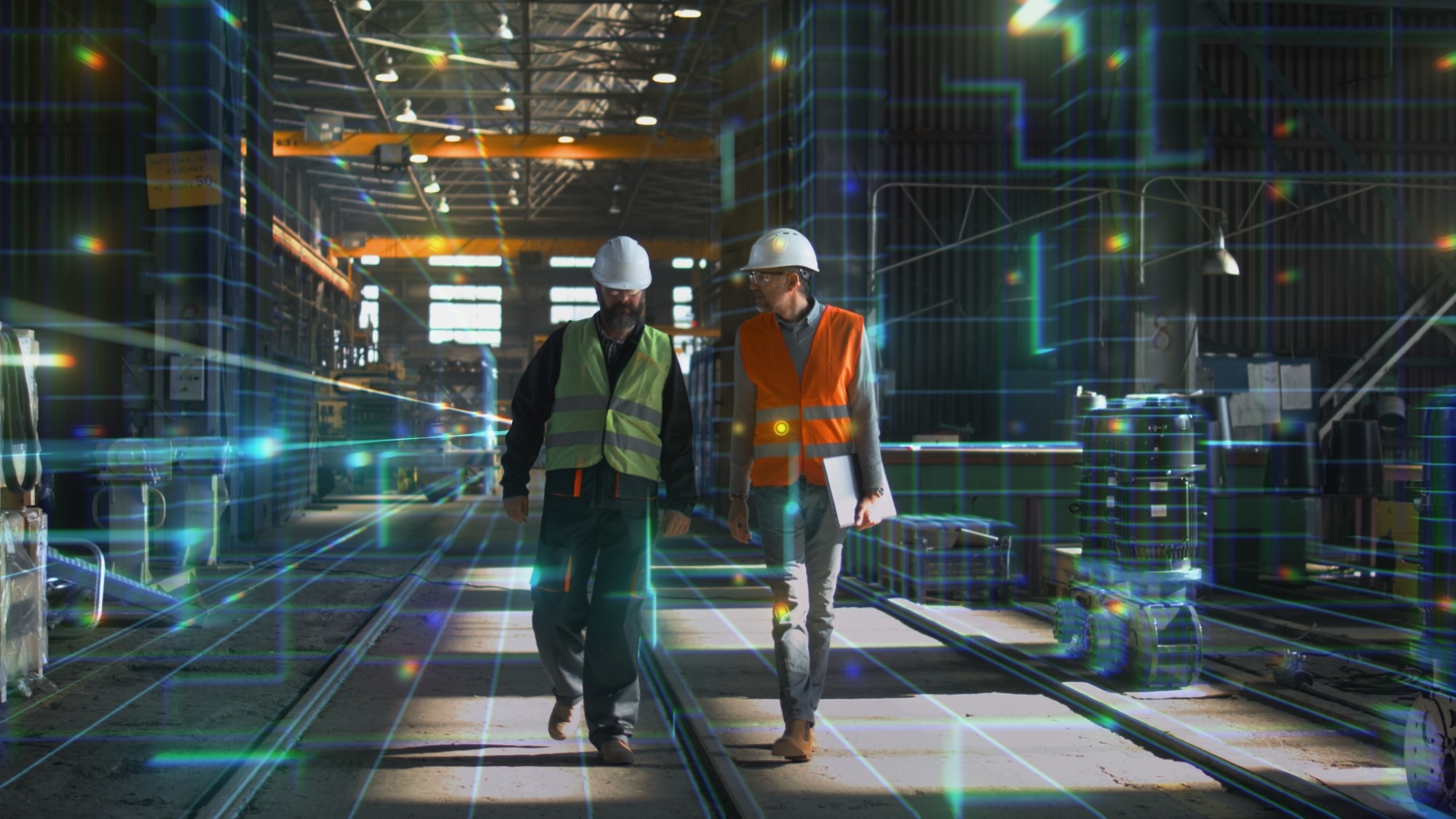
Image Credit: Frame Stock Footage/Shutterstock.com
The introduction of augmented reality (AR) helmets is enhancing worker safety. These helmets increase workers' awareness of their surroundings, help them perform tasks safely, and improve their interaction with project data.1,8
Fundamentals of AR Helmets
An AR helmet resembles a standard hard hat but includes a transparent visor display, onboard processors, cameras, and connectivity options. Unlike regular hard hats that only protect the head, an AR helmet actively streams context-aware information into the worker's field of view. The visor functions as a heads-up display, overlaying digital content onto the real world without obstructing vision.2,3
Using multiple sensors together, such as cameras and motion data, provides more stable tracking, making multi-sensor helmets a key focus in recent industrial research.2
Saving this for later? Download now.
AR and Building Information Modeling
AR helmets enhance construction by integrating with building information modeling (BIM). BIM provides data-rich digital models that encode geometry, materials, structural specifications, and scheduling information.3,4
Workers can overlay these models directly onto the physical site, aligning the as-designed version with the as-built conditions in real time. When a worker looks at a concrete wall through the helmet's visor, the embedded plumbing or electrical conduit appears as a digital overlay, precisely drawn from the BIM data.3,4
This ability reduces costly rework. On-site application of AR-BIM systems enables early detection of clashes between structural and mechanical systems, such as a beam conflicting with a duct route, before any physical work begins in that zone.
For mechanical, electrical, and plumbing coordination, this type of real-time visual alignment has measurable effects on installation accuracy and project timelines.4
Precision and Task Performance
Recent research confirms that AR helmets improve measurable task outcomes, not only situational awareness. A study published in the ASCE Journal of Construction Engineering and Management evaluated AR head-mounted display devices during full-scale MEP assembly tasks, comparing AR models at different levels of detail against traditional paper plans.5
Workers using high-detail AR models completed tasks faster and produced significantly lower rework rates than those working from paper drawings. The effect was especially pronounced among novice workers, with error rates dropping substantially.5
A separate study focused on AR-assisted fastening in timber construction reported a mean position error of just 2.1 mm and an orientation error of 2 ° in screwing tasks, and 2.7 mm and 3.1 ° in nailing tasks, all within compliance standards. These numbers illustrate that AR guidance translates into genuine precision gains on the job, not just a visual aid.6
Hazard Detection and Safety Awareness
AR helmets work on construction sites by visualizing hazard zones that are not visible to the naked eye. Electrical hazard boundaries, restricted zones near active equipment, and fall-risk edges can all be marked as digital overlays and updated in real time.7
This dynamic approach bridges the gap between training and real-life situations. Workers do not have to remember complex safety information. As conditions change, the helmet automatically updates the hazard zones, making the work environment safer and more efficient.1,7
A study published in the Journal of Construction Engineering and Management examined how head-mounted AR devices affect hazard identification under varying environmental conditions. In simpler, low-stress settings, AR enhanced hazard detection compared to unaided observation.8
However, the study also found that in highly complex and fast-paced environments, the cognitive load imposed by AR displays could reduce hazard identification performance. This finding reinforces the importance of task-specific AR design, in which the information density presented to a worker is calibrated to the complexity of the task at hand.8
Immersive Safety Training
Traditional safety training depends on classroom instruction and static diagrams, formats that fail to simulate real site conditions. AR helmets change the training model by placing workers in simulated scenarios that look and feel like actual job sites.1
A worker can practice scaffold assembly, lockout/tagout procedures, and emergency evacuations in a controlled AR environment before ever setting foot in a live hazardous zone. This experiential approach improves knowledge retention and builds decision-making skills relevant to unpredictable site conditions.1
AR training programs are also flexible. When safety protocols change, the AR content updates digitally, removing the need to reprint manuals or schedule fresh classroom sessions. Workers in the field can access updated training during project mobilization. This reduces the logistical burden that typically delays safety re-training after regulatory updates.1
Smart Helmet Vision Systems
Smart safety helmets are now being used in industrial infrastructure inspections. These helmets are equipped with advanced Visual Simultaneous Localization and Mapping (VSLAM) systems. With VSLAM, a camera mounted on the helmet can create maps of the environment while also tracking the wearer's location.2
This technology, initially developed for robotics, can produce a real-time 3D map of a construction site as the worker walks through it. It also records important inspection data, photos, and measurements linked to specific locations.2
Helmet-mounted camera systems fall into three categories: monocular, stereo, and omnidirectional. Stereo systems use two cameras to measure depth, providing high accuracy for tasks such as measuring crack widths or checking structural clearances.
Omnidirectional systems capture a full 360-degree view, which helps prevent tracking failures. They also allow remote experts to see the entire area rather than just the worker’s viewpoint.2
Each camera setup has trade-offs related to weight, processing power, and accuracy. Choosing the right system depends on the specific needs of the inspection task at hand.2
BIM-Based Hazard Warning Systems
Scientists have developed AR helmets that combine BIM positioning with safety warning functions to enhance safety at construction sites. These helmets use BIM and site CAD maps together with a modified Kalman filtering algorithm to generate precise 3D location data for each worker.
The helmet sends this information to a central platform, which issues warnings when a worker gets too close to danger zones, even on different floors of a building.9
This approach converts the helmet from a passive display device into an active node in a broader site intelligence network. Supervisors gain a live view of worker positions mapped against BIM data, enabling faster response when a worker enters an unplanned zone.
When combined with gas sensors, proximity detectors, and emergency buttons, these systems create a continuous feedback loop between the physical site and digital management platforms.9
Challenges Ahead
Several barriers hinder the widespread use of AR helmets in construction. Significant hardware costs make it hard for smaller firms to justify implementation without clear data showing return on investment.
Ease of use is another critical factor: if the system overwhelms workers with too much information, it can hinder their work. The design must be simple and focus only on the data that matters for each job.1
Technical challenges such as battery life and processing power in harsh outdoor conditions still need to be addressed. Standardization across devices and integration with existing management software are also areas needing attention. How these issues are resolved will determine the future of AR helmets in the construction industry.2
References and Further Reading
- Azuruole, P. I. (2025). Augmented Reality (AR) for on-site hazard identification and worker training. World Journal of Advanced Research and Reviews, 25(03), 2246-2249. https://wjarr.com/sites/default/files/fulltext_pdf/WJARR-2025-0988.pdf
- Merchán-Cruz, E. A. et al. (2025). Smart Safety Helmets with Integrated Vision Systems for Industrial Infrastructure Inspection: A Comprehensive Review of VSLAM-Enabled Technologies. Sensors, 25(15). https://www.mdpi.com/1424-8220/25/15/4834
- Daqri’s AR smart helmet will be industry’s ‘interface to the Internet of Things’. Construction Management. https://constructionmanagement.co.uk/daqris-ar-sma6rt-helm7et-will-be-indu2strys/
- Fara, R. et al. (2025). Augmented Reality for On-Site Construction Coordination with BIM Integration. Engineering And Technology Journal, 10(10), 7324–7336. https://everant.org/index.php/etj/article/view/2261
- Chaudhari, R. et al. (2025). Exploring the Impact of Augmented Reality on Work Performance in a Full-Scale MEP Assembly Task: Study of Industry and Novice Populations. Journal of Construction Engineering and Management. https://ascelibrary.org/doi/abs/10.1061/JCEMD4.COENG-16726
- Fazel, A., & Adel, A. (2024). Enhancing construction accuracy, productivity, and safety with augmented reality for timber fastening. Automation in Construction, 166. https://collaborate.princeton.edu/en/publications/enhancing-construction-accuracy-productivity-and-safety-with-augm/
- AR in Safety and Compliance for Construction. (2025). AUGmentecture. https://www.augmentecture.com/blog/ar-in-safety-and-compliance-for-construction/
- Liu, J. et al. (2024). A Dualistic Perspective of Opportunity and Risk: The Impact of Head-Mounted Augmented Reality on Construction Onsite Hazard Identification of Workers. Journal of Construction Engineering and Management. https://ascelibrary.org/doi/abs/10.1061/JCEMD4.COENG-14684
- Wu, B. et al. (2023). Hazard Warning Design of Intelligent Safety Helmet Based on BIM Technology Joint Positioning. Atlantis Highlights in Engineering. https://www.atlantis-press.com/proceedings/icem-23/125995160
Disclaimer: The views expressed here are those of the author expressed in their private capacity and do not necessarily represent the views of AZoM.com Limited T/A AZoNetwork the owner and operator of this website. This disclaimer forms part of the Terms and conditions of use of this website.