How Do You Build with Mushrooms?
Transparent Aluminum Ceramics for Tough Windows
Self-Growing Biological Materials That Capture Carbon
Transparent Wood as a Glass Alternative
Conclusion
References and Further Reading
Using fungi, bacteria, and transparent wood for construction sounds like the work of science fiction. However, driven by the large volumes of waste produced by conventional construction materials and the environmental issues underpinning them, researchers are looking in the direction of such unusual materials. Some such materials have already found their place in laboratories, exhibitions, and product catalogs!
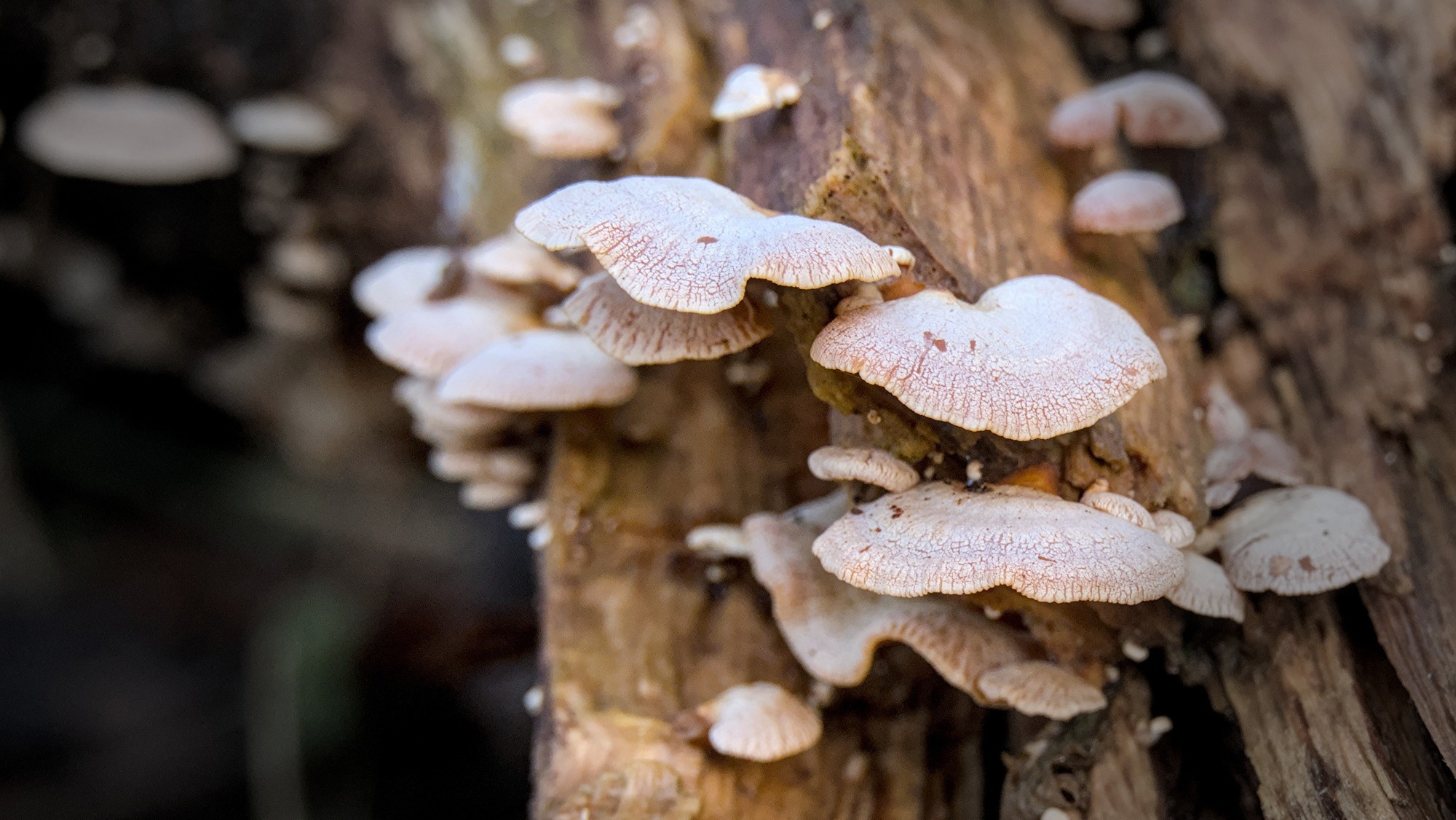
Image Credit: Brinja Schmidt/Shutterstock.com
This article explores mushroom-based composites, transparent aluminum ceramics, self-growing biological materials, and translucent wood, outlining how each is produced, its appeal, and how likely it is to become mainstream.1,2
How Do You Build with Mushrooms?
Building with mushrooms relies on mycelium, the root-like threads that a fungus spreads through soil and wood.
To begin, manufacturers source agricultural or forestry waste such as rice husks, sawdust, straw, or spent coffee grounds. They sterilize this substrate, inoculate it with a fungal species, and pack it into molds. The mycelium then grows through the particles, binding them into one solid piece that is dried and finished.3
The resulting mycelium-based composites are porous, lightweight, elastic, and inexpensive to produce, and their properties can be tuned by changing the fungal species or the substrate. Their main ingredients are low-value crop and timber residues, and the finished products biodegrade at the end of their service life.
Some versions have also shown encouraging fire performance, with composites grown on rice husks and coffee grounds displaying clear fire-retardant behavior.1,3
However, the same biological origin that makes mycelium appealing also creates its main weaknesses as a building material. The composites have limited compressive strength, readily absorb water, and can attract termites. Engineers also lack agreed mycelium-specific testing standards, so results vary between laboratories.
Commercial mycelium-based products therefore focus on interiors, with the Italian company Mogu selling acoustic panels made from mycelium and textile waste, while load-bearing mushroom walls remain experimental.3,4
Transparent Aluminum Ceramics for Tough Windows
The material popularly called transparent aluminum is aluminum oxynitride, also known as ALON, a ceramic composed of aluminum, oxygen, and nitrogen.
Download a free copy of this page here!
Producers prepare a high-purity powder, shape it into the desired form, and fire it at around 1880 oC. Conventional furnace cycles hold the temperature for six to 30 hours, allowing the tiny pores that scatter light to close, leaving a dense, glass-clear solid.5
Once fully dense, ALON transmits more than 80% of light across the ultraviolet-to-infrared range. A recent study published in the Journal of Advanced Ceramics reported a Vickers hardness of 19.6 GPa, several times that of ordinary window glass.5 This feature explains why ALON is commercially produced for transparent armor, protective domes, and infrared windows.
In buildings, it could provide scratch-resistant, impact-resistant glazing for high-security facilities or harsh, abrasive environments.2,5
High production costs keep ALON confined to defense and aerospace markets. Furthermore, long firing cycles consume a large amount of energy, and each piece requires careful polishing. To address these methodological limitations, researchers are testing faster sintering and 3D printing.2
Self-Growing Biological Materials That Capture Carbon
Self-growing biological materials take the mushroom-construction concept further by keeping the organisms alive inside the finished product.
In 2025, researchers at ETH Zurich embedded cyanobacteria, photosynthetic microbes, in a 3D-printable hydrogel, a water-rich gel made of cross-linked polymers. The printed structures need only sunlight, CO2, and artificial seawater with common nutrients to grow, and their shapes draw nutrient-rich fluid through the material by capillary action.6
The cyanobacteria inside the gel sequester CO2 through two routes: biological and mineral. They convert the gas into biomass as they grow, and their photosynthesis alters the surrounding chemistry, causing carbonates such as lime to form. Over 400 days of laboratory testing, the material stored about 26 ± 7 mg of CO2/g, mostly as stable minerals that also strengthen the structure.6
These living materials remain experimental, although they have already appeared in architecture. The ETH team exhibited tree-trunk-like structures at the 2025 Venice Architecture Biennale, the largest about three meters tall, each binding up to 18 kg of CO2 per year. Scaling production from laboratory samples to room-sized objects has proven difficult, and the researchers now see façade coatings as a promising first application.6
Transparent Wood as a Glass Alternative
Transparent wood begins as a thin timber veneer. Chemists remove or bleach the lignin, the compound that gives wood its brown color, often using sodium chlorite at 70–80 °C. After that, they fill the empty spaces in the wood with a polymer or epoxy that matches the wood's refractive index. This helps light pass through with minimal scattering.7
The finished material transmits between 10 and 90% of light, depending on the wood species, sample thickness, and polymer used. It conducts heat three to four times more slowly than glass, which reduces energy losses through windows and skylights. Translucent wood also bends and absorbs impacts where glass would shatter, and the soft, diffused light it produces suits roofs, partitions, and decorative panels.7
Translucent wood remains at the research and patent stage, with no commercial building products yet. Most samples are relatively thin, with those between 20 and 50 mm seen as breakthroughs.
In addition, the use of common polymers and epoxy raises toxicity concerns, the chemical treatments consume energy, and the wood still absorbs moisture. However, researchers remain hopeful that bio-based fillers such as polylactic acid could address these problems in future versions.7
Conclusion
Construction’s strangest materials fall along a spectrum of commercial readiness. Mycelium panels are ready for interior use, and ALON is a ceramic used in defense and optics. However, materials like self-growing bacteria and translucent wood are still highly experimental. All these options face challenges such as cost, durability, scalability, and lack of standards, which impact their adoption by architects.
So, could we build with mushrooms?
For acoustic panels and other lightweight interior products, the answer is already yes, while structural walls await stronger, moisture-resistant composites. Biology and advanced ceramics have become serious subjects in construction research, but their integration into mainstream construction relies on manufacturers' ability to produce them affordably, consistently, and at a scale that meets the demands of real projects, backed by reliable test data.
References and Further Reading
- Madusanka, C. et al. (2024). A review of recent advances in fungal mycelium based composites. Discover Materials, 4. DOI:10.1007/s43939-024-00084-8. https://link.springer.com/article/10.1007/s43939-024-00084-8.
- Volfi, A. et al. (2024). Industrial potential of additive manufacturing of transparent ceramics: A review. Open Ceramics, 20, 100682. DOI:10.1016/j.oceram.2024.100682. https://www.sciencedirect.com/science/article/pii/S2666539524001469.
- Aiduang, W. et al. (2024). A Comprehensive Review on Studying and Developing Guidelines to Standardize the Inspection of Properties and Production Methods for Mycelium-Bound Composites in Bio-Based Building Material Applications. Biomimetics, 9(9), 549. DOI10.3390/biomimetics9090549. https://www.mdpi.com/2313-7673/9/9/549.
- Mycelium Acoustic Panels. [Online] Mogu. Available at: https://mogu.bio/mycelium-acoustic-panels/
- Guo, H. et al. (2025). A novel two-step sintering strategy for highly transparent AlON ceramics by combination of ultra-fast high-temperature sintering followed by conventional sintering. Journal of Advanced Ceramics, 14(11), 9221182. DOI:10.26599/JAC.2025.9221182. https://www.sciopen.com/article/10.26599/JAC.2025.9221182
- Dranseike, D. et al. (2025). Dual carbon sequestration with photosynthetic living materials. Nature Communications, 16(1), 3832. DOI:10.1038/s41467-025-58761-y. https://www.nature.com/articles/s41467-025-58761-y
- Hai, L. V. et al. (2025). Transparent Wood Fabrication and Applications: A Review. Molecules, 30(7), 1506. DOI:10.3390/molecules30071506. https://www.mdpi.com/1420-3049/30/7/1506
Disclaimer: The views expressed here are those of the author expressed in their private capacity and do not necessarily represent the views of AZoM.com Limited T/A AZoNetwork the owner and operator of this website. This disclaimer forms part of the Terms and conditions of use of this website.