*Important notice: This news reports on an unedited version of an accepted paper and is awaiting final editing. Therefore, the paper should not be regarded as conclusive or treated as established information.
Researchers have investigated the durability, impact resilience, and crack resistance of coir (coconut) fiber-reinforced oil palm shell concrete, combining machine-learning models with experimental methods to present a sustainable, lightweight construction material. Their findings are published in the journal Scientific Reports.
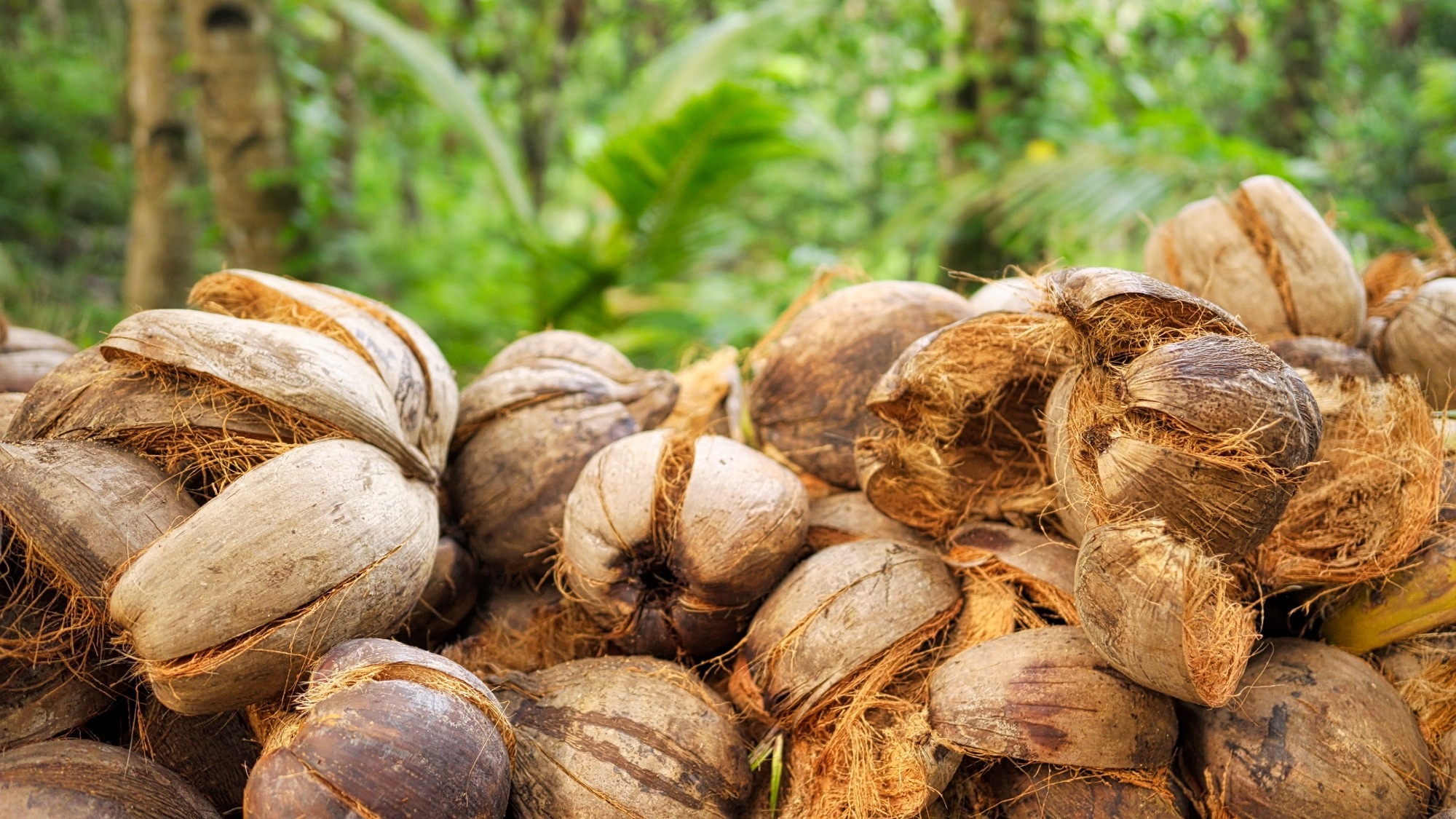 Study: Durability and impact resilience of OPS coir fibre reinforced concrete with experimental insights and machine learning predictions. Image Credit: Real People Images/Shutterstock.com
Can Coconut Waste Make Concrete Stronger?
The demand for sustainable and lightweight construction materials has driven interest in agricultural waste products as alternatives to traditional aggregates. Oil palm shell (OPS), a byproduct of the palm oil industry predominantly produced in countries like Indonesia and Malaysia, has shown promise as a lightweight aggregate due to its low density, cost-effectiveness, and environmental benefits.
This substantial volume of OPS waste, if not properly managed, poses environmental risks; thus, repurposing it for concrete production addresses both sustainability and waste management challenges. OPS concrete has demonstrated improved thermal insulation and reduced overall density compared to normal-weight concrete.
Impact resistance is a critical parameter for such materials, especially under dynamic loads; prior research suggests that incorporating fibers can enhance the energy absorption and mechanical resilience of OPS concrete.
While synthetic fibers such as polypropylene have been studied extensively, there is limited recent research on natural fibers like coir, which is derived from coconut husks and is widely available in the same regions that produce OPS.
Combining Impact Tests With Machine Learning
The experimental program involved fabricating OPS concrete slabs measuring 300 mm square by 30 mm thick, making up 45% by volume of the total coarse aggregate. The OPS was sieved to particle
sizes between 8 mm and 10 mm, washed, and air-dried to ensure saturation surface-dry conditions due to its high water absorption.
Coir fibers of different lengths (from 10–50 mm) were introduced at 2% volume content, having been pre-cleaned and soaked to improve bonding and reduce water absorption during mixing. The mix included grade 42.5 ordinary Portland cement partially replaced by 10% microsilica, with river sand fine aggregate and a superplasticizer added to maintain workability.
The concrete mixes were designed using Design Expert software, with fiber length treated as a continuous variable from 0 to 50 mm and support configurations as discrete variables representing two-, three-, or four-point boundary conditions on the slabs. Control samples without fiber were also prepared for comparison purposes.
Samples were cured in water for 28 days before testing. The slabs underwent low-velocity impact testing to assess energy absorption and crack propagation both at initial crack formation and ultimate failure stages.
Durability assessments involved measuring water absorption and permeability under varying curing ages and conditions, including air-drying and pure-water curing. One-dimensional permeability tests were conducted by sealing the specimens’ sides and applying water pressure, with permeability coefficients calculated accordingly.
Machine learning models, specifically support vector machines (SVM) with linear and radial basis function kernels and artificial neural networks (ANN), were developed to predict impact energy absorption and crack resistance based on input variables of fiber length and support conditions.
The dataset was split into training, validation, and testing subsets, with k-fold cross-validation employed to optimize model performance and minimize bias. Hyperparameter tuning for the SVM models was carried out systematically to identify optimal settings.
Longer Fibers Help Concrete Resist Cracking
The OPS concrete slabs reinforced with coir fiber exhibited notable improvements in both impact energy absorption and crack resistance relative to the non-fiber-containing controls.
Crack propagation analysis showed that plain OPS concrete failed in a brittle manner with rapid crack growth, whereas fiber-reinforced samples displayed crack bridging and fiber pull-out mechanisms that enhanced toughness and delayed crack widening.
At the service stage, simply supported slabs with longer fibers sustained more impact blows before cracking, indicating increased energy absorption capacity. Similarly, ultimate failure resistance improved substantially with fiber length and boundary support, reaching up to 135 Joules and 631 N/mm2 crack resistance with 50 mm fiber length under four support configurations.
Download a free copy of this page here!
Statistically, while some overlap in performance occurred among specific fiber lengths and support combinations, the overall trend indicated improved performance with increasing fiber length.
Machine-learning models showed promising results when predicting the complex, nonlinear interaction between fiber length and support configuration affecting both impact energy and crack resistance. Among them, the ANN demonstrated the highest predictive accuracy, with an R2 of approximately 0.76, followed closely by the linear-kernel SVM.
Graphical optimization using the predictions identified that fiber lengths around 40 mm combined with four-point supports provided an optimal balance of high crack resistance and impact absorption at crack initiation, offering practical guidance for mix design tailoring.
Durability tests revealed that water-cured specimens exhibited up to a 97% reduction in permeability compared to air-cured samples. This improvement is attributed to pore-sealing effects from continued hydration processes, enhancing long-term resistance to water ingress and potential chemical attack.
What the Findings Mean for Sustainable Construction
The integration of coir fibers into OPS lightweight concrete significantly enhances the material’s impact resilience and crack resistance. Future investigations are encouraged to explore longer-term dynamic behavior, fatigue under cyclic stress, and real-world performance validation to fully harness the potential of OPS-coir fiber-reinforced concrete in infrastructure projects.
Journal Reference
Ja’e, I. A., et al. (2026). Durability and impact resilience of OPS coir fibre reinforced concrete with experimental insights and machine learning predictions. Scientific Reports. DOI: 10.1038/s41598-026-76254-w, https://www.nature.com/articles/s41598-026-76254-w