*Important notice: This news reports on an unedited version of an accepted paper and is awaiting final editing. Therefore, the paper should not be regarded as conclusive or treated as established information.
Researchers have developed a low-carbon concrete mixture using fly ash and GGBS that achieved a compressive strength of 68.4 MPa after 56 days. By combining accelerated CO2 curing with self-compacting geopolymer concrete and machine learning analysis, they have identified a promising approach to improve concrete strength while potentially reducing its environmental impacts. Their findings were published in Scientific Reports.
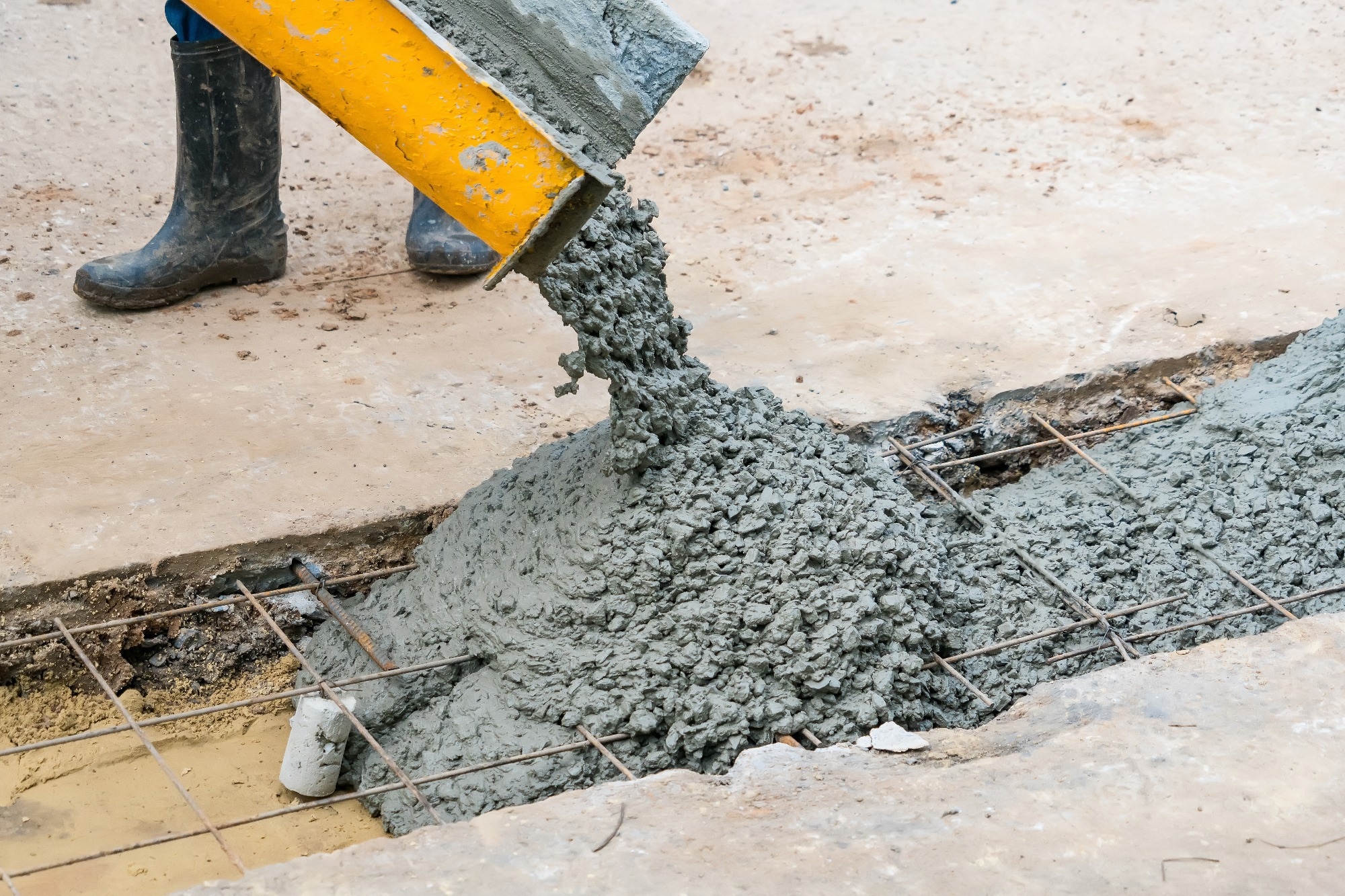 Study: Accelerated CO2 curing of fly ash–GGBS self-compacting geopolymer concrete: experimental, environmental and explainable machine learning assessment. Image Credit: Bubbers BB/Shutterstock.com
Can CO2 Curing Make Concrete Stronger and Greener?
The construction sector is responsible for significant environmental impacts, primarily due to the widespread use of ordinary Portland cement (OPC), a major source of carbon dioxide emissions globally.
Reducing such emissions has become a priority in developing sustainable materials that maintain structural performance. Geopolymer concrete (GPC), formed through alkaline activation of aluminosilicate precursors such as fly ash (FA) and ground granulated blast-furnace slag (GGBS), has emerged as an eco-friendly alternative.
This technology not only reduces CO2 emissions but also valorizes industrial byproducts, contributing to circular economy principles. Among various strategies, accelerated CO2 curing has gained attention as a way to improve engineering properties and capture carbon within the concrete matrix.
Despite prior research on individual aspects such as mechanical performance, durability, microstructure, and environmental impacts of geopolymers, integrated studies that encompass accelerated carbonation, material composition, and predictive modeling remain scarce.
This study addresses that gap by investigating fly ash–GGBS-based self-compacting geopolymer concrete (SCGC) subjected to accelerated CO2 curing, with an emphasis on building sustainable infrastructure through enhanced performance and reduced environmental footprint.
Fly Ash, Slag, and CO2 Curing Put to the Test
The study adopted a multidisciplinary framework involving experimental work, microstructural characterization, life cycle assessment (LCA), and machine learning (ML) prediction. Five binder
compositions with varying ratios of fly ash to GGBS were developed to create 10 mixtures under ambient and accelerated CO2 curing regimes.
The geopolymer binder was activated using a sodium hydroxide solution (10 M) mixed with sodium silicate at a fixed ratio. Fresh properties such as flowability were assessed per EFNARC guidelines to verify self-compacting behavior.
Hardened properties including compressive, splitting tensile, and flexural strengths were tested at multiple curing ages (seven, 28, and 56 days). Durability was evaluated through tests for water absorption, sorptivity, acid resistance, and sulfate attack.
Apparent CO2 uptake was estimated by measuring changes in specimen mass following accelerated carbonation curing, although this indirect method could not establish the amount of CO2 permanently sequestered.
Microstructural analysis employed scanning electron microscopy (SEM), energy-dispersive spectroscopy (EDS), X-ray diffraction (XRD), and Fourier-transform infrared spectroscopy (FTIR) to study geopolymerization, pore refinement, and carbonate formation.
A cradle-to-gate life cycle assessment was conducted using openLCA software to estimate environmental impacts, including global warming potential and embodied energy.
For predictive modeling, three machine learning algorithms - artificial neural networks (ANN), random forest (RF), and extreme gradient boosting (XGBoost) - were trained on the experimental database to forecast compressive strength based on input parameters such as binder composition, curing age, and curing method.
SHAP (Shapley additive explanations) analysis helped interpret the influence of different variables on model predictions.
Download a free copy of this page here!
CO2-Cured Concrete Reaches 68.4 MPa as XGBoost Achieves R² of 0.983
The fresh property tests confirmed that all mixes maintained self-compacting characteristics, suggesting potential suitability for building applications requiring easy placement without vibration.
Mechanical testing revealed consistent strength gains with curing age across all mixtures, with the blend containing 40% GGBS (M3) performing optimally when subjected to accelerated CO2 curing (M3-C). Specifically, the compressive strength of M3-C reached 68.4 MPa at 56 days, outperforming ambient-cured counterparts by a significant margin.
This improvement is attributed to the reaction between CO2 and calcium-bearing slag phases, producing stable calcium carbonate, which densifies the matrix by filling pores and refining the microstructure. Corresponding split tensile and flexural strengths also followed similar trends, indicating enhanced crack resistance and bending capacity.
Durability tests supported these observations, as M3-C exhibited lower water absorption and sorptivity, alongside improved resistance to acid and sulfate attack. Microstructural assessments confirmed the densification of the matrix and formation of carbonate phases, aligning with the increased mechanical performance.
The environmental evaluation through LCA showed that M3-C had the lowest carbon footprint (148.8 kg CO2 equivalent per cubic meter), along with reduced embodied energy and carbon intensity, highlighting the sustainability benefits of combining optimized slag content with accelerated carbonation.
Machine learning models demonstrated strong predictive capabilities, with XGBoost achieving the highest accuracy (R2 = 0.983). Feature importance and SHAP analyses identified curing age, GGBS content, and CO2 curing as the most influential factors governing compressive strength development, corroborating experimental insights.
Overall, the data suggests that the combination of appropriately balanced binder composition and accelerated CO2 curing synergistically enhances engineering properties, durability, and environmental performance, positioning this approach as promising for sustainable building construction.
High-Strength Geopolymer Concrete Shows Low-Carbon Potential
This study presents a comprehensive approach to developing high-performance self-compacting geopolymer concrete using fly ash and ground granulated blast-furnace slag, with accelerated CO2 curing as a key technique to enhance build-related characteristics.
Collectively, the findings highlight the viability of slag-modified, carbon-cured self-compacting geopolymer concrete as a next-generation construction material that balances performance with environmental responsibility.
This integrated experimental, environmental, and computational framework offers valuable guidance for advancing low-carbon concrete technologies in the building sector.
Journal Reference
Joseph H.S., et al. (2026). Accelerated CO2 curing of fly ash–GGBS self-compacting geopolymer concrete: experimental, environmental and explainable machine learning assessment. Scientific Reports. DOI: 10.1038/s41598-026-77232-y. https://www.nature.com/articles/s41598-026-77232-y.