By breaking down polyethylene waste and rebuilding it like LEGO, researchers have created a new class of smart materials that are engineered to resist fire, block UV, conduct static, and be recycled again and again.
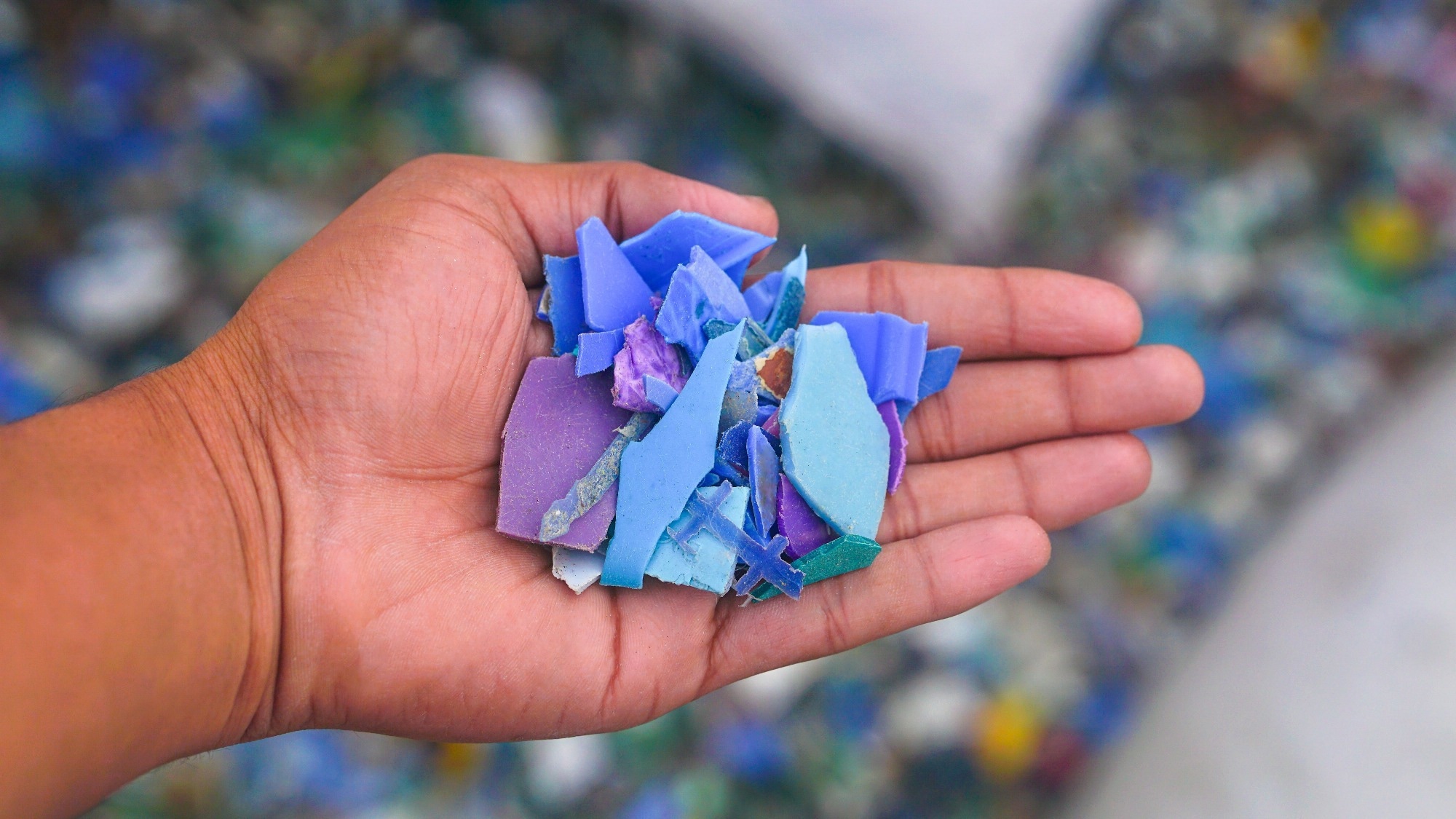
Image Credit: Chitro Stock/Shutterstock.com
A paper recently published in Chinese Chemical Society Chemistry proposed a flexible “LEGO” approach to synthesize sustainable multifunctional materials based on oxidative polyethylene (PE) degradation.
Polyolefin Recycling and Modification
Polyolefins are widely used in consumer products and infrastructure thanks to their low cost, chemical stability, and durability. However, their robust carbon–hydrogen (C–H) and carbon–carbon (C–C) bonds make them difficult to chemically recycle or modify, limiting their use in high-end applications where tailored functionalities, like antistatic performance or UV resistance, are needed.
Traditional strategies to modify polyolefins often rely on post-functionalization techniques, such as grafting reactive groups onto polymer chains. While some success has been achieved (for example, incorporating succinic anhydride) it's still difficult to produce highly functionalized, application-specific materials at scale.
A promising new direction involves breaking the C–C backbone of waste polyolefins to create small, functional molecules that can be rebuilt into new materials.
This process opens the door to high-value applications but has been hindered by the very chemical stability that makes polyolefins attractive in the first place. Recent work has shown it’s possible to degrade polyolefins into molecules containing reactive carboxyl and hydroxyl groups, which can then be used to construct advanced materials, such as dynamically crosslinked elastomers. Still, creating multifunctional, reprocessable materials with tunable properties remains a challenge.
The Study
In this latest research, the team developed a two-step “LEGO” strategy to turn PE degradation products into recyclable, high-performance materials.
The approach begins with controlled oxidative degradation of PE to create macromolecular blocks containing reactive functional groups. These blocks, specifically, aldehyde-modified, amine-degraded oxidized PE (ADOPE-CHO), serve as building blocks that can be chemically linked to functional components using dynamic imine bonds.
These imine bonds offer modular connectivity and are reversible, making the resulting materials thermally and chemically recyclable. Researchers demonstrated that by varying the ratio of ADOPE-CHO to functional blocks such as hexakis(4-aldehydephenoxy)cyclotriphosphazene (HCCP-CHO), they could fine-tune properties like elasticity, mechanical strength, flame retardancy, and electrical conductivity.
The team used a wide array of reagents, including low-density polyethylene (LDPE), ethanolamine, tetrahydrofuran (THF), and various aldehyde and amine-containing compounds, to construct these new materials. The process involved dissolving the components in THF at 60?°C, followed by gelation and film formation under heat and pressure.
Additional formulations were created using other additives, such as [N4444][Lys] and bis(3-aminophenyl) phenyl phosphate (3-APPP), to further expand functionality.
Characterization and Performance
To evaluate the materials, the researchers used a comprehensive suite of characterization tools, including FTIR, NMR, tensile testing, DMA, TGA, UV-vis spectroscopy, and surface resistivity measurements. This allowed them to assess structural, thermal, optical, and electrical properties in detail.
The results were impressive:
- Flame Retardancy: Flame-retardant blocks reduced peak heat release rates by 73 % and increased the limiting oxygen index (LOI) from 18 % (virgin LDPE) to 27 %.
- UV Shielding: UV-blocking modules provided full-spectrum protection across 200–380?nm.
- Antistatic & Dyeability: Modified materials showed a three-order-of-magnitude reduction in volume resistivity and improved dye uptake from 8.3 % to 28.6 %. Dyes remained stable with no leaching after 24 hours in water.
- Mechanical Strength: The materials reached tensile strengths up to 27?MPa and elongation at break up to 185 %, outperforming unmodified LDPE, even with high levels of functional additives.
Critically, these performance gains were achieved without sacrificing recyclability. Thanks to the nature of the imine bonds, the materials could be thermally reprocessed multiple times or chemically depolymerized to recover the original building blocks. Even though imine bonds are typically acid-sensitive, the hydrophobic PE blocks protected the network, maintaining material integrity under acidic conditions.
Broader Implications
This study showcases a highly adaptable, sustainable approach to upcycling polyethylene waste into advanced functional materials. By combining oxidative degradation with dynamic modular reconstruction, researchers have created a platform that not only addresses plastic waste challenges but also enables the design of high-performance materials with specific, customizable properties.
Because of the versatility of the ADOPE building blocks, this strategy could be extended to other dynamic bonding systems and functional monomers, opening the door to new applications in electronics, packaging, textiles, and more.
Journal Reference
Shen, C. et al. (2026). On-Demand Upcycling of Polyethylene Wastes to Recyclable Multifunctional Materials by LEGO Strategy. Chinese Chemical Society Chemistry, 1-11. DOI: 10.31635/ccschem.025.202506819, https://www.chinesechemsoc.org/doi/10.31635/ccschem.025.202506819
Disclaimer: The views expressed here are those of the author expressed in their private capacity and do not necessarily represent the views of AZoM.com Limited T/A AZoNetwork the owner and operator of this website. This disclaimer forms part of the Terms and conditions of use of this website.