A new study shows that high-performance concrete made with recycled concrete aggregates can retain structural strength while supporting more resource-efficient construction practices.
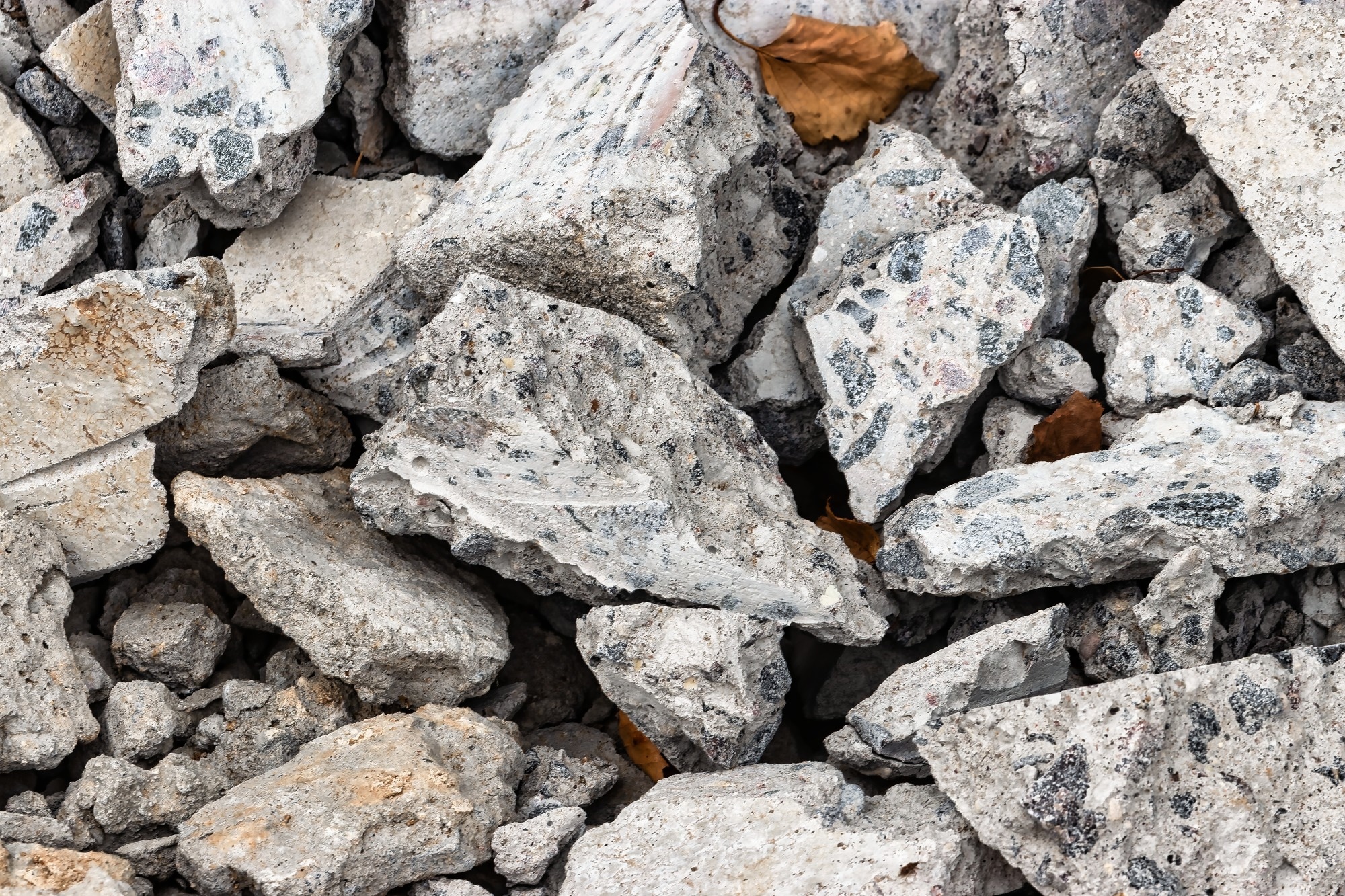
Study: Development of High-Performance Eco-Friendly Concrete Incorporating Recycled Fine Aggregates: Mechanical, Microstructural and Carbon Footprint Assessment. Image Credit: Another77/Shutterstock.com
Researchers investigated the use of recycled concrete aggregate (RCA) in high-performance concrete (HPC). Their work, published in the journal Buildings, examined how replacing fine aggregates with RCA affects mechanical properties, microstructure, and environmental performance.
The results confirm that RCA can serve as a sustainable alternative in high-performance concrete applications, while also highlighting a measurable trade-off between environmental benefits and material performance.
The Environmental Challenge of Concrete Production
Concrete is the most widely used construction material worldwide, yet its production accounts for roughly 7–8 % of global carbon dioxide (CO2) emissions, largely due to cement manufacturing. As urbanization and infrastructure development continue to expand, reducing the environmental footprint of concrete has become an urgent priority.
Sustainable construction strategies, particularly the use of recycled materials, offer practical ways to address this challenge. One promising approach involves the use of recycled concrete aggregate (RCA), which is produced from crushed demolition waste. By reusing these materials, the construction sector can conserve natural resources while also reducing landfill demand.
However, recycled aggregates typically have higher porosity and lower density than natural aggregates, which can negatively influence the mechanical performance of concrete. For this reason, understanding how RCA affects high-performance concrete is essential for determining its practical viability.
The study, therefore, focuses on evaluating whether RCA can be incorporated into HPC while maintaining the mechanical properties required for structural applications.
Investigative Framework and Methodology
To explore this question, the researchers evaluated the feasibility of replacing fine aggregates in HPC with RCA at substitution levels of 0 %, 25 %, 50 %, 75 %, and 100 %. Five concrete mixtures were produced and tested to measure hardened density, compressive strength, splitting tensile strength, and flexural strength after curing periods of 7 and 28 days.
Beyond mechanical testing, the team also investigated how RCA influences the internal structure of the material. Microstructural characteristics, especially the interfacial transition zone (ITZ), were examined using scanning electron microscopy (SEM). This allowed the researchers to better understand how recycled aggregates interact with the cement matrix.
In addition, the properties of the RCA itself were characterized. Water absorption and attached mortar content were measured, and hydrochloric acid treatment was used to quantify the proportion of residual cementitious mortar adhered to recycled aggregate particles.
To complement the experimental work, the researchers also conducted a cradle-to-gate carbon footprint analysis. This assessment considered emissions associated with raw material production, transportation, and RCA processing, helping establish a broader relationship between RCA content, mechanical performance, microstructure, and environmental impact.
Findings: Mechanical and Structural Performance
The experimental results revealed a clear trend in that mechanical performance gradually declined as RCA content increased. Compressive strength decreased from 78 MPa in the control mix (0 % RCA) to 53 MPa at full replacement, representing a reduction of about 32 %.
Splitting tensile and flexural strengths followed similar patterns, reflecting the inherent limitations of recycled aggregates. Hardened density also declined slightly by approximately 5.8 % at 100 % RCA replacement, while water absorption increased significantly, rising by about 42 % and indicating greater permeability.
To better understand these changes, the researchers examined the microstructure using SEM. The images revealed a weaker interfacial transition zone around RCA particles, characterized by increased porosity and micro-cracking. These features reduce load transfer efficiency and contribute to lower overall strength.
The presence of adhered mortar on recycled aggregates creates a weaker mortar-to-mortar interface with the new cement matrix. In addition, the angular particle morphology and grading differences of crushed RCA fines can reduce packing efficiency and introduce localized stress concentrations within the cementitious matrix.
Despite these limitations, all mixtures still achieved compressive strengths above 50 MPa. This finding confirms that structurally adequate high-performance concrete can still be produced with substantial RCA content, remaining within the strength classifications typically associated with HPC materials.
From an environmental perspective, the carbon footprint analysis indicated a slight increase in embodied emissions as RCA levels rose. This increase was mainly attributed to processing energy and the constant cement content used across all mixtures. Cement production alone accounted for more than 90 % of total emissions, meaning that aggregate substitution has a relatively limited effect on overall emissions.
Even so, using RCA still offers sustainability benefits by reducing the demand for virgin aggregates and improving the management of demolition waste. These advantages align with circular economy principles that emphasize the reuse of construction materials.
At the same time, the findings highlight a performance–durability trade-off, suggesting that optimized mix designs and supplementary cementitious materials may be necessary for certain structural applications.
Applications for Sustainable Construction Practices
Taken together, these findings have significant implications for sustainable construction. The study demonstrates that high-performance concrete can incorporate substantial amounts of RCA while still maintaining compressive strengths above required thresholds.
This opens the possibility of using recycled aggregates more widely in concrete production, helping reduce reliance on natural materials. To further improve performance, adjustments to the mix design may be required.
For example, incorporating supplementary cementitious materials such as fly ash or silica fume and optimizing water-to-cement ratios could help offset some of the strength reductions associated with higher RCA content. With these modifications, RCA-based HPC could become suitable for a broader range of structural and infrastructure applications.
The research also highlights an important environmental consideration: transportation distance. When natural sand must be transported over long distances, mixtures containing higher proportions of RCA may provide greater environmental advantages by shortening supply chains and reducing transport-related emissions.
Conclusions and Future Directions
Overall, the study demonstrates that recycled concrete aggregates can be incorporated into high-performance concrete while maintaining adequate structural performance. Although mechanical strength decreases as RCA content increases, the resulting mixtures still meet acceptable performance levels for many applications.
These findings emphasize the importance of optimizing mix design (particularly through the use of supplementary cementitious materials and appropriate water-to-cement ratios) to balance durability and mechanical performance.
Future research should focus on evaluating long-term durability under environmental exposures such as freeze–thaw cycles and chemical attack. Expanding the analysis to full life-cycle assessments would also provide a more complete understanding of environmental impacts by considering service-life performance, maintenance requirements, and end-of-life scenarios.
Overall, this work provides valuable insights into integrating recycled materials into modern concrete production while supporting more resource-efficient construction practices.
Journal Reference
Bahmani, H.; & et al. (2026). Development of High-Performance Eco-Friendly Concrete Incorporating Recycled Fine Aggregates: Mechanical, Microstructural and Carbon Footprint Assessment. Buildings, 16, 973. DOI: 10.3390/buildings16050973, https://www.mdpi.com/2075-5309/16/5/973
Disclaimer: The views expressed here are those of the author expressed in their private capacity and do not necessarily represent the views of AZoM.com Limited T/A AZoNetwork the owner and operator of this website. This disclaimer forms part of the Terms and conditions of use of this website.