Reviewed by Frances BriggsFeb 4 2026Reviewed
Plastic could soon be uniquely recycled and 3D-printed to create sustainable floor truss systems.
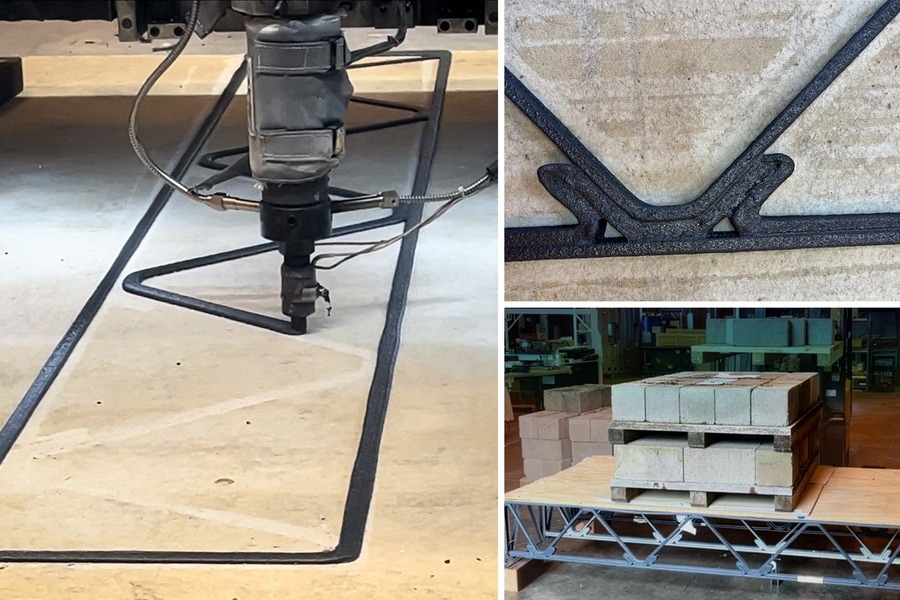 On left, the MIT HAUS large format 3D printer system deposits the first layer of a polymer composite 3D printed floor truss. A closeup of a notched joint is seen on right, and the assembled floor system undergoing a bending test with a ~2,000 lb concrete block load in the center. Image Credit: Courtesy of the researchers, MIT
The plastic bottle discarded in the recycling bin might offer structural support for the future home. A team from the Massachusetts Institute of Technology introduces their design, which hopes to turn recycling into construction-grade infrastructure.
The study was published in the Solid FreeForm Fabrication Symposium Proceedings.
Engineers at MIT are using recycled plastic to 3D-print construction-grade beams, trusses, and other structural components that could eventually provide lighter, modular, and more sustainable alternatives to conventional wood-based framing.
A traditional floor truss is composed of wood beams connected by metal plates, arranged in a ladder-like pattern with diagonal rungs. When placed on its edge and connected to additional parallel trusses, the resulting structure provides support for flooring material, such as plywood, laid over the trusses.
The MIT researchers printed four long trusses from recycled plastic, assembled them into a conventional plywood-topped floor frame, and evaluated the structure's load-bearing capabilities. The printed flooring supported more than 4,000 pounds, exceeding essential building criteria established by the United States Department of Housing and Urban Development.
The plastic-printed trusses weigh around 13 pounds each, making them lighter than comparable wood-based trusses, and they can be produced on a large-scale industrial printer in less than 13 minutes. The team is also working on printing other components and assembling them into a whole frame for a small home.
The researchers believe that as global demand for housing surpasses wood supply in the coming years, single-use plastics like water bottles and food containers could be repurposed as recycled framing material, alleviating both a global housing crisis and an overwhelming demand for timber.
We’ve estimated that the world needs about 1 billion new homes by 2050. If we try to make that many homes using wood, we would need to clear-cut the equivalent of the Amazon rainforest three times over. The key here is: We recycle dirty plastic into building products for homes that are lighter, more durable, and sustainable.
AJ Perez, Lecturer, School of Engineering and Research Scientist, Office of Innovation, Massachusetts Institute of Technology
Perez and Hardt founded MIT HAUS in 2019, a group within the Laboratory for Manufacturing and Productivity that aims to build homes from recycled polymer products using large-scale additive manufacturing, including technologies capable of generating large structures layer by layer in relatively short timescales.
Some companies are now looking at large-scale additive manufacturing to 3D-print small dwellings. These efforts mostly focus on printing with concrete or clay, which have a significant negative environmental impact during manufacture.
So far, the printed home materials have primarily consisted of walls. The MIT HAUS group was among the first to examine printing structural frame parts, such as foundation pilings, floor trusses, stair stringers, roof trusses, wall studs, and joists.
Furthermore, they want to do it using recycled "dirty" plastic rather than cement, which does not require cleaning or preprocessing before reuse.
The researchers hope that one day, recycled bottles and food containers will be put straight into a shredder, pelletized, and then fed into a large-scale additive manufacturing machine to form structural composite building components.
The plastic composite sections would be lightweight enough to be transported by pickup truck rather than a standard lumber-hauling 18-wheeler. At the building site, the components could be easily assembled into a lightweight yet strong dwelling frame.
We are starting to crack the code on the ability to process and print really dirty plastic. The questions we’ve been asking are, what is the dirty, unwanted plastic good for, and how do we use the dirty plastic as-is?
AJ Perez, Lecturer, School of Engineering and Research Scientist, Office of Innovation, Massachusetts Institute of Technology
Weight Class
The team's latest study is one step closer to the broader objective of sustainable, recycled building. In this project, they designed a printed floor truss composed of recycled plastic. They created the truss with a high stiffness-to-weight ratio, meaning it should be able to withstand a certain amount of weight with minimal deflection or bending.
The researchers began by simulating several truss designs and subjecting each to a simulated load-bearing test. Their modeling revealed that one design in particular had the best stiffness-to-weight ratio, making it the most viable pattern for printing and testing.
The design is similar to the conventional wood-based floor truss pattern, which resembles a ladder with diagonal, triangular rungs. The team slightly modified this design by adding minor reinforcing pieces at each node where a “rung” met the main truss.
Perez and his team traveled to MIT's Bates Research and Engineering Center to create the design. There, they used the group's industrial-scale 3D printer, a room-sized industrial device that can print massive structures quickly – up to 80 pounds of material per hour.
In their initial study, the researchers employed pellets composed of glass fibers and recycled PET polymers, a blend that enhances the material’s durability and printability. The pellets were loaded into the printer as composite “ink” after they were acquired from an aircraft materials business.
Each of the four trusses the team printed was 8 feet long, 1 foot high, and about 1 inch wide. It takes around 13 minutes to print each truss. Perez and Godfrey fastened the trusses to a sheet of plywood to resemble a 4×8-foot floor frame, spacing them in a parallel arrangement similar to conventional wood-based trusses.
They assessed the deformation of the trusses beneath after placing bags of sand and concrete of varying weights in the middle of the flooring system.
The trusses readily supported 300-pound loads, far more than the deflection requirements established by the United States Department of Housing and Urban Development. They continued to add weight past 300 pounds: The trusses didn't buckle and split until the loads exceeded 4,000 pounds.
The printed trusses meet current U.S. building code requirements for stiffness. According to Perez, the cost of manufacturing the structures must be reduced to match the price of wood for them to be prepared for widespread adoption.
He refers to the source of the recycled plastic used to print the trusses in the latest study as the “crème de la crème of recycled feedstocks.” Although it is factory-discarded plastic, it is not quite the "dirty" plastic that he intends to eventually shred, print, and construct.
The most recent study shows that recycled plastic can be used to print structural components for construction. To see how such impurities affect the quality of the printed output, Perez is now experimenting with dirtier plastic, such as discarded soda bottles that still contain some liquid residue.
If it is possible to turn these plastics into long-lasting housing structures, Perez added, “the idea is to bring shipping containers close to where you know you’ll have a lot of plastic, like next to a football stadium. Then you could use off-the-shelf shredding technology and feed that dirty shredded plastic into a large-scale additive manufacturing system, which could exist in micro-factories, just like bottling centers, around the world. You could print the parts for entire buildings that would be light enough to transport on a moped or pickup truck to where homes are most needed.”
The study received partial support from the Gerstner Foundation, the Chandler Health of the Planet grant, and Cincinnati Incorporated.