The Structural Logic Behind Concrete’s Dominance
Performance Beyond Structure: Fire Resistance and Thermal Mass
Versatility Across Construction Scales
Engineering the Next Generation of Concrete
Confronting the Carbon Reality
What Comes Next for Concrete
References and Further Reading
Concrete is one of the most widely used construction materials in the world, accounting for roughly 70 % of all materials produced each year. That level of use reflects a combination of structural reliability, economic practicality, safety performance, and ongoing technical refinement that competing materials have struggled to match at scale.
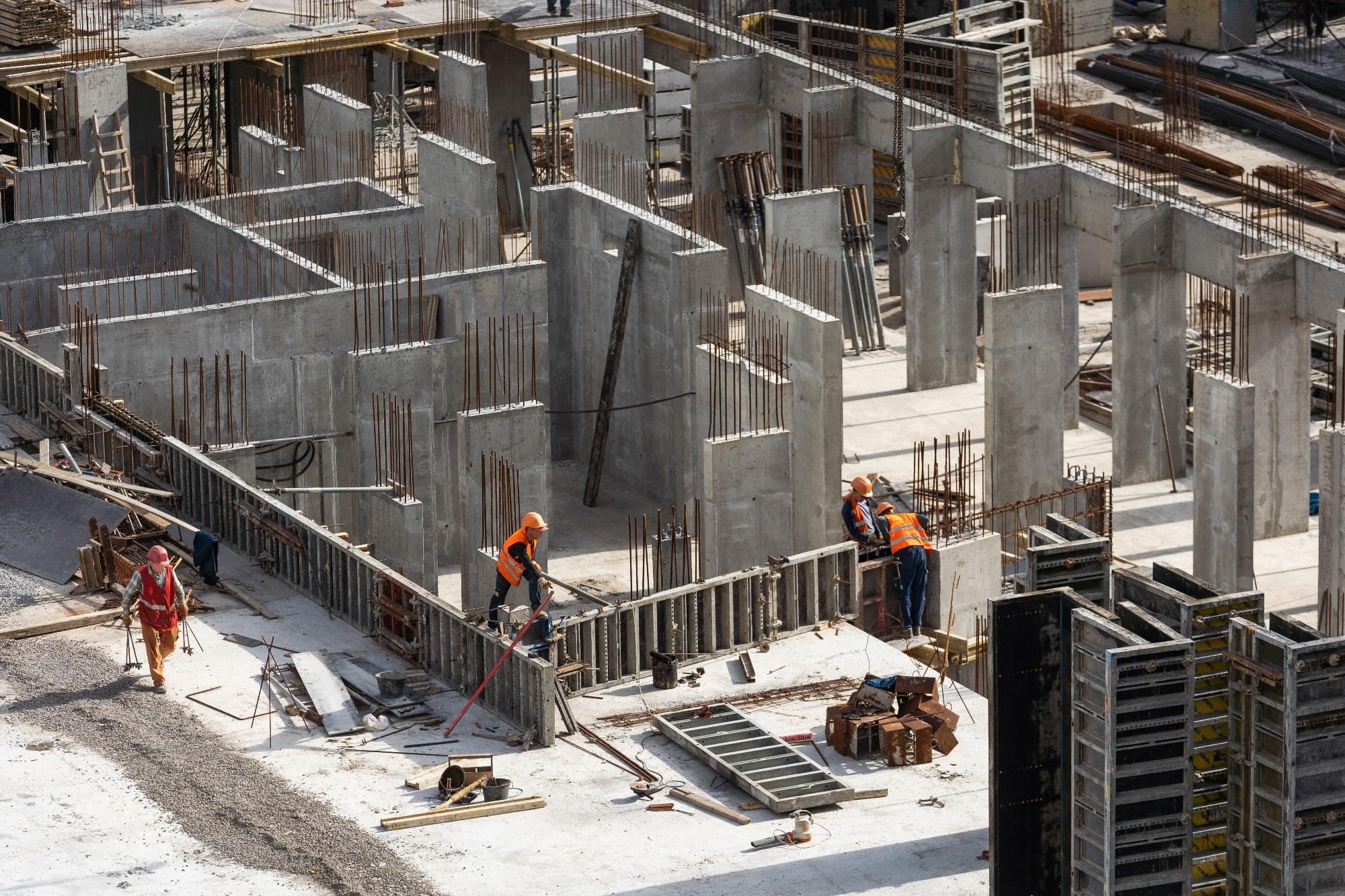
Image Credit: Andrew Angelov/Shutterstock.com
While steel and timber each offer distinct advantages, concrete continues to anchor foundations, frame high-rise cores, support bridges, and shape infrastructure across both established and rapidly urbanizing regions. Its dominance persists because it solves several fundamental engineering challenges at once. Understanding why requires looking first at how it performs structurally.
Save this PDF for later by downloading it here.
The Structural Logic Behind Concrete’s Dominance
Concrete’s continued dominance begins with compressive strength. It performs exceptionally well under vertical loads, which makes it indispensable for foundations, columns, bridge piers, and load-bearing walls. These elements form the structural backbone of buildings and infrastructure, and concrete provides the stability they require.
Importantly, this performance is predictable. Compressive strength is primarily determined by the water-to-cement ratio and the type of cement used, variables that can be specified, tested, and adjusted before construction begins. Engineers can model expected behavior with confidence, reducing uncertainty across projects ranging from parking structures to dam walls.1,3
However, modern structures are rarely subjected to compression alone. Wind loads, seismic forces, and uneven settlement introduce tension and bending stresses. Concrete on its own is weak in tension, which is why reinforcement is integral to its widespread use. By embedding steel within the concrete matrix, engineers combine compressive and tensile capacity in a single structural system.
This composite behavior allows reinforced concrete to resist cracking, bending, and buckling under dynamic conditions. Hospitals, schools, residential towers, and critical infrastructure rely on this system because it performs under routine service loads and emergency stress alike. Its resistance to fire, corrosion, and long-term wear further reinforces its reliability.3
Concrete dominates modern construction not because it is flawless, but because it provides a structurally dependable, adaptable system that engineers understand deeply and can scale efficiently.
Beyond structural strength, concrete maintains its dominance because of how it performs in fire and over a building’s operational life. Safety and energy performance are central design constraints. And concrete can be used to address both.
As a non-combustible material, concrete does not ignite, burn, or emit toxic fumes when exposed to fire. Unlike timber or light steel systems, it does not contribute fuel to a fire event.
Studies published in Materials Today examining concrete structures under elevated temperatures show that while extreme heat can reduce compressive strength and cause surface spalling, the material generally retains structural stability long enough to support containment and evacuation. These degradation mechanisms are measurable and can be mitigated through design detailing and material selection.4
In practical terms, this predictable fire performance reduces structural risk in densely built environments, high-occupancy buildings, and critical facilities. It is one of the reasons reinforced concrete remains widely specified in hospitals, schools, and transportation infrastructure.
Concrete also supports long-term operational efficiency through thermal mass. Its density allows it to absorb heat during warmer periods and release it gradually as temperatures fall. This moderates indoor temperature swings and reduces peak heating and cooling demand. A detailed review in the JJournal of Building Engineering highlights that high-thermal-mass materials such as concrete can lower overall energy consumption, particularly in climates with significant day–night temperature variation.3,5
When structural safety and energy performance are considered together, concrete offers a combination that is difficult to replicate with lighter or more combustible systems.
Versatility Across Construction Scales
Structural reliability and fire performance explain why concrete is trusted within individual buildings. Its dominance, however, becomes clearer when viewed at scale.
Concrete is one of the few materials that performs consistently across the full spectrum of construction. It is used in single-family home foundations, mid-rise residential frames, high-rise cores, transportation infrastructure, and large-scale civil works such as dams and bridges.
That breadth allows designers and contractors to rely on a single structural system across project types, rather than shifting between entirely different material strategies as scale increases.
This adaptability begins with its plastic state. Before curing, concrete can be cast into complex forms, enabling curved geometries, thick shear walls, deep foundations, and large monolithic elements without extensive secondary fabrication. Once hardened, it delivers the rigidity and mass required for structural stability.
Industrial production methods reinforce this scalability.
Precast systems shift fabrication into controlled environments, improving quality control and reducing variability. Ready-mix supply chains enable large volumes to be delivered efficiently to project sites. Together, these systems shorten construction timelines, reduce on-site labor demands, and maintain consistency across projects.3
Market data reflects this reach.
The global concrete construction materials market was valued at approximately USD 1049 billion in 2023 and is projected to reach USD 1582.5 billion by 2031.
Concrete accounts for roughly 26 % of the total building materials market by revenue, with new construction driving the majority of demand. Growth is fueled both by infrastructure renewal in established economies and rapid urbanization in Asia, Africa, and Latin America, where scalable, cost-effective building systems are essential.6
When performance, safety, and scalability are considered together, concrete’s continued dominance is less surprising.
Engineering the Next Generation of Concrete
If concrete’s dominance were based only on legacy infrastructure, its long-term position would be uncertain. What sustains it is continued technical development. Advances in material science are refining and expanding what it can do.
Ultra-High-Performance Concrete (UHPC) represents one of the most significant recent developments. With compressive strengths exceeding 200 MPa, UHPC achieves superior performance through a densely packed microstructure that limits crack formation under mechanical and environmental stress.
Research published in Materials and Structures shows that pre-cracked UHPC samples exposed to aggressive environments, including saltwater and geothermal conditions, can exhibit partial stiffness recovery through self-healing mechanisms. The primary healing product identified is calcium carbonate deposition within micro-cracks. This healing response can improve after initial cracking cycles, indicating that the material does not simply degrade linearly under stress.7
This capacity has direct implications for infrastructure exposed to chemically aggressive conditions. Reduced crack propagation and partial stiffness recovery translate to lower maintenance requirements and extended service life.
Material refinement is not limited to cement chemistry. Reinforcement strategies are also evolving. Basalt fiber reinforcement, derived from natural volcanic rock, provides corrosion resistance and high-temperature stability without the degradation risks associated with traditional steel reinforcement in certain environments. Research published in Scientific Reports indicates that adding basalt fibers at 0.1–0.5 % by volume can bridge micro-cracks, improve load distribution, and enhance long-term durability, particularly in chemically exposed settings.8
At the fabrication level, digital construction methods such as 3D concrete printing further extend concrete’s application range. Automated deposition enables complex geometries with reduced material waste and tighter dimensional control. These methods shorten construction timelines while maintaining structural performance standards.
Confronting the Carbon Reality
Despite the success of continued innovation, it does not eliminate concrete’s most serious challenge: carbon emissions.
Cement production remains energy-intensive and chemically carbon-releasing. In 2022, global cement manufacturing generated approximately 1.6 billion metric tonnes of CO2, accounting for roughly 8 % of total global emissions. More than half of these emissions result from the calcination process itself, meaning they are inherent to clinker production rather than solely tied to fuel use.9,10
This environmental burden cannot be overlooked. As construction demand increases globally, particularly in rapidly urbanizing regions, the scale of cement production makes decarbonization urgent.
At the same time, concrete’s durability complicates a simple emissions narrative. Structures commonly last 50 to 100 years, often with limited material replacement. The initial carbon cost is therefore distributed across decades of service life. Longevity does not negate emissions, but it does influence lifecycle assessment when compared with materials requiring more frequent replacement or maintenance.
Nonetheless, efforts are underway to reduce the carbon intensity of cement and concrete.
Limestone Calcined Clay Cement (LC3), which partially replaces traditional clinker with calcined clay and limestone, has demonstrated the potential to reduce CO2 emissions by approximately 40 %. Carbon capture and storage (CCS) systems are also being deployed at an industrial scale. The Heidelberg Materials cement facility in Norway, for example, has implemented large-scale CCS technology, marking a significant step toward emissions reduction in cement manufacturing.9,10
In parallel, low-carbon design strategies, whether that be optimizing structural geometry, incorporating supplementary cementitious materials, or increasing recycled content, are working to further reduce embodied emissions without compromising on performance.
Concrete’s environmental impact remains a defining constraint on its future. Yet the scale of ongoing technical and industrial efforts suggests that the industry recognizes and acknowledges this reality.
If decarbonization progresses alongside performance innovation, concrete is likely to remain central to global construction.
What Comes Next for Concrete
Concrete continues to dominate modern construction because it combines structural reliability, safety performance, and scalability in a way few materials can match. Its environmental impact is significant, but so is the scale of current efforts to reduce it.
Whether concrete remains central to the built environment will depend on how successfully innovation and decarbonization progress together.
The real question now is how far material innovation can go. Exploring low-carbon cement chemistries, lifecycle assessment methods, and emerging alternatives such as geopolymer systems offers a clearer view of what comes next.
References and Further Reading
- Shrestha, B. et al. (2023). Study on Concrete Compressive Strength Through Destructive and Non-Destructive Testing. International Journal of Science, Mathematics and Technology Learning, Vol. 31, No. 2. DOI:10.5281/zenodo.8366195. https://zenodo.org/records/8366195
- Li, F., Luo, D., & Niu, D. (2025). Data-intelligence driven methods for durability, damage diagnosis and performance prediction of concrete structures. Communications Engineering, 4(1), 100. DOI:10.1038/s44172-025-00431-4. https://www.nature.com/articles/s44172-025-00431-4
- Santhosh, M. (2023). Concrete as A Structural Material: Strength and Versatility. International Journal of Engineering Research in Mechanical and Civil Engineering (IJERMCE) Vol 9, Issue 8S. https://ijermce.com/downloads/vol9-si-8s.pdf
- Bhawani, A., & Kishor Banjara, N. (2023). Response of concrete structures to fire. Materials Today: Proceedings. DOI:10.1016/j.matpr.2023.05.469. https://www.sciencedirect.com/science/article/abs/pii/S2214785323031036
- Barbhuiya, S., Das, B. B., & Idrees, M. (2024). Thermal energy storage in concrete: A comprehensive review on fundamentals, technology and sustainability. Journal of Building Engineering, 82, 108302. DOI:10.1016/j.jobe.2023.108302. https://www.sciencedirect.com/science/article/pii/S2352710223024853
- Concrete Construction Materials Market. (2024). Congruence Market Insights. https://www.congruencemarketinsights.com/report/concrete-construction-materials
- Xi, B. et al. (2024). Evolution of self-healing performance of UHPC exposed to aggressive environments and cracking/healing cycles. Materials and Structures 57, 36. DOI:10.1617/s11527-024-02312-2. https://link.springer.com/article/10.1617/s11527-024-02312-2
- Onyelowe, K. C. et al. (2025). Modeling the compressive strength behavior of concrete reinforced with basalt fiber. Scientific Reports, 15, 11493. DOI:10.1038/s41598-025-96343-6. https://www.nature.com/articles/s41598-025-96343-6
- Cement is a big problem for the environment. Here's how to make it more sustainable. (2024). World Economic Forum. https://www.weforum.org/stories/2024/09/cement-production-sustainable-concrete-co2-emissions/
- Scaling Low-Carbon Design and Construction with Concrete: Enabling the Path to Net-Zero for Buildings and Infrastructure. (2023). World Economic Forum. https://www3.weforum.org/docs/WEF_Scaling_Low_Carbon_Design_and_Construction_with_Concrete_2023.pdf
Disclaimer: The views expressed here are those of the author expressed in their private capacity and do not necessarily represent the views of AZoM.com Limited T/A AZoNetwork the owner and operator of this website. This disclaimer forms part of the Terms and conditions of use of this website.