What Makes a House Amphibious?
Engineering the Foundation
The UK's First Amphibious House
Self-Floating Houses and Fiber Molding
Retrofitting Existing Homes
Viability in Flood-Prone Regions
Materials, Utilities, and Connections
References and Further Reading
Flooding displaces millions of people every year, and conventional flood defenses are becoming less reliable as climate patterns change. Amphibious houses present a fundamentally different answer to this problem; instead of blocking floodwaters, these structures rise with them. After the floodwater recedes, the house gently settles back in place, providing an innovative and adaptive approach to flood resilience.
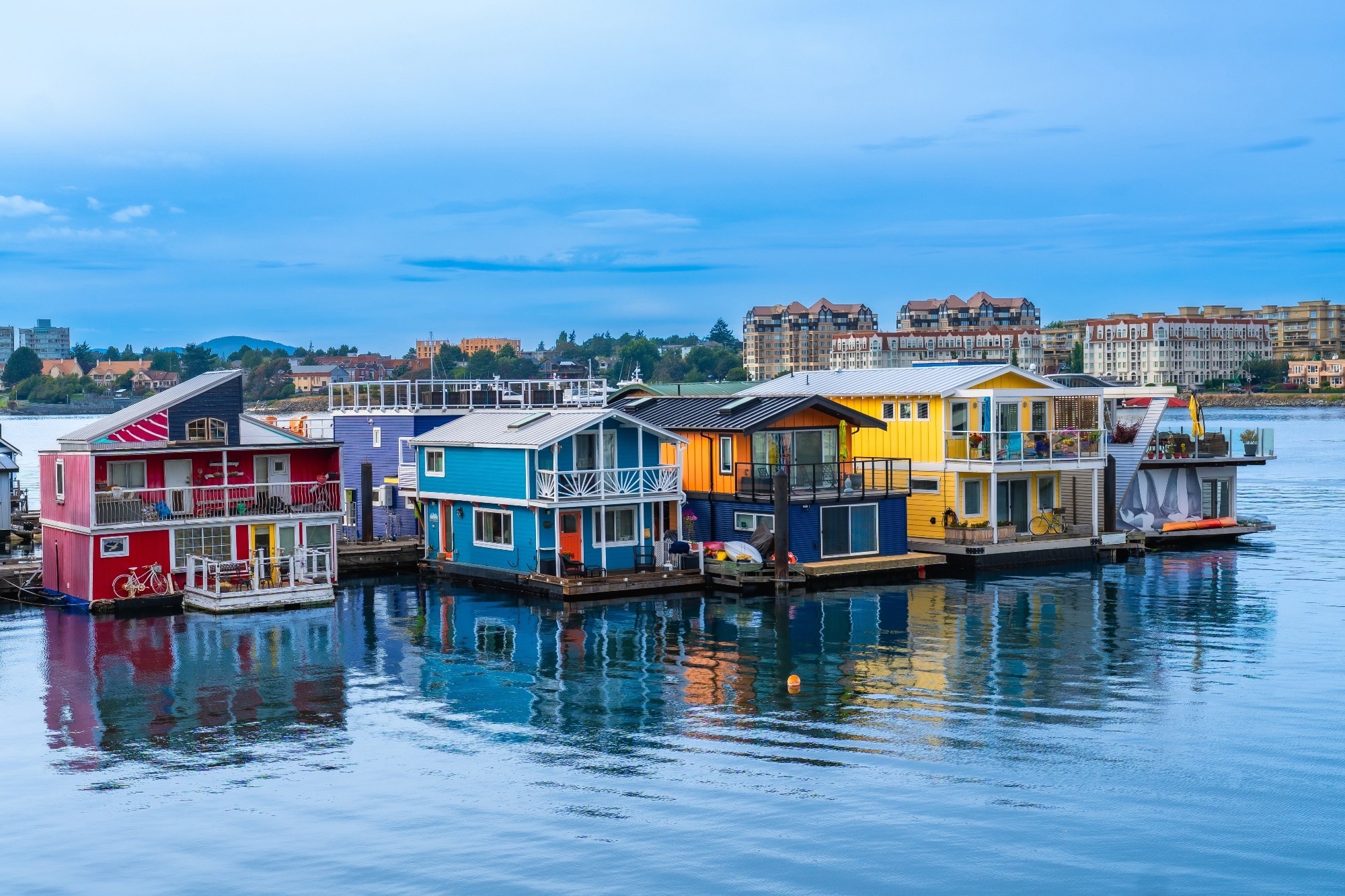
Image Credit: Unai Huizi Photography/Shutterstock.com
What Makes a House Amphibious?
An amphibious house rests on solid ground during dry periods and behaves like an ordinary residential building. When floodwaters rise, the structure lifts off its foundation and floats. Once the water level drops, the house settles back into exactly the same position.
This unique behavior depends on three integrated components working in tandem: a buoyancy system beneath the house displaces water to generate lift; a structural sub-frame distributes that force across the entire structure; and vertical guideposts constrain all movement to a single vertical axis.1
Each component is carefully calibrated to the expected flood depth and the house's weight for proper stability during floods. This design uses Archimedes' principle, which states that water exerts an upward force equal to the weight of the displaced water. A well-designed amphibious foundation uses this force predictably and turns floodwaters into a source of support.1,2
Saving this for later? Download a PDF here.
Engineering the Foundation
The buoyancy system in most amphibious houses uses foam-filled concrete or high-density closed-cell plastic, materials chosen for their lightweight, watertight, and structurally durable nature over decades.3
These materials form a sealed base that traps air and resists water ingress even under prolonged submersion. The sealed base also serves as a thermal barrier, reducing heating loads during normal occupancy.
Vertical guidance systems, sometimes called guideposts or dolphin piles, are anchored deep into the ground and extend well above the maximum expected flood level. The house slides along these posts using low-friction collars or sleeve brackets. The posts are strong enough to resist lateral hydraulic forces from moving water.2
The structural sub-frame connects the buoyancy base to the rest of the building. In timber-framed homes, engineers use reinforced beams and moment connections to ensure the entire load transfers cleanly to the floating base.1
In concrete and masonry structures, this frame is sometimes post-tensioned to add stiffness without adding excessive weight, keeping the house within its buoyancy limits.
Explore more examples of flood-resistant buildings
The UK's First Amphibious House
One of the most cited real-world examples sits on a small island in the River Thames in Buckinghamshire, England. The original houses were built on timber piles, sitting just one meter above ground.
However, flood projections changed, requiring new structures to be at least 2.5 meters high, which would have made living conditions impractical and disrupted the area's visual appeal.4
To address this challenge, Baca Architects created an amphibious design. The house is placed in a shallow dock, nearly hidden from view, with the ground floor elevated less than one meter. During a flood, the dock fills with water, lifting the entire building while keeping the interiors dry.4
The project satisfied both the Environment Agency's flood requirements and the area's heritage conservation rules. It also demonstrated that effective flood adaptation can be both functional and aesthetically pleasing.
This blend of flood resilience and design flexibility has established the ‘Thames house’ as a widely cited proof of concept in flood adaptation literature.4
Self-Floating Houses and Fiber Molding
Researchers in Kerala, India, have developed a self-floating, amphibious house model designed to address frequent flooding in the region while keeping construction costs low. The team used innovative fiber molding technology to achieve both buoyancy and sustainability goals. The lightweight, water-resistant, fiber-reinforced panels can be produced locally, helping to cut material costs and reduce transportation-related carbon emissions.5
The self-floating design eliminates the need for external guideposts in certain configurations, relying on internal ballast management to control the building's rise. It can monitor water levels and adjust its balance to keep the floor level, even as water rises unevenly around it. This active response to flooding is a significant advancement over passive systems.
The study also emphasizes that amphibious housing solutions in developing areas should incorporate local resources and skills to be adoptable at scale.5
Retrofitting Existing Homes
The Buoyant Foundation Project by Professor Elizabeth English at the University of Waterloo aims to upgrade existing wooden houses instead of building new ones. This project focuses on the traditional "shotgun" houses in Louisiana's Lower Ninth Ward, which were heavily impacted by Hurricane Katrina. Since these homes share similar designs, the project offers a standardized retrofit kit that can be used for many houses.1,6
The retrofit involves adding buoyancy blocks under the existing floors and connecting them with a steel frame. Vertical guideposts are then anchored into the ground beside the house.
This unique system can be installed without major changes to the house itself. This allows homeowners to keep the architectural charm of their neighborhood while protecting their homes from future flooding.1,6
Research shows that these retrofitted foundations can handle typical water rise from slow floods and moderate storm surges. However, it's important to assess local conditions before installation, especially since fast-moving water can pose greater risks.1,6
Viability in Flood-Prone Regions
A recent Atlantis Press study explored amphibious architecture in Bangladesh's Haor Basin, a region known for its wetland. Each year, about 25% of Bangladesh’s area faces seasonal flooding, and climate change threatens to increase this number.7 The Haor Basin communities are particularly vulnerable as they live in low-lying areas that can’t easily be protected by levees.7
The researchers assessed amphibious designs based on several factors, such as strength, buoyancy, energy use, and community support. They found that with the right materials and designs tailored to local needs, this type of architecture can be a sustainable solution. Involving residents in the design process significantly increased social acceptance, making them more likely to adopt and care for the structures.7
Residents can remain in their amphibious homes when waters rise, a key advantage of this type of engineering. This aspect is especially crucial for those with limited mobility or caregiving roles.7
Materials, Utilities, and Connections
Utility connections in amphibious houses use flexible couplings that accommodate vertical movement of up to several meters. Water supply lines, sewer connections, and electrical conduits are all fitted with accordion-style joints or slack loops that extend and contract as the house moves.
Electrical panels are positioned well above the maximum anticipated flood level, and sealed cable conduits prevent water from wicking into the building's wiring during partial submersion.8
Walls and floor systems in amphibious houses are typically built with closed-cell insulation and non-absorbing materials such as composite boards or treated timber.8 These choices allow the exterior structure to be temporarily exposed to standing water without retaining moisture or degrading over time. When the house returns to ground level, it does not need the kind of drying-out period that a flooded conventional home requires.
Lightweight construction is preferred because it reduces the buoyancy demand on the base system and lowers the building's center of gravity, contributing to stability during the float phase.
Structural engineers balance this preference for lightness against the need for rigidity, since a flexible structure can rack or distort under the uneven forces generated when one side of the base contacts the water before the other. Getting that balance right is one of the central technical challenges in amphibious house design.5
References and Further Reading
- About the Buoyant Foundation Project. Buoyant Foundation. https://www.buoyantfoundation.org/
- Varkey, E. S. et al. (2019). DESIGN AND ANALYSIS OF FLOATING RESIDENCE. International Research Journal of Engineering and Technology (IRJET). 6(5). https://www.irjet.net/archives/V6/i5/IRJET-V6I5549.pdf
- Collins, F. (2025). Floating Buildings? A Look Into Amphibious Constructions. Veritas Newspaper. https://www.veritasnewspaper.org/post/floating-buildings-a-look-into-amphibious-constructions
- The UK's First Amphibious House. BACA Aquatecture. https://www.baca.uk.com/projects/amphibious-house
- M.V., V., & Philip, P. M. (2021). Flood risk mitigation through self-floating amphibious houses - Modelling, analysis, and design. Materials Today: Proceedings, 65, 442-447. https://www.sciencedirect.com/science/article/abs/pii/S221478532201210X
- English, E. (2025). Building resilience: The benefits of amphibious foundation retrofits, 9, The Water Institute, University of Waterloo. https://uwaterloo.ca/water-institute-research/issue-9/feature/building-resilience-benefits-amphibious-foundation-retrofits
- S. Sarkar, et al. (2025). Amphibious Architecture as a Resilient Solution for Flood-Prone Regions: Assessing Viability in Bangladesh's Seasonal Flood Zones. Advances in Engineering Research, ICERIE.https://www.atlantis-press.com/proceedings/icerie-25/126018306
- Accommodation of flooding (flexible buildings and infrastructure). UNEP-DHI Partnership – Centre on Water and Environment. https://www.ctc-n.org/technologies/accommodation-flooding-flexible-buildings-and-infrastructure
Disclaimer: The views expressed here are those of the author expressed in their private capacity and do not necessarily represent the views of AZoM.com Limited T/A AZoNetwork the owner and operator of this website. This disclaimer forms part of the Terms and conditions of use of this website.