Reviewed by Frances BriggsJan 30 2026Reviewed
Using 3D printing to create concrete underwater, a new strategy could transform on-site maritime construction and facilitate the repair of essential infrastructure that links continents.
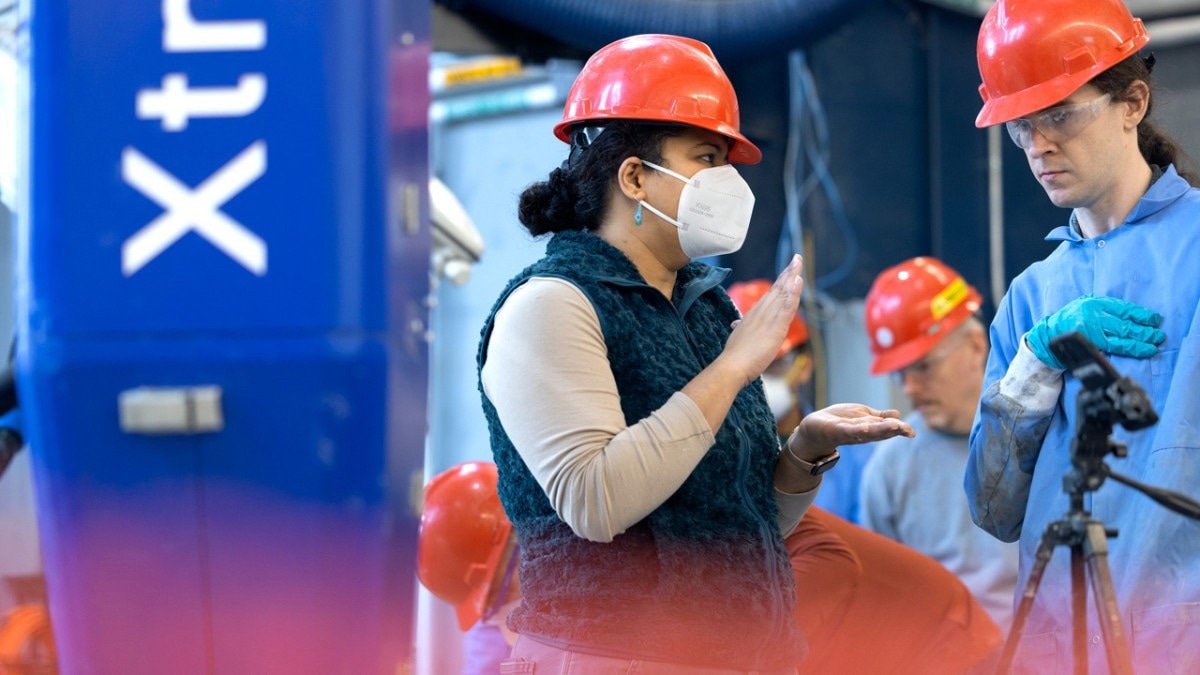 Project lead Sriramya Nair, left, assistant professor of civil and environmental engineering, and doctoral student Caleb Lunsford are part of an interdisciplinary collaboration that has developed a way to 3D-print concrete underwater. Image Credit: Ryan Young/Cornell University
An interdisciplinary team of Cornell researchers is working on this method to apply 3D printing in oceanic environments. Their first study on this subject has been published in the journal Cement and Concrete Composites.
We want to be constructing without being disruptive. If you have a remotely operated underwater vehicle that shows up on site with minimal disturbance to the ocean, then there is a way to build smarter and not continue the same practices that we do on the land.
Sriramya Nair, Study Lead and Assistant Professor, Civil and Environmental Engineering, David A. Duffield College of Engineering, Cornell University
The initiative commenced in the autumn of 2024, following a request for proposals from the Department of Defense’s Defense Advanced Research Projects Agency (DARPA) to create 3D-printable concrete capable of being deposited several meters beneath the water's surface.
“When the call for proposals came out, we said, ‘Hey, let’s just do this and see, so that we will at least understand what the challenges are. And it turned out, with our mixture we could actually 3D-print underwater by making adjustments to account for continuous water exposure,” said Nair, whose group had already been working with a roughly 6,000-pound industrial robot to 3D-print large-scale concrete structures.
Underwater printing encounters various obstacles. The primary issue is the prevention of washout, a phenomenon where cement particles do not properly adhere during deposition, resulting in a weakened material.
The usual remedy involves using admixture chemicals; however, these can lead to complications of their own.
When you add those chemicals, it makes your mixture really viscous, and you can’t pump. So, you’re balancing that pumpability with these anti-washout agents. When it extrudes, even if you don’t have washout, you still want it to be able to hold the shape and bond well with the other layers. There are multiple parameters at play.
Sriramya Nair, Study Lead and Assistant Professor, Civil and Environmental Engineering, David A. Duffield College of Engineering, Cornell University
DARPA introduced an additional challenge: The concrete must be predominantly composed of seafloor sediment, with only a minimal inclusion of cement. Using materials from the ocean floor would significantly reduce the logistical challenges associated with shipping large amounts of cement.
In September, the Cornell team effectively demonstrated to visiting DARPA officials that they were nearing meeting the agency's stringent sediment requirements. This was a significant milestone, as noted by Nair.
“Nobody is doing this right now. Nobody takes seafloor sediment and prints with it. This is opening up a lot of opportunities for reimagining what concrete could look like,” said Nair.
The intricacy of underwater 3D printing requires a range of specialized expertise, prompting Nair to form an interdisciplinary team divided into two subgroups: one focused on material design and the other on fabrication.
The second phase of the DARPA challenge will conclude with a bake-off of sorts, where several teams will 3D-print an arch underwater in March. For several months, Nair's team has been performing test prints in a large water tank, frequently generating multiple samples each week at the Bovay Civil Infrastructure Laboratory Complex.
This laboratory environment enables the researchers to meticulously observe the deposition of layers as well as the strength, shape, and texture of each arch. However, such tactile evaluation can only be conducted on dry land.
“Let’s say you want to print underwater in the real world – we can’t send somebody down with a scuba suit, right? We have to be able to detect those things and adjust our tool path in real time. The overall goal is to achieve good print quality, because if you don’t place your material where it needs to be, you’re not going to get the strength you need,” said Nair.
In place of scuba divers, the fabrication team embarked on designing sensors to monitor the printing process in real time. The marine environment presents significant challenges to this procedure.
“The problem is sediment is super fine, and as soon as you stir it up, you can have zero visibility. We didn’t know how much turbidity – or murkiness – there would be in the water,” said Napp, who specializes in building and programming mechatronic devices that navigate and modify unstructured environments.
Napp's team has developed a control box equipped with various sensing systems that can be integrated with the robotic arm. This device will complement Sabin's contributions to robotics, enhancing autonomy and control in underwater concrete printing.
The final demonstration of the DARPA competition is scheduled for March, and the team is working diligently to merge the advancements achieved by the fabrication team with those from the materials team to successfully print the arches.
Although the fast-paced and high-pressure environment of the competition can be challenging, the sense of urgency has significantly boosted the team's productivity.
As soon as the grant was awarded, we were all meeting once a week, trying to make progress. It’s a pretty ambitious timeline, and it’s cool to see so many different areas of expertise coming together quickly and pushing this forward.
Nils Napp, Assistant Professor, Electrical and Computer Engineering, Cornell University
Journal Reference:
Ozturk, O. et al. (2025). Breaking barriers in underwater construction: A two-stage 3D printing system with on-demand material adaptation. Cement and Concrete Composites. DOI: 10.1016/j.cemconcomp.2025.106306. https://www.sciencedirect.com/science/article/abs/pii/S0958946525003889?via%3Dihub