*Important notice: This news reports on an unedited version of an accepted paper and is awaiting final editing. Therefore, the paper should not be regarded as conclusive or treated as established information.
An innovative, cement-free construction material has been developed in a proof-of-concept study by binding mineral sand into cohesive composites with cellulose nanofiber (CNF) gel as the sole binder. This research, published in the journal Scientific Reports, provides an early composition–property map of CNF–sand composites and demonstrates that CNF-sand composites achieved dry compressive strengths comparable to rammed earth and adobe.
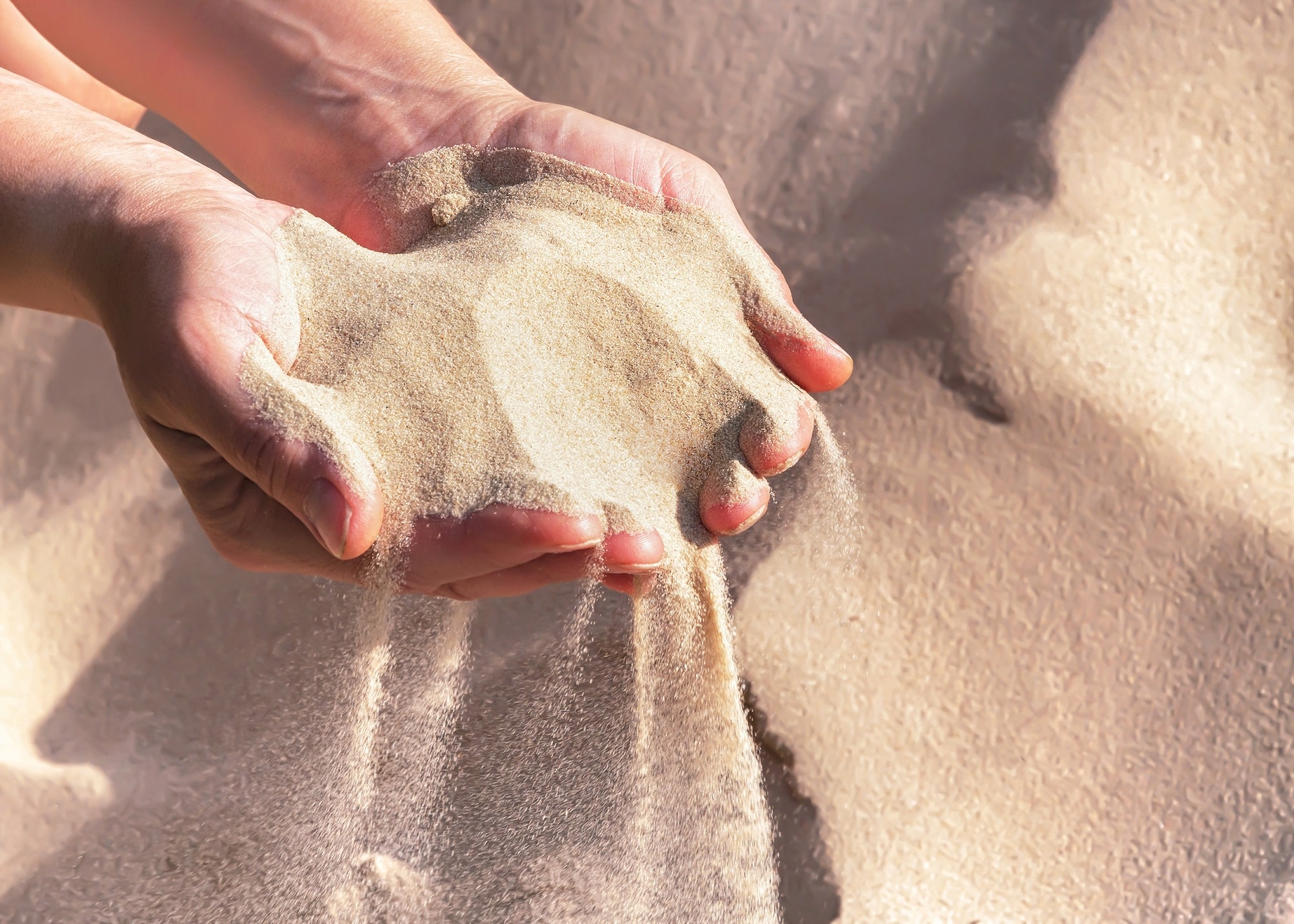 Study: Using cellulose nanofibers as the sole binder for cement-free construction materials. Image Credit: Augusta16/Shutterstock.com
Can Wood-Derived Fibers Replace Cement?
Concrete is a dominant construction material globally but is associated with significant CO2 emissions, primarily due to the use of cement, the binder in conventional concrete. Despite cement constituting only 10–15% of concrete by mass, it contributes over 90% of the CO2 emissions related to concrete production.
While many alternative binders such as geopolymers and blended cements have been explored, thus far, none have fully eliminated cementitious materials.
Cellulose nanofibers (CNFs), derived from wood, have well-known hydrogen-bonding capabilities and have been used as binders in wood-based products. However, to date, they have not been used as the sole binder for mineral aggregates such as sand, without any hydraulic cement or additives.
The high surface area and abundance of hydroxyl groups in CNF suggest their potential as a renewable, bio-based binder for sand, reducing reliance on cement and potentially reducing its associated emissions.
With these qualities in mind, researchers aimed to create a non-cement construction material with CNF as the binder.
CNFs Bind Sand Without Cement
The CNF gel was mechanically refined in aqueous solution, with solids content adjusted to 3.00%, 3.17%, 3.98%, and 5.87% by evaporative drying. Sand aggregates were coarse fraction (0.5–5 mm)
for the primary matrix, with some fine-sand variants (0.1–2 mm) included.
Twelve main compositions were prepared by combining the four CNF gel solids contents with three gel-to-sand mass ratios: 25:75, 40:60, and 50:50 (gel content based on fresh mass), resulting in dry cellulose levels between approximately 1.0 and 5.5 wt% on a dried-composite basis.
Mixing involved standard rotary mixing without vibration, followed by manual tamping in small molds (285 × 25 × 25 mm). After shaping, samples were dried at 60 °C for 24 hours to reach constant weight and tested for their compressive strength when dry. Additional tests included water absorption and measurements after water saturation and redrying to determine moisture effects.
Repeatability was explored through three independently prepared replicate batches. Scanning electron microscopy (SEM) was used to examine fractured surfaces and binder distribution, while statistical analysis (two-factor ANOVA) and regression models identified preliminary relationships between gel composition and compressive strength.
Ultimately, the researchers found differences in compressive strength of up to 61% when comparing specimens from different batches prepared to the same ratio. They suggest, therefore, that their findings establish preliminary trends.
Performance Analysis: Composites Lose 94% of Their Strength When Wet
All compositions with effective dry CNF content above roughly 1 wt% (gel-to-sand ratio at least 25:75, solids content variations) produced cohesive specimens. Below about 0.5 wt% cellulose, however, specimens failed to hold together upon drying, indicating a threshold cellulose content for cohesion between 0.5% and 0.8%.
Mass loss upon drying matched the water content introduced with the gel, confirming effective drying. Shrinkage varied markedly with gel content, reaching up to 12% length reduction at the highest gel fractions, consistent with the expected contraction of nanocellulose networks.
Dry compressive strength generally increased with both the CNF gel solids content and the gel fraction, with a regression model including an interaction term explaining 99% of the variation in mean strengths.
Strength ranged from 0.42 to 3.73 MPa across the tested cellulose contents, comparable to natural earth materials like rammed earth and adobe.
Download a free copy of this page here!
Moisture had a significant impact on mechanical performance: saturating specimens with water reduced strength to approximately 6% of the dry value. Importantly, strength was largely restored upon redrying (recovering to about 110% of initial strength), demonstrating a reversible physical binding mechanism, potentially dominated by hydrogen bonding between CNF fibrils and sand surfaces.
This reversible strength loss upon wetting, while limiting outdoor or load-bearing uses, suggests potential for reprocessing and recycling.
Directional dependence was observed in compressive strength, with loading perpendicular to the tamping direction yielding 1.1 to 2.1 times higher strengths than parallel loading, though the exact mechanism (fiber alignment or specimen geometry effects) remains unresolved. Water absorption was rapid and high (23–31% by mass), with hydrophobic treatments reducing but not eliminating water uptake.
SEM observations showed CNF forming a fibrillar matrix enveloping the sand grains, consistent with binding via physical entanglement and hydrogen bonding. The bulk density decreased with increasing gel content due to water evaporation leaving porosity (approximately 41–56%). Yet strength increased as the binder content rose faster than porosity did.
Moisture and Drying Energy Stand in the Way of Adoption
This research establishes, to the authors’ knowledge for the first time, that cellulose nanofiber gels alone can bind unsintered sand into cohesive, cement-free composites with compressive strengths comparable to those of traditional building materials.
Moisture sensitivity and high energy requirements for drying present the principal barriers to practical applications outside controlled dry environments. Future developments should therefore focus on improving water resistance, potentially via reactive silicate hybrid binders, and assessing long-term durability, biological resistance, and life cycle impacts.
In addition, replication with standardized specimens and further materials characterization would enhance reliability.
Although limitations remain, this study provides a foundational composition-property map for CNF-sand composites and establishes a strong basis for future work into bio-based, cement-free construction materials.
Journal Reference
Szafraniec M., Li L., et al. (2026). Using cellulose nanofibers as the sole binder for cement-free construction materials. Scientific Reports. DOI: 10.1038/s41598-026-78922-3, https://www.nature.com/articles/s41598-026-78922-3.