*Important notice: This news reports on an unedited version of the paper which has been accepted. and is awaiting final editing. Scientific Reports sometimes publishes preliminary scientific reports that are not fully edited and, therefore, should not be regarded as conclusive or treated as established information.
Nano-calcium carbonate improves the flow and strength of recycled concrete by refining pores and accelerating hydration. This nano-concrete approach enables sustainable construction using recycled aggregates while maintaining structural performance and durability.
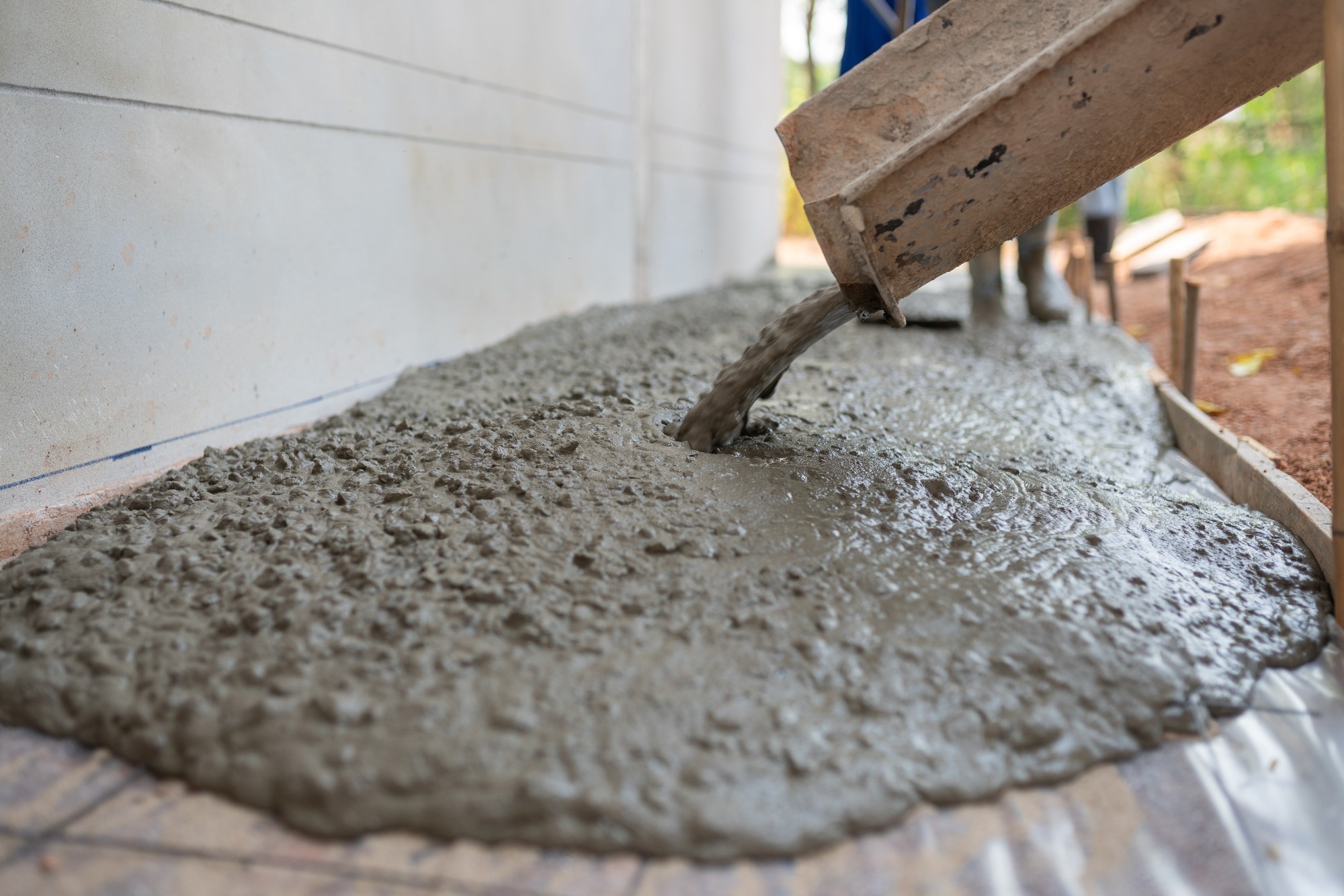 Study: Study on rheological and mechanical properties optimization and mechanism of nano CaCO3 regenerated aggregate concrete. Image Credit: Sutipond Somnam/Shutterstock
A new study published in Scientific Reports investigates the use of nano-calcium carbonate (nano CaCO3) to improve the performance of recycled aggregate concrete in sustainable construction. The researchers show that controlled addition of nano CaCO3 significantly enhances flow behavior and compressive strength. This approach supports the production of high-performance, sustainable construction materials while promoting the circular use of construction waste and reducing environmental impact.
Balancing Sustainability and Structural Performance
Recycled aggregate concrete (RAC) plays a key role in sustainable construction. It reduces dependence on natural aggregates and helps manage large volumes of demolition waste. RAC contains residual mortar, high porosity, and irregular surfaces. These characteristics result in poor flowability, higher viscosity, and reduced mechanical strength. As a result, RAC struggles to meet the demands of structural applications.
Previous research studied the use of mineral additives and chemical treatments to improve RAC. These conventional methods improve strength, but they often compromise workability or raise costs. As a result, achieving a balance between fresh-state performance and hardened strength remains a key challenge.
This study addresses that gap by introducing nano CaCO3 as a multifunctional modifier. Nano CaCO3 provides both physical and chemical benefits, unlike conventional additives. It fills micro-pores, promotes hydration through nucleation, and strengthens the interface between aggregates and cement paste.
The study aims to evaluate how nano CaCO3 dosage, recycled aggregate content, and water-to-binder ratio interact with each other. Achieving this balance is essential for real-world construction, where both workability and durability are critical.
Experimental Design and Analytical Approach
The research follows a structured experimental framework that combines material testing with microstructural analysis. It investigates three main variables – nano CaCO3 content (0–2.5%), recycled aggregate replacement rate (0–100%), and water-to-binder ratio (0.35–0.45).
Researchers pre-wet recycled aggregates to control water absorption and improve consistency, and the C40 concrete mix is used as the reference. They ultrasonically disperse nano CaCO3 particles, sized between 30–80 nm, to ensure uniform distribution within the cement matrix.
The study is conducted in two stages –first, single-factor tests isolate the effect of each variable on rheological behavior and mechanical strength. Then, an orthogonal experimental design (L9 matrix) evaluates the combined influence of all factors. Major performance indicators such as yield stress, plastic viscosity, and 28-day compressive strength are included.
The study models rheological behavior using the Bingham equation, which describes concrete as a fluid with yield stress and viscosity components. Researchers assess mechanical properties through standard compressive, tensile, and flexural strength tests.
To understand the underlying mechanisms, the study uses microstructural techniques. Scanning Electron Microscopy (SEM) examines interface bonding, X-ray Diffraction (XRD) identifies hydration products, and Mercury Intrusion Porosimetry (MIP) evaluates pore structure. This multi-scale approach links material behavior to structural performance.
Performance Improvements and Mechanistic Insights
The results show clear improvements in both workability and strength when nano CaCO3 is used within an optimal range. When the dosage ranges from 1.0% to 1.5%, yield stress decreases by up to 31%, and plastic viscosity decreases by about 25%. This indicates better flowability and easier placement during construction.
At the same time, mechanical performance improves significantly. The 28-day compressive strength increases by up to 26.7%, reaching values above 50 MPa. Early-age strength also shows notable gains, indicating accelerated hydration.
However, performance declines when nano CaCO3 content exceeds 1.5%. Excess nanoparticles tend to agglomerate, increasing internal friction and creating weak zones. This highlights the importance of precise dosage control.
Recycled aggregate content strongly influences performance. Increasing replacement rates leads to higher viscosity and lower strength due to poor aggregate quality and weak interface zones. A 50% replacement rate provides the best balance between sustainability and performance.
Similarly, the water-to-binder ratio affects both flow and strength. Higher ratios improve workability but reduce strength due to increased porosity. A ratio of 0.40 delivers optimal results. The orthogonal analysis identifies the best mix –1.2% nano CaCO3, 50% recycled aggregate, and a 0.40 water-to-binder ratio. This combination achieves a compressive strength of 52.8 MPa while maintaining suitable rheological properties for construction.
Microstructural observations indicate that SEM images depict a denser interface transition zone with fewer cracks. XRD patterns indicate increased formation of C-S-H gel and reduced calcium hydroxide content. MIP data confirm reduced porosity and improved pore distribution. These findings support a three-fold mechanism that involves pore filling, hydration acceleration, and interface strengthening. Together, these mechanisms enhance both the microstructure and macroscopic performance of RAC.
Practical Implications and Future Outlook
This study provides a practical framework for improving recycled aggregate concrete using nanotechnology. The optimized mix achieves structural-grade performance while incorporating 50% recycled material. This represents a significant step toward sustainable construction practices.
The improved rheological properties of nano CaCO3-based RAC ensure better pumpability and placement. The enhanced strength makes the material suitable for load-bearing applications such as residential and municipal structures. The balance between performance and sustainability aligns with global carbon reduction goals.
Long-term durability under harsh conditions, such as freeze-thaw cycles or chemical exposure, needs further investigation. In addition, large-scale applications depend on the cost-effective production and dispersion of nano CaCO3.
Future research should focus on combining nanomaterials with other modifiers to improve durability. Long-term performance monitoring is also necessary to validate structural reliability over decades. Finally, researchers must develop industrial-scale implementation strategies to integrate this technology into mainstream construction.
Download the PDF of this page here
Overall, the study demonstrates that nano-engineering can transform recycled concrete into a high-performance material. It offers a practical pathway to reduce construction waste while maintaining structural integrity and efficiency in modern buildings.
Journal Reference
Xu, J., Lyu, G., et al. (2026). Study on rheological and mechanical properties optimization and mechanism of nano CaCO3 regenerated aggregate concrete. Scientific Reports. DOI: 10.1038/S41598-026-49784-6, https://www.nature.com/articles/s41598-026-49784-6
Disclaimer: The views expressed here are those of the author expressed in their private capacity and do not necessarily represent the views of AZoM.com Limited T/A AZoNetwork the owner and operator of this website. This disclaimer forms part of the Terms and conditions of use of this website.