When deciding whether to rent or buy construction equipment, it’s easy to focus on the sticker price. But the real picture is much bigger. That’s where total cost of ownership (TCO) comes in.
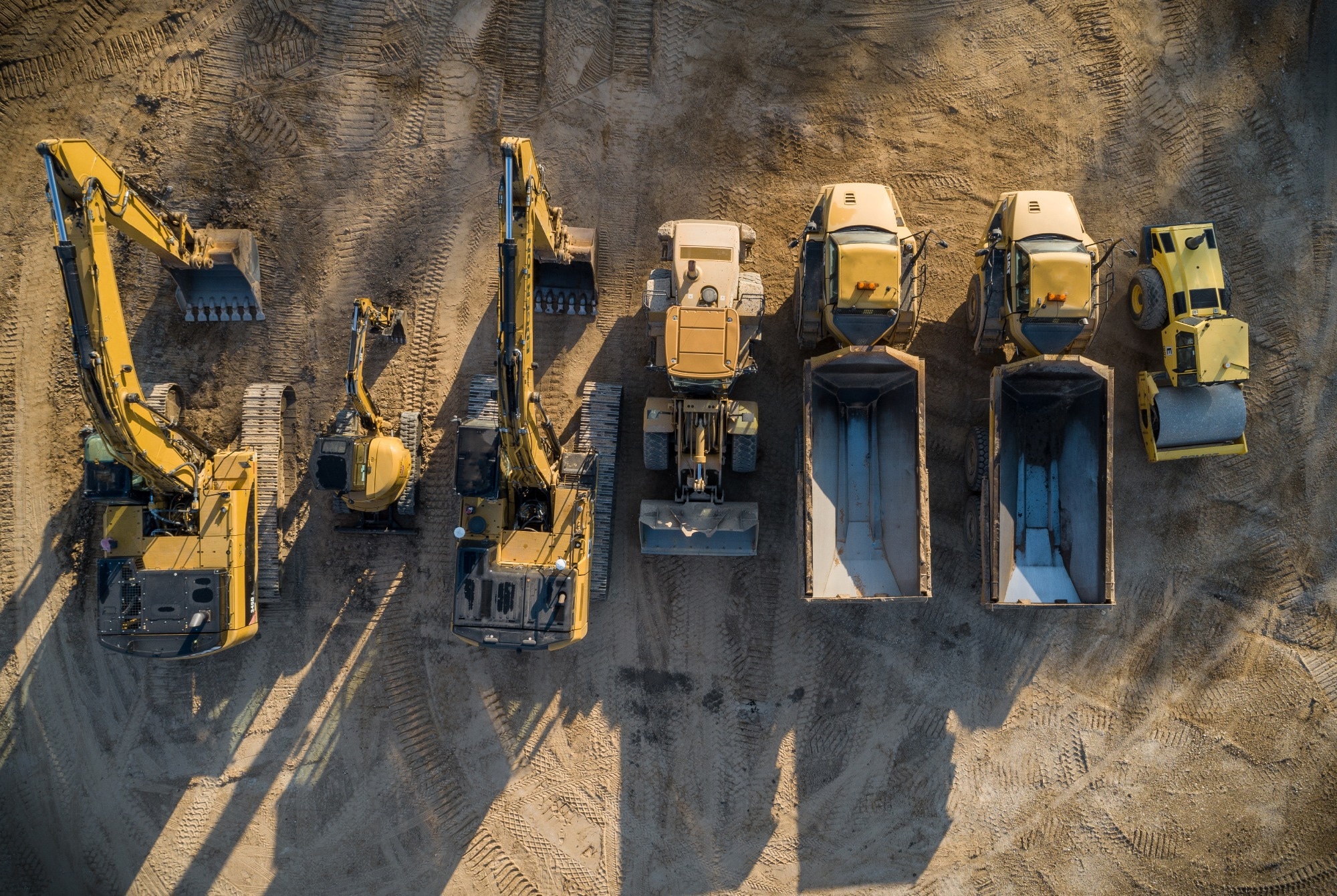
Image Credit: Big Fish Drones/Shutterstock.com
TCO looks beyond upfront costs to show the full financial impact of using a machine over its entire life, from purchase or rental, all the way through to maintenance and disposal.
For contractors, understanding these long-term costs helps make smarter decisions about which equipment to invest in and when.
Want all the details? Grab your free PDF here!
Defining Total Cost of Ownership
So, what exactly does “total cost of ownership” refer to in construction?
Whether you’re buying or renting, TCO includes every cost tied to the equipment over its lifetime, not just the initial price tag. That means purchase or rental costs, fuel, repairs, maintenance, insurance, downtime, and even the cost of selling or disposing of it later. Some of these are direct cash expenses, while others show up in less obvious ways, like lost time when a machine breaks down or the admin work it takes to manage it.1,2
For equipment you buy outright, ownership costs usually include things like:1,3
- Purchase price
- Loan interest (if financed)
- Depreciation
- Taxes and insurance
- Storage and upkeep
- And the expected resale value at the end
On top of that, you have to factor in operating costs: fuel, maintenance (planned and unplanned), parts, tires, operator wages, and transportation. These can often be estimated by looking at past data or manufacturer guidelines.
Rentals, on the other hand, bundle many of those costs into one rate. That rate often includes capital, maintenance, and sometimes insurance or basic service. But that doesn’t mean everything’s covered. You’ll still need to consider delivery, on-site coordination, penalties for going over time, or fees for damage.1,2,4
Financial Structure of Renting vs. Buying
When comparing renting and buying, it’s not enough to just look at the daily or monthly rates. You have to zoom out and consider how the financial setup of each option fits into your long-term costs, and that’s where TCO really helps.
Buying equipment means taking on a big upfront cost, which usually gets spread out over time through a loan or by tying up company funds. That turns into a long-term financial commitment. The upside of this is that owners may get tax breaks through depreciation and build long-term value by using the equipment across multiple projects. The goal is to recover that investment (and hopefully profit) before maintenance costs and downtime start eating into returns.1,4,5
Renting works differently. Instead of locking in a big purchase, you’re paying a variable cost that adjusts with how much you actually use the machine. This can be a huge plus for contractors with unpredictable workloads or seasonal projects. Since you only pay when you’re actively using the equipment, you avoid the financial drag of owning something that’s just sitting idle.4,5
Rentals also shift a lot of the risk, like resale value and long-term maintenance, to the rental provider. That means more financial flexibility and fewer surprises, especially when you’re juggling multiple projects or working with tight margins.4,5
Utilization, Risk, and Operational Flexibility
One of the biggest factors to consider in relation to total cost of ownership is how much a piece of equipment gets used.
The more hours that it runs, and the more projects it serves, the more sense it makes to own. But if your usage is low or inconsistent, renting often saves money.5,6
That’s why accurate forecasting is so important. If you overestimate how often you'll use a machine you bought, it can end up sitting idle, draining cash without delivering value. On the flip side, renting gives you access to equipment only when you need it, making it easier to match costs to actual project timelines.1,5,6
Ownership also comes with risks: uncertain demand, rising repair costs, resale value drops, or new tech making your machine outdated. All of these can drive up the real cost per hour over time.
Rentals help manage that risk. You get access to newer, well-maintained machines without the long-term commitment. That flexibility is key when project scopes change, new emissions rules kick in, or you need specialized equipment for a short-term task. You also avoid dealing with storage, spare parts, or lengthy learning curves. The rental company handles most of that.5,6
So, while owning works best for core machines you use constantly, renting gives you room to adapt, and that can be just as valuable.
Life Cycle Cost Analysis for Equipment Decisions
To really compare the cost of renting versus owning, contractors use something called life cycle cost analysis (LCCA). It’s a method that puts all the future costs (fuel, maintenance, repairs, resale value) into today’s dollars. This means that you can directly compare your options over time.
For ownership, LCCA tracks costs per year or per operating hour. It includes depreciation, major repairs, and the fact that maintenance usually gets more expensive as equipment ages. Some models even use probability-based methods (called stochastic modeling) to estimate the impact of fuel price changes, breakdowns, and usage uncertainty, helping you find the best time to repair, replace, or retire a machine.1,2,3
With rentals, life cycle cost analysis refers to more than the rental rate. It also considers how long you’ll use the machine, how often, and how those costs compare to what ownership would look like over the same period. The idea is to get a better understanding of the full picture. That means an understanding of not just what you’re paying now, but what it adds up to over the whole project.1,2,3
LCCA also lets you factor in things that aren’t strictly financial, like your team’s ability to handle in-house maintenance or how your equipment choices support company goals like sustainability or tech adoption. That way, you’re not just choosing the cheaper option; you’re choosing the one that fits your business long-term.1,2,3
Strategic Mix and Governance in the Construction Industry
In reality, most construction companies don’t just rent or own. More often than not, they do both. Using total cost of ownership as a guide helps companies build a smart mix that balances flexibility with long-term value.
Typically, machines that are used all the time, like core earthmoving or lifting equipment, are worth owning. They pay for themselves over time. But for specialized gear or machines needed during busy periods, renting keeps things lean by avoiding extra fixed costs.5,6v
To make those decisions consistently, companies need solid systems. That means tracking how often machines are used, what they cost to run, and how they perform over time. When that data is centralized and connected to digital tools like project planning software or building information modeling (BIM), it becomes way easier to make informed choices, even during bidding or early project design.1,3
The most forward-thinking firms treat TCO as an ongoing strategy rather than a one-time calculation. They regularly reassess whether to rent or own, compare supplier performance, and adjust for shifts in tech, financing, and market conditions. This approach builds more resilient operations, tighter cost control, and better alignment between equipment decisions and company goals.1,6
Conclusion
At the end of the day, total cost of ownership is a smarter way to think about equipment decisions. It’s not only about what something costs upfront; it’s about what it really costs to use, maintain, and eventually get rid of it over time.
For most contractors, it’s a balance.
If you’ve got a machine you use all the time, owning probably makes more sense. You get control, predictability, and better long-term value. But if you only need something for a few weeks or your workload is constantly shifting, renting keeps things flexible and frees up cash for other parts of the job.
There’s no perfect formula when it comes to making a decision on this. But when you understand all the costs involved, you can make better calls that actually fit your projects, your cash flow, and your goals.
The companies that really stay ahead use TCO as an ongoing tool, updating their strategy as projects change, tech evolves, or the market shifts. That’s how you build a fleet that works for you, not the other way around.
References and Further Reading
- Gransberg, D. D. et al. (2015). Major Equipment Life-cycle Cost Analysis. Minnesota Department of Transportation, Research Services & Library. https://www.lrrb.org/pdf/201516.pdf
- Mearig, T. et al. (2024). Guidelines for Utilizing Life Cycle Cost Analysis and Cost-Benefit Analysis. In: Life Cycle Cost Analysis Handbook: Cost Benefit Guide, 3rd Edition. State of Alaska - Department of Education & Early Development Finance & Support Services. https://education.alaska.gov/facilities/publications/LCCAHandbook.pdf
- McNeil-Ayuk, N., & Jrade, A. (2024). A Building Information Modeling-Life Cycle Cost Analysis Integrated Model to Enhance Decisions Related to the Selection of Construction Methods at the Conceptual Design Stage of Buildings. Open Journal of Civil Engineering, 14(03), 277–304. DOI:10.4236/ojce.2024.143015. https://www.scirp.org/journal/paperinformation?paperid=134445
- Febrianto, A. et al. (2024). Development Study of Cost of Ownership Model in Heavy Equipment Business in Indonesia. Evolutionary Studies In Imaginative Culture, 836–847. DOI:10.70082/esiculture.vi.738. https://esiculture.com/index.php/esiculture/article/view/738
- Padmanaban, G. et al. (2024). Analysis of Renting Versus Buying Construction Heavy Equipment. Proceedings of the 3rd International Conference on Optimization Techniques in the Field of Engineering. DOI:10.2139/ssrn.5088893. https://ssrn.com/abstract=5088893
- Buvanesan, G. et al. (2020). Comparative Study on Equipment Management by Owning and Rental using SPSS. SSRG International Journal of Economics and Management Studies, 7(7), 47-51. DOI:10.14445/23939125/IJEMS-V7I7P108. https://www.internationaljournalssrg.org/IJEMS/2020/Volume7-Issue7/IJEMS-V7I7P108.pdf
Disclaimer: The views expressed here are those of the author expressed in their private capacity and do not necessarily represent the views of AZoM.com Limited T/A AZoNetwork the owner and operator of this website. This disclaimer forms part of the Terms and conditions of use of this website.